

Neck Pain Relief Exercises to do at your Desk
Introduction:
If you’re feeling stiff and uncomfortable while working at a sedentary job, there are desk exercises that can help you feel refreshed.
Workplace health problems are not limited to heavy industry and construction. They can occur in offices as well as other types of enterprises and workplaces.
Desk jobs frequently need you to stay still while completing repetitive tasks, but if you work there for long periods of time, this might not be the most comfortable or healthful position.
One simple way to make sure you include exercise in your daily routine is to set a timer to remind you to stretch or go for a little stroll. If you’re pressed for time, you can even stretch at your desk.
Impact of Desk Work on Neck Pain:
Spending too much time in one spot causes muscles to tense and stiffen, making movement uncomfortable.
Bad posture:
Because it puts more strain on your shoulders and neck, slouching at your desk can lead to stress and pain.
Restricted mobility:
It becomes more challenging to move freely without feeling uncomfortable as a result of decreased flexibility during the day.
Together, these factors cause the well-known stiffness and discomfort that many individuals experience after using computers for extended periods of time. However, by incorporating stretches into your routine, you can successfully manage these issues.
Benefits:
By regularly adjusting your posture with stretching, you can prevent the slouching and poor alignment that cause shoulder and neck pain.
Boost adaptability:
Stretching keeps your joints and muscles flexible, increasing your range of motion and facilitating pain-free daily activities.
Cut down on stress:
Regular stretching helps release the muscle tension that builds up from prolonged sitting, which will eventually result in decreased stiffness and discomfort.
Increase concentration and output:
You can also revitalise your mind by stretching for short periods of time, which will help you return to work with better focus and concentration.
By implementing these exercises into your workweek, you may quickly and effectively prevent and manage discomfort, which will keep you comfortable and focused throughout the day.
Exercise:
Neck Side Stretch:

- Sit down on a sturdy chair with your feet flat on the floor.
- Bend forward a little to avoid “hunching” your shoulders and back.
- Raise your right arm above your head and bend your upper body to the left in a reaching motion. Keep your posture straight. Avoid twisting to the side when you bend.
- The muscles on your side should gradually extend from your lower back to your shoulder.
- For fifteen seconds, hold the stretch. Go back to your initial position.
- Change sides to perform the stretch in the opposite direction.
Cross Body Shoulder stretch:

- Holding one arm above the elbow with the other hand, take a seat in a sturdy chair and pull it across your body to your chest until your shoulder begins to stretch.
- Don’t raise your elbows over your shoulders.
- Hold for a minimum of fifteen seconds.
- Continue on the opposite side.
Overhead Shoulder Stretch:

- Take a straight sitting with your shoulders back, your chest out, and your feet shoulder-width apart.
- Raise one arm above your head, bend the elbow, and place the hand behind your neck.
- Using the other hand, gently raise the elbow behind the head.
- For fifteen seconds, hold the stretch.
- Repeat with the other arm after you’ve relaxed.
Hands Clasped Palm Press:

- To start, place your hands together in front of your chest with the palms facing back.
- Turn your palms outward and raise your arms above your head.
- Raise your shoulders and ribs and straighten your elbows when your arms are over your head.
- Go back to your initial position.
- After swapping your finger interlock, repeat the earlier steps in the same order.
Chin tucks:
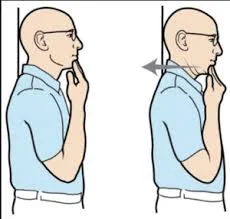
- Lean your lower back on the wall with your feet around 40 cm away.
- The head should be pressed against the wall.
- Bring your chin closer till the back of your neck is in contact with the wall. Take care not to tilt your head forward when doing this if you want the most “double chin” appearance.
- Avoid applying as much pressure as you can. Just until the back of your neck starts to gently stretch, pull your chin back.
- Hold the stance for ten seconds, then release your grip. Ten times over, repeat.
Pectoralis stretch:
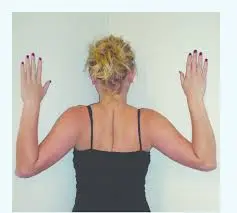
- When the door is open, position yourself in the doorway.
- Raise your arms to the side and press them against the door frame with your forearms pointing up and your elbows at shoulder height.
- Through the door frame, bend forward.
- Your upper arms and the front of your chest should feel somewhat stretched.
- Repeat twice after holding for 30 seconds.
Upper Trapezius Stretch:
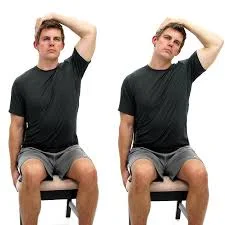
- Take a seat on your left hand.
- While keeping your eyes straight, tilt your head to the right such that your right ear becomes close to your right shoulder.
- If your left trapezius is not being pulled, you can use your right hand to move your head slightly to the right.
- After ten seconds of holding, switch sides.
- On each side, repeat three times.
What should be avoided?
People with neck issues shouldn’t perform neck circles, despite the fact that they are a standard exercise in many gym classes. It’s not advisable to roll your neck excessively. Research has shown that neck rolls might put undue strain on the spine. This movement may even cause the arteries in the neck to become more squeezed.
FAQs
How to stop neck hurting at the desk?
Make sure your forearms are parallel to the floor when typing by adjusting the desk’s height.
Choose a chair where your feet can firmly plant on the ground, and your thighs are parallel to the floor.
On your laptop or computer monitor, focus your gaze on the top third of the screen.
Can a standing desk help with neck pain?
After four weeks, the CDC found that a sit-to-stand desk reduced neck and upper back pain by 54%. These workstations increase mobility and reduce the likelihood of strained muscles and back pain.
What are the top five causes of neck pain?
Strained muscles. Overuse, such as hunching over a computer or smartphone for extended periods of time, frequently results in strained muscles.
Worn joints. Like other joints in the body, neck joints degrade with age.
Compression of the nerves.
Injuries.
Illnesses.
How to stop neck pain at the desk?
Make sure your screen is at eye level.
Keep your spine in a neutral position.
To lessen stress, take frequent breaks.
Develop Your Upper Back and Neck Strength.
Make use of a supportive office chair.
Stretch your neck and perform chin tucks.
Occasionally, switch to a standing desk.
Modify the position of your mouse and keyboard.
References:
- Stretches to do at work every day – 2026 – The Healthline Editorial Team/www.scribbr.com/citation/generator/folders/4qVgdrETrlhCtP5MH7dXit/lists/2IGlCIy1RqpsdPhm4HaqmA/
- Work from home? 4 Easy-to-do Desk Exercises for the Neck & Shoulder/www.moov.co.in/en/pain-advice/4-easy-to-do-desk-exercises-for-neck-and-shoulder-pain/
- Stretches to do at work every day – 2026 – The Healthline Editorial Team/www.sports-injury-physio.com/post/top-7-neck-exercises-for-computer-related-neck-pain/
- Desk stretches: Quick relief for neck and shoulder pain – 2026 – Promotions/pelhamrehab.com/blog/desk-stretches-quick-relief-for-neck-and-shoulder-pain/
- 4 Neck stretches to do at your desk | Preventing headaches and neck pain – 2019 – Amplified, Amplified/drspine.com/4-neck-stretches-to-do-at-your-desk-preventing-headaches-and-neck-pain/