
Best Exercises For Lateral Pelvic Tilt
Introduction
Lateral pelvic tilt occurs when one side of the pelvis is higher than the other, often leading to postural imbalances, lower back pain, or hip discomfort. Targeted exercises can help correct muscle imbalances, improve alignment, and restore pelvic stability.
It’s crucial to maintain your shoulders and pelvis in a consistently level and flat position. A lateral pelvic tilt describes a condition where the two sides of the pelvis are not level, resulting in one hip appearing elevated compared to the other. Some muscles may become stiff as a result, while others may become weak.
The weak ones can be strengthened with daily exercise.
Exercises To Correct Lateral Pelvic Tilt
The following are the exercises to correct a Lateral Pelvic Tilt:
Reverse Leg Raises

- Lying in a supine position on a soft mat.
- Rest your legs on the ground, keeping your forehead supported by your hands.
- Gently lift one leg, maintaining a straight knee and softly activating your glutes.
- It’s crucial to maintain that leg lift for a full two to five seconds, ensuring a slow and controlled descent afterward.
- Repeat the movement 12 times.
- Alter the legs.
Reverse Standing Leg Raises
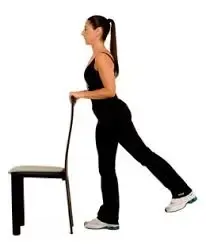
- To maintain stability, one may utilize a wall or chair for support during the activity.
- Maintain a straight posture, activate your abdominal muscles, and lift one leg backward.
- With a straight back, gently lift your leg up behind you, going only as high as feels good.
- Gradually bring your leg down until your toes make contact with the ground.
- Repeat this motion gently 12 times, maintaining steady breath and control.
- Switch legs and do the exercise again.
Hip Hike

- To start, position the leg on the side where your hip is higher onto a small box.
- Press firmly through your standing foot to raise the opposite side of your pelvis as high as possible.
- Maintain your spine in neutral posture.
- Stay there for 10 seconds, then bring yourself back to where you started
- Repeat the movement 5–10 times, stopping when the standing leg starts to tire.
Clamshell

- Get into a side-lying position.
- Bend both knees to form a 90-degree angle and rest your head on your lower arm.
- Before beginning, gently rotate your top hip forward toward the floor, ensuring your spine remains both relaxed and well-supported.
- While maintaining foot contact, slowly elevate your upper knee in a controlled motion.
- Elevate the knee and sustain the position for a five-second count, followed by a controlled return to the starting point.
- Complete the exercise 12 times.
- Change sides and repeat the movement.
Hip Adduction

- Gently lie on your side, stretch out your legs, and let your head rest comfortably on your lower arm.
- Gently cross your upper leg over the lower one.
- Position the foot of your upper leg on the floor, directly adjacent to and forward of your lower knee.
- Straighten your bottom leg and raise it as high as feels okay for you.
- Sustain the elevated position for precisely five seconds, then execute a controlled and gradual lowering of the limb.
- Complete the exercise 12 times.
- Change sides and perform the same reps.
Step Up/Down

- Position yourself at the edge of the step, balancing on your right leg.
- Ensure your pelvis stays steady and does not tilt during the exercise.
- Just gently lower your left leg towards the floor, letting it settle at a pace that feels comfortable for you.
- Allow your right knee to bend naturally as you put the left leg downward.
- Slowly return to the starting position.
- Perform this movement 10 times.
Side Plank With Upper Leg Lift

- Lift into that side plank, fully supported by your strong left arm and side.
- Do not forget to activate your left side core gently as you move! This is key.
- Extend your right leg outward, creating a long line through your body.
- Raise the right leg while ensuring pelvic stability is maintained throughout the movement.
- As you perform the exercise, be mindful to activate the muscles of your right gluteus, ensuring its participation in the movement.
- Stay in this position for as long as feels comfortable and sustainable.
Single Leg Balance
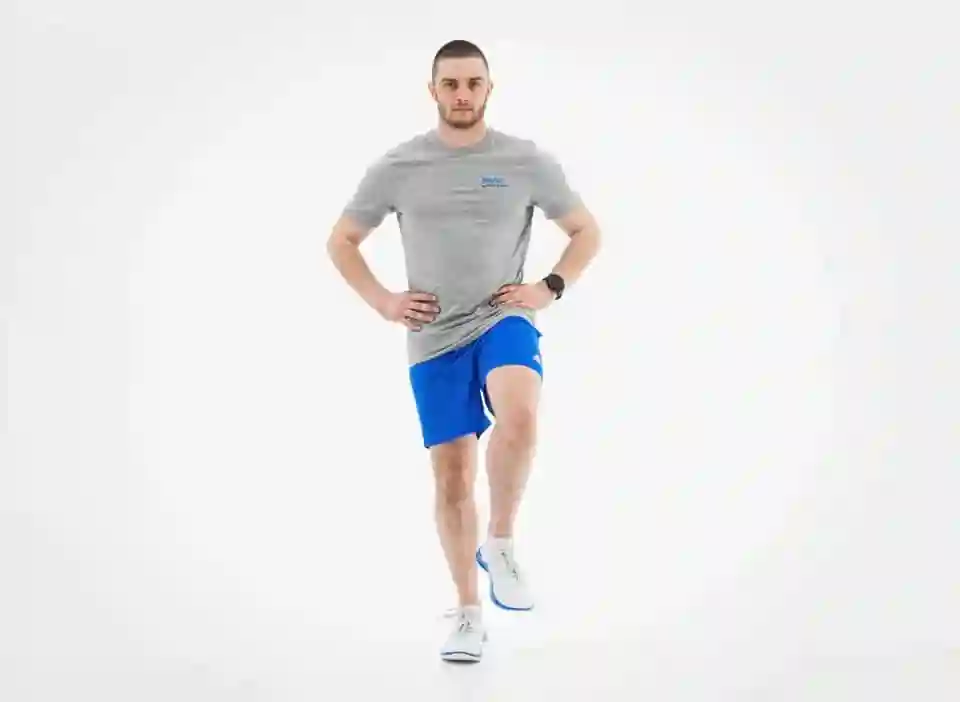
- Stand on your affected leg.
- Shift the pelvis towards the weight-bearing leg.
- Keep your pelvis aligned and level during the entire exercise.
- Focus on staying balanced throughout the movement.
- Try to minimize any movement in your body.
- Keep going for a full 60 seconds.
Lateral Squats

- To begin, position your feet so they are wider than your hips, ensuring that both your knees and toes are aligned to face directly forward.
- Drive your weight into that right heel, really hinge those hips back, and powerfully bend your right knee, keeping that left leg strong and extended.
- Use your arms for stability by reaching them out in front or holding them close to your chest.
- Press firmly through your right foot to return to the starting position.
- At the top, contract your glutes and gently press your hips forward for a stretch.
- Switch sides and repeat the exercise.
Quadratus Lumborum (QL) Stretch
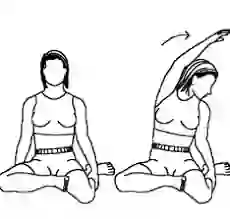
- Take a sitting position on the floor and stretch your legs straight ahead.
- Bend the knee on the side you’re targeting, extend that arm overhead.
- For a good side stretch, lean away from that side.
- Maintain the stretch for 30 seconds.
- Switch sides and repeat.
Lateral Pelvic Tilt Exercises To Avoid
Exercises that excessively load one side:
These can include unilateral activities that might worsen the tilt, such as single-leg squats or lunges, if done improperly or without adequate core activation.
Exercises that promote muscle imbalances:
Exercises that target specific muscles without correcting the underlying imbalance may cause issues if those muscles are already weak or tight as a result of the tilt. Exercises that overwork one side’s quadratus lumborum, for instance, may make the tilt worse.
Exercises that don’t promote core stability:
Having a strong core is essential for pelvic stability. Exercises that don’t adequately work the core might make the tilt worse or continue.
Important Considerations:
Consult a professional
A physical therapist or other trained healthcare provider should always be consulted in order to evaluate your unique circumstances and receive tailored workout advice. They are able to determine the root causes of your lateral pelvic tilt and suggest the activities that will work best for you.
Focus on proper form
If done incorrectly, even workouts that are usually thought to be healthy might be detrimental. Be mindful of your body and ensure that you are utilizing the right technique.
Listen to your body
Please pay close attention if you feel any pain or discomfort while exercising. It’s important to listen to your body and stop if needed. Exercise should be modified or stopped rather than continued despite discomfort.
FAQs
What muscles are weak in lateral pelvic tilt?
A lateral pelvic tilt can create the illusion that one leg is shorter than the other. The quadratus lumborum muscle typically plays a key role in both causing and correcting this tilt.
How to sleep with lateral pelvic tilt?
Maintaining a neutral spine and supporting the hips and lower back will assist in controlling a lateral pelvic tilt during sleep. By sleeping on your side with a cushion between your knees, you can reduce pressure and aid with pelvic correction. For a more neutral pelvic posture, consider lying on your back with a cushion placed beneath your knees.
Can a lateral pelvic tilt be corrected?
Your discomfort might be linked to the extent of any tilt or misalignment. Should you feel pain in your knees, hips, or lower back, we recommend speaking with your doctor or physical therapist. They’re equipped to help determine if a tight iliopsoas or pelvic tilt is playing a role in what you’re feeling
Can Lateral Pelvic Tilt cause knee pain?
Lateral pelvic tilt can directly cause or significantly contribute to knee pain. The pelvis is critically important for stabilizing your entire lower body. Its misalignment disrupts normal weight distribution and force transfer, ultimately leading to knee problems.
What are the side effects of lateral pelvic tilt?
How much discomfort you feel is often directly related to the degree of tilt or misalignment. Jaw pain, headaches, shoulder, back, and/or buttock/hamstring discomfort that mostly affects one side of the body may be exacerbated by it.
References:
- Ginta, D. (2021, June 8). 5 lateral pelvic tilt exercises. Healthline. https://www.healthline.com/health/fitness-and-exercise/lateral-pelvic-tilt-exercise#leg-raises
- Mark. (2025, February 17). Exercises to fix lateral pelvic tilt (Uneven hips). Posture Direct. https://www.posturedirect.com/lateral-pelvic-tilt/
- McCoy, J. (2022, May 26). How to do a lateral squat and why it’s a great exercise for runners. Runner’s World. https://www.runnersworld.com/training/a40105767/how-to-do-lateral-squats/
- Unknown. (n.d.). Athletic medicine. https://uhs.princeton.edu/sites/g/files/toruqf5356/files/documents/Pelvic-Stabilization-Hip-Strengthening.pdf
- Specialist, E. W. B.-. K. a. M. (2022, September 1). Fix anterior, posterior or lateral pelvic tilt via awareness & control. Precision Movement. https://www.precisionmovement.coach/how-to-fix-pelvic-tilt/
- Iposture.com – Posture for Life – Armchair exercises – Supported standing – Backward leg raise. (n.d.). http://www.iposture.com/exercise_armchair-backward.php
- Lateral Step-Up. (n.d.). Sweat. https://sweat.com/exercises/lateral-step-up
- ReGo Single Leg Stance test – static balance test for rehab, ortho & RTS. (n.d.). Moticon. https://moticon.com/single-leg-stance-test-2
- Advice – The Quadratus lumborum; a contributor to lower back pain – REBECCA WASEY | Sport and Remedial massage. (2022, April 11). REBECCA WASEY | Sport and Remedial Massage. https://rebeccawasey.com/a-contributor-to-lower-back-pain/
- Upright Health. (2025, January 23). 2 Exercises to fix lateral pelvic tilt [Video]. YouTube. https://www.youtube.com/watch?v=9ERZw8R49E0