Hollow Hold Exercise
Introduction
An intermediate to advanced abdominal exercise that works your core muscles is the hollow body hold. This exercise is great for athletes because it focuses on maximum tension through the abdominal muscles due to the force needed to press the lower back into the floor.
You can modify this move by altering your arm or leg position if you’re a beginner. The hollow body hold can be used as part of a dynamic warm-up or added to an abdominal and core circuit at intermediate to advanced levels.
The hollow body hold is similar to a flipped-over plank in which you raise your arms, shoulders, and legs off the ground in a slight C shape while lying on your back and brace your core muscles.
The hollow hold is an extremely easy (yet surprisingly challenging) exercise that helps you improve core bracing, which is another important muscle group function. Gymnasts frequently use this basic exercise to improve their posture and core strength.
Muscles Engaged in Hollow Body Hold
We already know that hollow holds exercise your core muscles, but which specific muscles are we talking about? Let’s start at your head and work our way down.
First, this exercise works the muscles in your neck, deltoids (the muscles that attach your arms to your body), and pectoral muscles (the muscles on the front of your chest) because you’re holding your arms parallel to your ears.
The rectus abdominis, also known as your external “abs,” the transverse abdominals, which are the deeper “abs” that cover your entire midbody, and your obliques, which are two pairs of muscles on the sides of your torso, are all shown by the hollow.
Finally, as you struggle to keep your legs floating off the ground, the hollow hold strengthens your lower back, hip flexors, and quadriceps.
In the end, hollow holds are essentially a full-body workout, so prepare to shake, sweat, and gain strength.
What Muscles does a Hollow Hold Work?
Rectus abdominis:
The muscle that covers the front of your abdomen is called the rectus abdominis. You can do things like sit up in bed or bend over to pick something off the floor because it allows you to flex forward at the waist.
Transverse abdominis: This muscle is located below your rectus abdominis, deep within your core. It acts as a corset, keeping your torso strong and straight while protecting your internal organs.
Quadriceps: By strengthening your quadriceps, you can improve knee joint stability and reduce the strain on your knees when you walk.
Glutes: The gluteus maximus, gluteus minimus, and gluteus Medius are the three different muscle groups that make up your butt. You must use all of these butt muscles to maintain your stability while holding this exercise.
Quadratus lumborum is a muscle located deep in the lower back that is essential to stabilizing the spine. Reduced back pain has also been connected to strength here.
Erector spinae: These are the muscles that run along either side of your spine and help in stabilizing, rotating, and extending your back. They are among your back’s strongest muscles.
How to Do a Hollow Body Hold
Performing a Hollow Hold, Step-By-Step
- To begin, lie down on the floor with your arms long by your sides and your legs straight.
- Place your lower back on the mat by pushing your pelvis under. Nothing should be able to move between the mat and your lower back.
- Hover one leg long at first, then extend the other leg to join it. Next, raise your head, neck, and shoulders off the ground while extending both arms alongside your ears. Your body needs to look like a canoe.
- Hold for ten seconds, gradually increasing the duration as you move ahead.
Other Variations of a Hollow Body Hold
Dead Bug

- With your knees bent and both feet on the mat, start lying down.
- Place your lower back on the mat by pushing your pelvis under. Nothing should be able to pass between the mat and your lower back.
- Lift your feet and bring your legs to hover over the mat while keeping your knees bent and your shins horizontal to the ground. Raise your arms straight into the air.
- Lower your right leg so it hovers an inch above the ground, and lower your left arm above your head so it hovers above the ground. Lower your left leg and right arm after you’ve returned to the center.
- For ten seconds, keep switching sides; as you progress, gradually increase the duration.
Feet on the Floor Modification
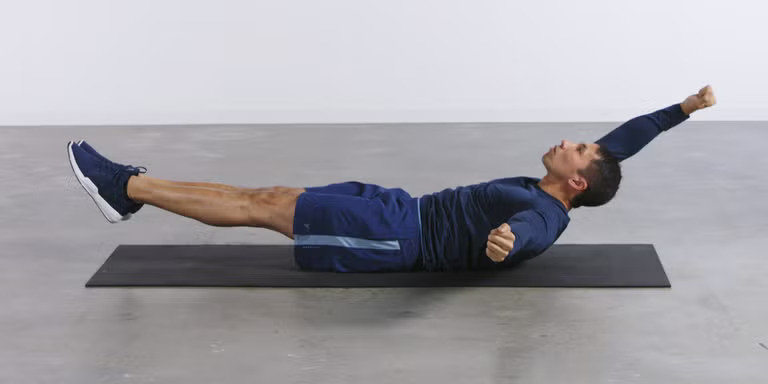
- With your knees bent and both feet on the mat, begin lying down.
- Place your lower back on the mat by pushing your pelvis under. Nothing should be able to pass between the mat and your lower back.
- Raise your head, neck, and shoulders off the floor by extending both arms beside your ears. Make sure your feet remain on the mat.
- Hold for ten seconds, gradually increasing the duration as you move ahead.
Bent-Knees Modification
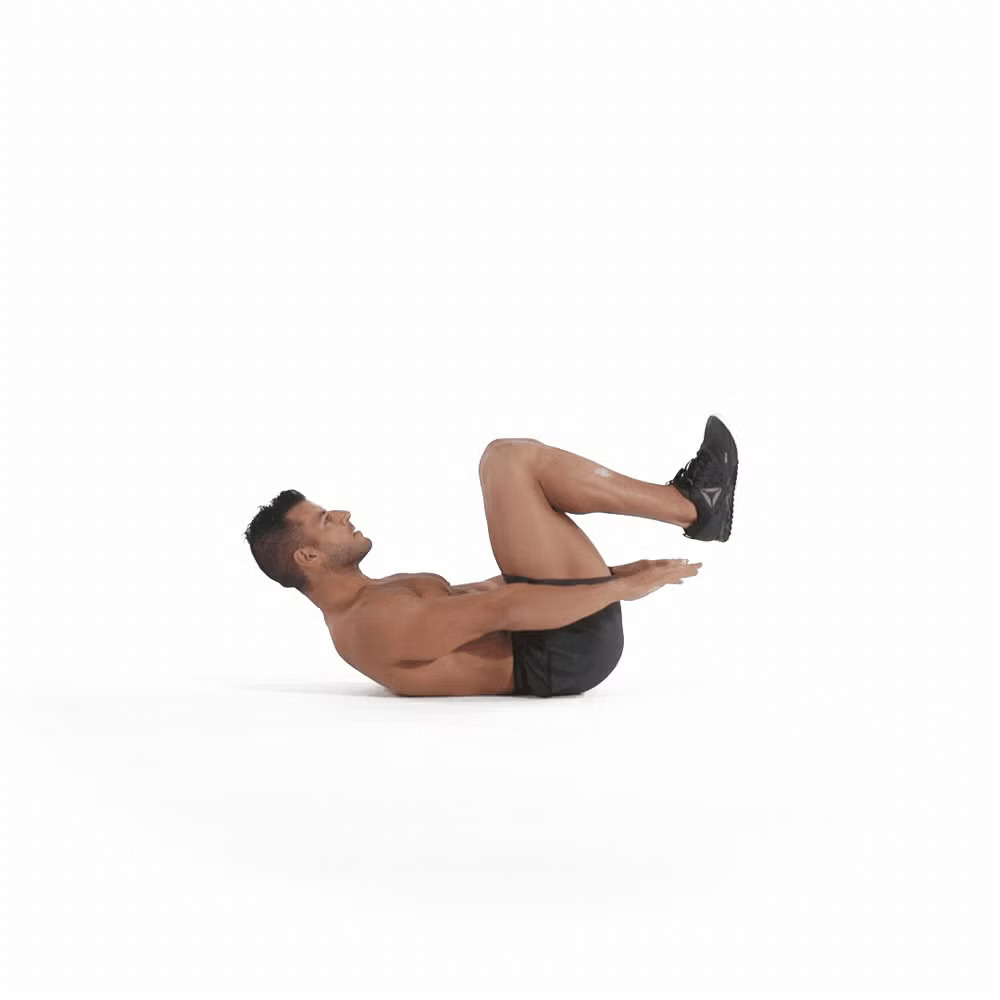
- With your knees bent and both feet on the mat, begin lying down.
- Place your lower back on the mat by pushing your pelvis under. Nothing should be able to pass between the mat and your lower back.
- Raise your legs until your shins are level with the ground. Raise your head, neck, and shoulders off the floor by extending both arms toward your ears.
- Hold for ten seconds, gradually increasing the duration as you move ahead.
Hollow Hold Rock
- To get started, lie down on the floor with your arms long by your sides and your legs stretched out.
- Place your lower back on the mat by pushing your pelvis under. Nothing should be able to pass between the mat and your lower back.
- Hover one leg long at first, then extend the other leg to join it. Next, raise your head, neck, and shoulders off the ground while extending both arms alongside your ears. Your body needs to look like a canoe.
- Without losing your form, start rocking your body back and forth and side to side with control. For ten seconds or as long as you can keep your form correct, keep going.
Weighted Hollow Hold
The exercise is the same, but for an added challenge, you’ll hold a small dumbbell or weight plate in your hands.
Uneven Hollow Hold
Make an L-shape with your arms, one out to the side and one extended overhead, to add an anti-rotation challenge.
Gator Roll
This version is even more difficult. Move to the right and roll over once you’re in the hollow hold position. Hold your position and keep your tension throughout. Roll back to the left after holding for a moment.
Benefits of a Hollow Body Hold
Your midbody or trunk, which includes your hips, lower back, pelvis, and stomach, is worked by hollow holds. “The hollow hold is a bodyweight, intermediate to advanced abdominal exercise that truly works your core muscles.” This move can be adjusted to fit individuals of all fitness levels, even though it isn’t necessarily beginner-friendly.
Hollow holds are an excellent addition to your exercise collection, no matter your level of fitness. “Hollow holds strengthen your lower back and core muscles and improve stabilization.” A stable midsection will make it easier for you to carry groceries and stand up, among other functional movements.
Example: if you have a strong core, you will use it rather than your lower back when picking something up. You risk injuring your lower back if you’re using it. Therefore, having a strong core aids in preventing injuries both during exercise and in daily life.
Your posture and athletic performance may both benefit from having a muscular midsection. Put another way, there are multiple reasons to include hollow hold in your upcoming exercise program.
One of the main functions of the core is bracing, which is why the hollow hold is such an effective exercise. Additionally, the posture is reinforced.
The transverse abdominis, rectus abdominis, obliques, quadriceps, hip flexors, inner thighs, and erector spinae muscles can all be effectively worked with the hollow body hold. Additionally, it strengthens and stabilizes your lower back and core muscles.
The hollow body hold can help with posture when done properly. Additionally, this exercise can help strengthen the muscles required to prevent lower back pain when the lower back and abs are in the proper position.
Functionally speaking, the hollow body hold teaches your core to avoid arching your lower back. This is due to the reason that you are teaching your body how to train the abdominal muscles when you use force to press the lower back into the floor. This increases the power your core can produce and helps you develop a stable midsection.
The type of hold needed for the hollow body hold is another reason for including it in a full-body or core workout. You will perform an isometric or static contraction after positioning your arms and legs correctly and pressing your back into the floor. Holding a muscle group steady for a while is necessary for this kind of contraction.
The hollow body hold is a great exercise to include in your routine because it requires you to maintain the stability of several different muscle groups.
Isometric exercises are frequently suggested for rehabilitation because they can increase strength without straining the joints. Additionally, they are a great exercise to incorporate into any sports conditioning program that calls for strong core muscles.
Additionally, studies indicate that isometric core exercises are more effective than dynamic core exercises at stiffening the core. In both daily life and sports, a stiffer core can improve load-bearing capacity and support the back.
Common Mistakes Made in Hollow Hold
Not Pressing the Lower Back Into the Ground
The ability to drive your lower back into the floor forms the basis of this exercise. You have to keep your core active the entire time while doing this. If the connection to the floor is lost, you might want to reposition your arms and legs. Try bending your knees or keeping your arms by your sides. Your abdominal muscles will feel less tense as a result.
Keeping the Shoulder Blades On the Floor
Your shoulder blades must lift off the ground when performing the hollow body hold. Raising your shoulder blades off the ground may be challenging if you can’t contract your core sufficiently. Keep in mind that there isn’t much space between your body and the ground. All you have to do is raise your shoulder blades sufficiently to tense your core.
Tucking Your Chin
Avoid trying to tuck your chin into your chest. This not only throws your neck out of alignment and raises the possibility of neck strain, but it also decreases the strain on your core muscles.
The hollow hold’s largest no-no? Raising your back off the floor. “Keeping your neck long and your lower back connected to the mat is important.” Your back is protected and your core activated when you tuck your pelvis under and connect it to the floor. Without this step, hollow hold hurts your back as opposed to your midsection. Try a modification if you are having trouble keeping your spine on the ground.
Putting too much strain on your neck is another common error. Jutting your chin forward can actually injure your neck, even though you want to work your upper body muscles. Make an effort to align your spine with the crown of your head while applying the move. Consider changing your hollow hold if you experience neck pain or discomfort.
How to Include a Hollow Hold in Your Exercise
Think about whether hollow holds are a good fit for you before including them in your next core-strengthening exercise. Before attempting the more difficult variation of the exercise, people with neck or lower back pain should begin with a variation like the dead bug to strengthen those muscles. Ask your doctor about safe core work if you are pregnant.
Safety and Precautions
For most fitness levels, the hollow body hold is a safe exercise as long as you use the right form. However, this exercise might not be appropriate if you have lower back problems, neck pain, shoulder pain, or limitations that make it difficult to lie on the floor.
Try a modified version first if you’ve never done this exercise before. You can progress to the complete movement. Additionally, cease the exercise if you experience any pain while performing the movement.
FAQs
Is hollow hold better than plank?
Planks work the abs, back, shoulders, and glutes, and are excellent for general core stability. Hollow holds put a greater focus on the hip flexors and lower abs. To increase core strength, incorporate both exercises into your routine.
How long should you hollow hold?
The hollow hold can be used for any kind of exercise, every day. Samuel suggests doing three or four rounds of holds lasting between 45 and 60 seconds. Just keep in mind that tension is essential—you’re probably not performing the exercise correctly if you don’t feel like your core is working hard.
Is hollow hold good for abs?
How does it develop abs
Strengthens the core as a whole: This full-body workout focuses on the anterior chain, which comprises the quadriceps, hip flexors, and abdominal muscles.
The deep abdomen: To press the lower back into the floor and keep the position, the hold requires a continuous, isometric contraction of the abdominal muscles.
Improves the stability of the core: By maintaining the position, you strengthen your core, which is essential for other motions and sports performance.
Disrupts the “rib-to-pelvis” link: It enhances the capacity to simultaneously lower the rib cage and tilt the pelvis posteriorly, a skill that is essential for complete core development and can be used in other exercises.
Are hollow holds safe?
For most fitness levels, the hollow body hold is a safe exercise—as long as you use the right form. However, this exercise might not be appropriate if you have lower back problems, neck pain, shoulder pain, or limitations that make it difficult to lie on the floor.
Is hollow hold good for beginners?
Because hollow holds require both hip mobility and core strength, they can start out as difficult to perform.
References
- Hollow hold. (n.d.). [Video]. Hingehealth. https://en-gb.hingehealth.com/resources/articles/hollow-body-hold/
- Lindberg, S. (2023, June 28). How to do a hollow body hold: proper form, variations, and common mistakes. Verywell Fit. https://www.verywellfit.com/how-to-do-a-hollow-body-hold-techniques-benefits-variations-5079591
- McPhillips, K. (1970, January 1). How to do a Hollow Hold—Plus all the muscles it works. The Output by Peloton. https://www.onepeloton.com/blog/hollow-hold
- Nasm, B. W. (2024, April 25). How to master the hollow hold for a stronger set of abs. Men’s Health. https://www.menshealth.com/fitness/a26887081/hollow-hold-form/