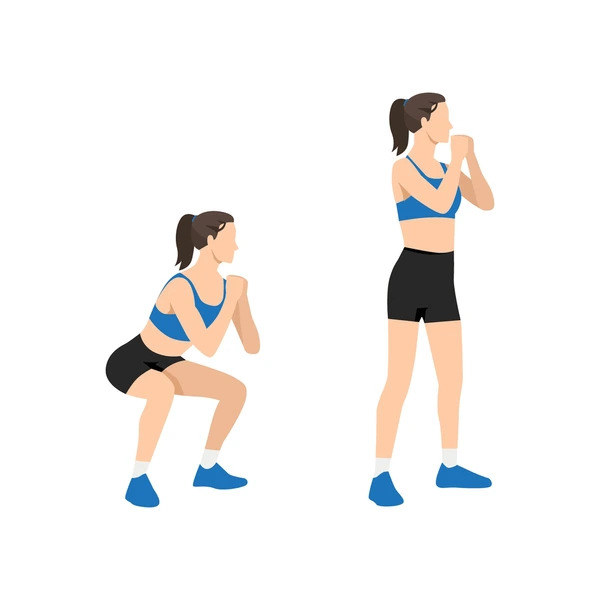
Lunges
Introduction:
The lunge is a popular and adaptable exercise that strengthens the lower body. Lunge strengthens many muscles in one movement and provide a number of benefits. Changing your technique highlights different muscles or their components.
This workout is good for both injury prevention and rehabilitation once an injury occurs. It’s frequently included in a fundamental strength program or rehab regimen, allowing athletes and exercisers to get back to their sport or activity of choice as soon as possible.
For example, it’s a frequent position used to rise up from the ground, and it shows many of the movements and muscle-activation patterns found in everyday activities like walking, sprinting, and ascending or descending stairs.
These principles will be discussed below, along with variants to change the difficulty level and emphasize other muscles.
What Muscles Are Used During a Lunge?
In a lunge, several muscles of the body work together to mobilize and stabilize the body.
They include:
- Quadriceps
- Hamstrings
- Calves (gastrocnemius, soleus)
- Transverse abdominis
- Obliques
- Multifidus
- Erector Spinae
Lunges Exercise Video
How to Perform a Lunge?
Stand with your feet hip-width apart.
Step forward at a quicker-than-walking pace, one leg in front of the other. Your foot should be placed straight on the ground and, your rear heel should rise from the ground.
Bend your knees up to a 90-degree angle and lower your whole body. Maintain your posture in an erect position while activating your core muscles.
Then, using your front leg, push off hard to return to the starting position.
Points to Remember:
- As you lower yourself to the ground, your lead knee should not extend beyond your toes.
- Make sure your opposite knee doesn’t touch the floor.
- Aim to maintain your hips symmetrical.
- Throughout the workout, engage your abdominal muscles to keep your trunk upright.
- Then, using your front leg, push off hard to return to the starting position.
Benefits of Lunges:
Lunges enhance strength and balance, all of which are vital for preventing or recovering from an injury. Some other advantages of lunges include:
- Strengthening the muscles utilized for walking, running, and high-intensity activity.
- If you have osteoarthritis, you can strengthen your leg muscles to better support your knees.
- Allowing your glutes to support your hips if you suffer hip or pelvic discomfort.
- Improving balance by stabilizing the core.
- Stretching your hip flexors.
- Managing muscle imbalances.
Variations of Lunges:
The lunge comes in many different variants. Each stimulates the same muscles, but with greater attention to specific places than others. To add variation and challenges to your workout, try a new variant each time or combine multiple versions.
Static Lunge

The static lunge, often called the split squat, does not need a stride out or back. Thus, it may be simpler to execute for people with knee problems or as a start to lunging exercises.
How to Perform:
- Maintain a split stance by keeping your feet hip-width apart and placing one foot in front of the other on either side. Your lifted heel will be above the ground.
- Push onto both feet to return to an erect and upright posture.
- Begin the exercise using your glutes, then use your quadriceps to straighten your knee. Push yourself back to stand up with both feet.
Back Lunge
The exercise stimulates the glutes and hamstrings more than the quadriceps because it is done backward through space.
How to Perform:
- Stand with your feet hip-width apart.
- Place one leg in front of your chest and the other behind you, and take a larger step back than you would normally take when walking.
- Your raised foot should fall on the ball of the foot, with the heel lifted.
Bring your knees nearly to a 90-degree angle. - Keep your hips level and your spine straight to maintain an upright posture.
- Return to the position where you started by pushing with force from the ball of your rear foot.
Lateral Lunge

A lateral lunge is a step that is taken sideways as opposed to forward or backward. Because of the lateral movement pattern, this lunge needs enhanced participation from the inner groin muscles (adductor). It also highlights the medial quadriceps.
How to Perform:
- Stand approximately hip-width apart.
- Take a large step to one side, keeping the other foot flat.
- One leg should be straight, and the other “stepping” knee bent. Unlike front and backward lunges, you’ll lean forward, your shoulders slightly ahead of your legs.
- To go back to where you started, forcefully push off with your foot.
Curtsy Lunge

The curtsy lunge is an excellent approach to emphasize the gluteus medius and hip adductors (or inner thighs).
How to Perform:
- Stand with your feet hip-width apart. Step one leg behind the other, out to the side, to form a cross.
- Your rear heel will rise above the ground.
- Bend your knees and drop till your front thigh is parallel to the ground.
- Maintain a raised chest, a tight core, and knees that are exactly over toes.
- Return to a hip-width, parallel posture by pressing into your legs (particularly your front leg) and straightening both knees while elevating your back foot.
Walking Lunge

Walking lunges are often performed forward (as demonstrated below), but they may also be performed backward. It is designed to target the glutes, medial quadriceps, and hamstrings.
How to Perform:
- Stand with your feet hip-width apart.
- Take a step forward, bend both knees, and then drop yourself to a 90-degree angle. Shift forward onto the lead leg.
- Elevate your back leg and push it forward till your back foot lands in front of you in a lunge as you push off with both legs and step through. Shift forward and repeat.
Assisted Lunge

For improved balance, grip a fixed object such as a wall or chair while performing this lunge variant. This allows you to concentrate on form without fear of tilting to one side or the other. Place your palm on the thing to help you stay steady as you fall down and rise up.
Half Lunge
This version has a shorter range of motion since you only drop half as far as in a regular lunge, ending long before your front knee reaches a 90-degree angle. This helps you to keep good form while decreasing stress on your knee joints.
Lunge with Front Foot Elevated

If regular lunges cause pain in your knees, consider placing your front foot on a step or tiny platform. Lower your body till your front thigh is parallel to the ground after making sure your front foot is fully on the platform or step.
Barbell Lunge

Because the weight is more uniformly distributed throughout your body, a barbell helps you to lunge with heavier loads. Before trying this version, ensure that you have an adequate balance. Perform these lunges with the barbell placed over your shoulders.
Lunge with an Elevated Rear Leg

Elevating the rear leg progresses to the standard lunge and emphasizes the quadriceps muscle in the back leg. When practicing lunges, place the top of your rear foot on a bench or an exercise ball.
Low Lunge

In contrast to a standard lunge, this version requires a tighter, smaller movement. This exercise particularly works the glutes and thighs of the front leg while also exercising the core.
Step back as far as achievable with your back foot, then bend your front knee and lower yourself, but maintain your back leg straight. To go back to where you started, straighten your front leg.
Adding Weight to Your Lunges
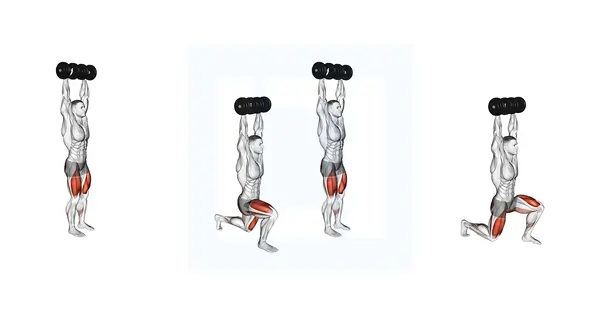
Start with the same weight you would normally use for a squat or deadlift before increasing it. This is mainly critical when doing a lunge that requires moving away from your center of gravity.
There are several options for adding weight. You can carry two dumbbells. Alternatively, you may do the lunge while holding a barbell on your shoulders, similar to a barbell squat. Your back extensors and core muscles will work harder to keep the weight stable.
Hold one dumbbell in the opposite hand from the lead leg while lunging. This workout targets both the upper gluteal muscles and the oblique muscles that support the trunk.
Common Mistakes while Performing Lunges:
- The lunge is either too short or too long, and the feet are on the same line, resulting in less stability.
- The front knee falls or is unsteady.
- Symptoms may include an unstable front foot on the ground, tilting forward or back, and jerky movements, mainly while stepping back.
- The back knee is too low, and the leg lacks the required strength.
- Body weight is unevenly distributed and forcibly pressed against the ground (mainly while stepping back).
- Poor posture.
Conclusion:
Lunges are a good workout for strengthening the muscles in the lower body. It has several variants that target the glutes, quadriceps, hamstrings, and other muscles. The variants allow you to scale the workout, whether you’re just starting out or an experienced lifter.
Incorporate this activity into your training routine, and enjoy the variations to keep things in their natural state.
FAQs
What is the lunge exercise for?
Lunges are a strength training exercise that primarily targets the legs, glutes, and core. They also provide various other benefits, such as increased balance, flexibility, and stability.
Do lunges reduce belly fat?
Belly fat offers serious health risks, but it may be reduced by indoor workouts such as jumping rope, squats, lunges, mountain climbers, smart bikes, treadmills, and burpees.
Do lunges reduce the buttocks?
Squats and lunges are two workouts that can help avoid loosening the buttocks by strengthening, tightening, and toning the gluteal muscles.
What will 100 lunges a day do?
Lunges are a great workout for growing lower body strength since they target your glutes, quadriceps, hamstrings, and calves while simultaneously training your core and improving your posture and range of motion.
How many lunges per day?
The ideal amount of lunges per day is determined by your fitness level, goals, and how frequently you incorporate lunges into your program. For novices, three sets of ten to twelve lunges in each leg are a decent place to start. As you progress, some people have success with a daily lunge regimen; you may add more sets, repetitions, or weights to enhance the intensity. such as 100 lunges each day.
References:
- Mpt, T. E. P. (2023, April 14). What muscles do lunges work? Healthline. https://www.healthline.com/health/fitness-exercise/lunges-muscles-worked#muscles-worked
- Lunges. (n.d.). [Video]. Hingehealth. https://en-gb.hingehealth.com/resources/articles/lunge/
- Cpt, P. W. (2024, June 13). How to do lunges: proper form, variations, and common mistakes. Verywell Fit. https://www.verywellfit.com/how-to-lunge-variations-modifications-and-mistakes-1231320
- Alexandramerisoiu, & Alexandramerisoiu. (2015, December 25). Lunges – Common Mistakes and correct technique | Merisoiu Technique Institute. Merisoiu Technique Institute | Running Technique Coaching / Run Faster, Further, With Less Effort and Fewer Injuries. https://themerisoiutechnique.com/2015/12/25/lunges-common-mistakes-and-correct-technique/