
Seated Forward Bend Pose (Paschimottasana)
What is Seated Forward Bend Pose?
Seated Forward Bend Pose (Paschimottanasana) is a calming yoga posture that stretches the spine, hamstrings, and lower back while promoting relaxation and flexibility. It helps release tension, improves digestion, and encourages mindfulness through deep forward folding.
The term “Paschimottanasana” is made up of three Sanskrit words: Paschima refers to the west, but in this case to the rear of the body; Uttana denotes stretching; and asana refers to the position. Paschimottanasana is a challenging forward bend asana for beginners that extends the entire back while bending from the waist. It relieves upper-body stress, tension, and strain while also calming the mind.
The Paschimottanasana, or Seated Forward Bend, is a simple-looking yoga asana that many practitioners neglect, especially newbies who are unfamiliar with its advantages or disregard it owing to its ease of difficulty.
Your complete back, neck, shoulders, back of the thigh and arms are elongated when you extend and descend your upper body to the floor. As a result, it increases physical flexibility and promotes relaxation in the lower back and hamstrings.
Muscle Work During Seated Forward Bend Pose:
- Neck Muscles
- Back Muscles
- Core Muscles
- Gluteus Muscle
- Hamstring Muscle
- Hip Muscle
Video of Seated Forward Bend Pose
How to Perform?
- Begin the Seated Forward Fold Paschimottanasana in a seated position with your legs outstretched in front of you, similar to Staff Pose.
- Remove the fleshy regions from behind your buttocks, ensuring that your sit bones are directly on the mat and your thighs are in neutral rotation.
- Lean forward slightly, sitting on the front edge of your sit bones. This makes it easier to tilt the pelvis forward to a neutral posture.
- Exhale and start leaning forward from the hips. Ideally, do this with your arms raised overhead and hinge at a 45-degree angle.
- Lower your hands and place them on your legs in the position they arrived (usually just under your knees).
- Inhale and raise the sternum (chest bone) back up to keep the small backbend. You may also move your sit bones slightly backward.
- Exhale and fold forward, over your thighs. Reach your hands further forward. Eventually, you’ll be able to take care of your feet.
- Connect your lower ribs to your thighs and flatten your back, even if it requires bending your knees.
Preparatory Pose:
- Staff Pose (Dandasana)
- Head to Knee Pose (Janu Sirsasana)
- Bound Angle Pose (Baddha Konasana)
- Child’s Pose (Balasana)
Benefits:
- Leg muscles are stretched and toned, particularly the hamstrings and calves, giving the leg an amazing contour.
- Enhances shoulder flexibility, suppleness, and range of motion.
- Increases blood circulation in the spinal column, which assists in decompression.
- Reduces stiffness in the back muscles and promotes their mobility.
- Massages the abdominal organs, including the pancreas, intestines, liver, kidneys, and endocrine glands, to enhance their function.
- Promotes healthier digestion and metabolism.
- Massaging the abdominal muscles can help to eliminate excess fat and aid in weight reduction.
- Helps women in menopause and controls menstrual cycles by supplying oxygenated blood to the reproductive organs.
- Helps to treat or prevent diabetes, hypertension, menstrual problems, IBD (Irritable Bowel Syndrome), urinary control issues, infertility, and impotence.
- Improves concentration, memory power, attention, and alertness.
- Reduces stress, despair, anxiety, rage, and other unpleasant emotions by increasing blood flow to the brain.
- Relaxes the mind and eliminates uneasiness.
Variations:
Paschimottanasana A

If you want to deepen your Paschimottanasana practice, try this variation where you hold your toes with your hands while keeping your forehead down in a comfortable posture.
Feel a tremendous deep stretch in your tailbone, back, and shoulders. Hold it here for 5-10 deep breaths.
One Leg Seated Forward Bend

The difference is that, bend one leg and keep it on one glute’s side while stretching the other leg out in front. This version helps to develop strength in the hamstrings, glutes, and lower back.
Deeper Forward Fold With Blocks
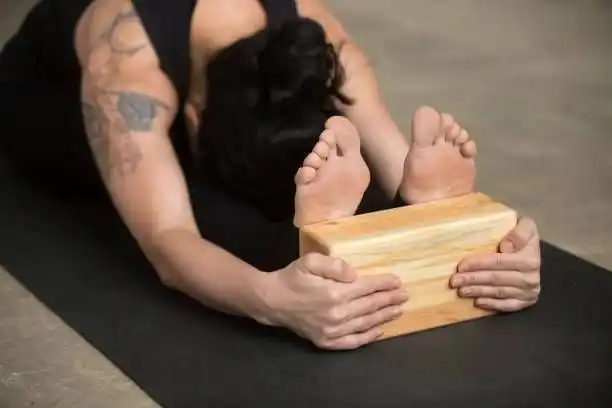
If everything we’ve stated so far seems too simple for you, consider adding one or two yoga blocks in front of your feet.
The extra yoga blocks will provide additional resistance as you stretch down with your centre body, head, and arms stretched straight in front of you.
Beginner’s Tips:
- Do not push your body to go beyond its boundaries. Go as far as your flexibility permits.
- You may also ask your partner or teacher to press your back to improve the stretch.
- Tuck a folded blanket under your hips for further comfort.
- A bolster placed lengthwise on your legs will support your upper body and relieve any discomfort.
- Because this position exerts pressure on your belly, practice it 3-4 hours after a meal.
Precautions & contraindications:
- If you have a slipped disc, spondylitis, or hernia, hypertension, or any other cardiovascular condition, you should avoid performing this position.
- Pregnant women should not do this asana because it puts strain on the abdomen and pelvis. It is detrimental to the health of the foetus.
- If you have recently been injured or had surgery on any portion of your legs, back, pelvis, or arms, do not attempt this asana.
Common Mistakes:
Keep your knees aligned and do not let them turn out. If this occurs, it reduces the stretch of your hamstrings and brings the tension closer to your joints.
Keep your back straight as long as possible while in the posture. This will help you get full breaths.
FAQs
What is Paschimottanasana and its benefits?
This sitting forward bending stretch promotes blood circulation in the lower back, shoulders, spine, belly, and pelvis, which improves organ performance in these muscle groups.
How to perform the Paschimottanasana Pose?
The Paschimottanasana Pose may be accomplished in the following steps: Begin by sitting in the Staff Pose.
Inhale deeply, then lift your arms above your head.
Take a deep breath and close your eyes.
Lean forward with your legs, vertebrate by vertebrate.
Exhale deeply as you lower yourself until your head rests on your knees.
Keep your arms extended forward and keep this position until your body is totally relaxed.
What is Ardha Baddha Padma Paschimottanasana?
Ardha Baddha Padma. Paschimottanasana, also known as the Half Bound Lotus front Fold, is a more advanced form of the straight leg front bend. This variation of Paschimottanasana applies pressure to the abdominal organs and improves digestive function even more.
Can a beginner accomplish the Seated Forward Bend Pose?
Yes, beginners may utilise the Seated Forward Bend Pose as a warm-up and relaxation exercise to progressively improve flexibility in their lower back and hamstrings.
Paschimottanasana may heal what kinds of diseases?
Diabetes, PCOD, PCOS, erectile dysfunction, high blood pressure, and depression can all be treated with frequent practice of Paschimottanasana.
References:
- Allen, W. (2025c, August 26). Paschimottanasana. https://myyogateacher.com/yoga-asana/paschimottanasana
- Seated Forward Bend Pose (Paschimottanasana): How to Do, Benefits & Precautions – Fitsri Yoga. https://www.fitsri.com/poses/seated-forward-bend
- Seated Forward Bend Pose Yoga Pose (Paschimottasana). Tummee. https://www.tummee.com/yoga-poses/Paschimottasana
- insideyoga.org. (2024b, March 27). Paschimottanasana – insideyoga.org. https://insideyoga.org/asana-library/paschimottanasana/
- Ryt, A. P. (2021, May 24). How to do a seated forward bend (Paschimottanasana) in yoga. Verywell Fit. https://www.verywellfit.com/seated-forward-bend-paschimottanasana-3567101


