Isometric Exercise For Core Strength and Muscle Endurance
Introduction
Wall sits, planks, and glute bridges are examples of isometric workouts that keep the body in one position for a certain amount of time.
Exercises that activate muscles and apply tension without lengthening (eccentric contraction) or shortening (concentric contraction) the muscle are classified as isometric training.
Your muscles are activated but not moved during these activities. They are a static method of applying pressure to a targeted muscle or group of muscles without causing joint or muscle movement.
For instance, you engage the muscles in your upper body, legs, and core to keep yourself upright while maintaining an isometric position like a plank.
In contrast, the biceps muscle becomes longer when you straighten your arm back out and shorter when your hand goes toward your shoulder during an activity like a biceps curl, which involves lifting and lowering your hand as the elbow bends.
For those who may be recuperating from an injury and wish to improve their strength, hypertrophy (muscle size), and mobility without overtaxing their joints and muscles, isometric exercises are perfect.
They can also be a fantastic way to work out if you’re short on space or just want to change up your current routine.
It’s time to reconsider what you might have learned in high school gym class, if the first thing that comes to mind when someone talks about core workouts is crunches and sit-ups. Maintaining a strong core involves more than just those exercises. For people of all ages, having a strong core—which is made up of all the muscles in your trunk, from your neck to your pelvis and from your belly and chest to your backside—becomes even more essential as you age. For seniors, core workouts can be very beneficial in maintaining their strength and stability.
Balancing, walking, carrying groceries, taking something from a high shelf, getting in and out of bed, picking up grandchildren, and participating in sports like pickleball and golf are just a few of the numerous activities that utilize the core. You will be more stable in day-to-day life if your core is stronger.
Isometric Exercise For Core Strength and Muscle Endurance
Wall sit

The goal of wall sits is to strengthen your thighs, particularly your quadriceps muscles.
No equipment is required.
The glutes, hamstrings, and quadriceps were used.
Lean your back against a sturdy wall about two feet away.
Make a 90-degree angle with your knee joints by bending them and lowering your buttocks. Your body should be positioned similarly to how you sit in a chair.
For at least 15 seconds, maintain this posture. Maintain your knees over your ankles and your shoulders and hips in contact with the wall.
Do two or three sets.
You’ll notice that your thighs are getting tighter and more worn out in order to keep this position.
Driving down your toes will work your quadriceps, while driving down through your heels will work your glutes.
Just be careful not to allow your knees to extend past your toes, and avoid applying excessive pressure to your knees when placing weight on your toes.
Straight arm plank hold

The straight arm plank hold is a great technique to work a variety of your body’s muscles.
No equipment is required; a yoga mat is optional.
Abdominal, quadriceps, glutes, arms, chest, and shoulder muscles were used.
Place your hands shoulder-distance apart to begin a kneeling pushup.
To elevate your body into a high plank position, press your hands into the ground, straighten your knees, and push down into the balls of your feet. It should appear as though you are performing a pushup.
As long as you can keep good form, hold this position for 20 to 60 seconds. Do these two more times.
Make sure your legs are straight, your hands and shoulders are in alignment, and your core is active throughout the exercise.
Side plank

The side plank is a great way to work your obliques, which are found on the sides of your stomach.
No equipment is required; a yoga mat is optional.
Obliques, quadriceps, glutes, shoulder stabilizers, hip abductors, and spinal stabilizers were among the muscles used.
Keep your hips, knees, and feet stacked while lying on your left side with your legs straight. Put your forearm on the floor above your shoulder and bend your left elbow.
Lift your hips and torso off the ground by pressing your left forearm into the ground. Make sure you’re drawing a straight line from head to heel and maintain a firm core.
Either retain your right arm by your side or raise it straight into the air.
For ten seconds or longer, maintain this posture. Next, flip sides.
Try the side plank with the lower arm straight if you want a more difficult exercise.
Low squat

By keeping your body still during the contraction, you can theoretically make the majority of workouts isometric. Using the squat as an example, this is what we mean.
No equipment is required.
The hamstrings, quadriceps, and glutes were used.
Place your feet slightly wider than hip-width apart when standing. If it’s more comfortable, you can hold your hands straight out in front of you or point your toes slightly out.
Then bend your knees. Don’t push your knees forward.
Until your butt is just below knee level, keep lowering yourself. Maintain a long spine without bending forward, and place your feet with your heels down.
For ten to thirty seconds, maintain this posture. After that, go back to where you were.
Do three to five sets.
Overhead hold

Overhead holds test your shoulder girdle’s muscle stamina. They resemble an overhead shoulder press, except you hold the weight up rather than lowering it again.
Light to medium-weight equipment is necessary (begin with a dumbbell weighing two to ten pounds in each hand, then raise the weight as needed).
Upper trapezius, shoulder girdle, chest, triceps, and core muscles were used.
Hold each weight in your hands at your shoulders while standing with your feet shoulder-width apart.
Holding the weight stable while extending your arms, press the weight up above your head. Make sure to use your core.
Make sure your arms are fully extended and parallel to your shoulders.
But if you’re worried that you could lose weight, stop before this.
Do two or three rounds.
Glute bridge

A fantastic exercise for building muscle and strength in your buttocks is the glute bridge.
No equipment is required; a yoga mat is optional.
The hamstrings, glutes, and core muscles were used.
The distance between your heels and your butt should be 12 to 16 inches.
Squeeze your glutes, stabilize your core, and press into your heels to raise your pelvis. Make sure this movement doesn’t cause your ribs to flare. Maintain your feet flat on the ground, your abdominals tight, and your tailbone slightly tucked.
Your hamstrings and glutes will begin to tire. Avoid allowing your back to arch or your hips to sink.
Perform two to three sets of thirty seconds each
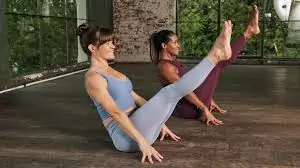
V-hold

You may improve your core strength and stability by using the V-hold.
No equipment is required; a yoga mat is optional.
Abdominal and hip flexor muscles were used.
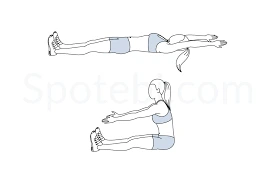
With your arms raised, shoulders forced down, and legs straight, lie back.
Make a “V” shape with your torso and legs by lifting your legs off the ground and reaching up with your arms while using your core. To make the workout easier, you can keep your arms by your sides.
Bend your knees slightly to extend your back and activate your abdominals more if keeping your legs straight makes it difficult to maintain a long spine or puts excessive strain on your hip flexors.
As long as you can while keeping good form, hold this position for 15 seconds.
Do two or three sets.
Avoid rounding your shoulders and maintain a straight back throughout the workout. Throughout the activity, keep breathing.
Calf raise and hold

Although they are sometimes overlooked, the calves are important for boosting lower-body strength, enhancing overall athletic performance, and improving balance and stability.
In this exercise, you will hold the top position of the calf raise rather than performing standard calf raises, which involve moving up and down.
No equipment is required; a chair or wall for support is optional, as a small weight to make it tougher.
Calves’ gastrocnemius and soleus muscles were used.
Place your feet hip-distance apart as you stand.
Push onto the balls of your feet and raise your heels off the ground while keeping your hands on your hips or softly leaning against a wall for support.
For 20 to 30 seconds, maintain this posture.
Do two or three rounds.
Try doing this on one foot for extra difficulty. Next, swap sides.
Tips for doing isometric exercises
When practicing isometric workouts, use the following advice to maximize muscular tension and avoid injury:
Pay attention to proper form: The exercise is finished when you are unable to complete it with correct form.
Actively contract your muscles: Observe how your muscles contract as you carry out the exercise. Increased strength and endurance increases will be possible because of improved muscle activation and correct form.
Breathe: When performing isometric workouts, it’s easy to forget to breathe. Throughout the entire activity, be careful to breathe.
Don’t overdo it: If you’re new, it could be tempting to stay in a position as long as you can. However, this can be extremely stressful on the body and could result in harm. Prioritize correct form instead.
Benefits of Core Exercises
There are many advantages to core workouts for seniors. You might observe these advancements over time:
Heightened activity. Walking, climbing stairs, and getting out of bed or off the sofa are all powered by your core. You’ll probably move more when it’s easier to go around.
Outstanding capacity for handling routine activities. Your core is called upon whenever you bend, reach, twist, pick something up, walk, or remain motionless. When your core is strong and flexible, you won’t find it difficult to perform these and other tasks.
Less discomfort. Your body will move more effectively and efficiently if your core is stronger, which will lessen the strain on your back and other joints. According to research, back discomfort can be reduced by strengthening your core.
Better equilibrium. Whether you’re standing still, moving in different directions, or navigating uneven ground, your core is in charge of keeping your body stable. You’ll feel more stable, upright, and balanced if your core is better at keeping your trunk in a neutral position. Your equilibrium is directly impacted by the muscles in your neck and upper core; strength and flexibility in these areas are important.
Reduced chance of harm. Controlling movement is one of the core stabilizing muscles’ primary functions. Your body experiences less stress when you have more control. This can strengthen your back and shield you from harm. Additionally, improved balance can lower your chance of falling and getting hurt. According to one study, incorporating core workouts into warm-ups decreased soccer players’ risk of injury.
Enhanced efficiency. A strong core gives you the energy for lengthy walks, hikes, or bike rides; it also gives you more power in your golf swing and helps you stay balanced when you lunge to strike a tennis ball. A strong core will not only help you perform better, but it will also allow you to play or enjoy what you like to do for many years to come.
FAQs
Which core exercise is isometric?
Wall sits, planks, and glute bridges are examples of isometric workouts that keep the body in one position for a certain amount of time. During the activity, muscles are engaged and tensed, but they do not lengthen.
Do core exercises help with scoliosis?
Although exercise hasn’t historically been a major part of scoliosis treatment, current techniques now acknowledge the importance of scoliosis-specific workouts. To assist patients with scoliosis, doctors are increasingly incorporating core workouts into their therapy schedule.
Are isometric exercises safe with high blood pressure?
You must focus on inhaling and exhaling carefully when performing an isometric or static workout. Isometric exercise may be a useful strategy for avoiding or reducing high blood pressure, according to recent studies.
What are the top 3 core exercises?
The curl-up, side plank, and bird dog are the three best core exercises, and they are often called the “McGill Big Three.” These movements focus on stabilizing the spine while simultaneously strengthening the abdominal, back, and oblique muscles without putting too much stress on them.
1. Curl-up: Targets the rectus abdominis to make the abs stronger while keeping the lower back flat, which puts less strain on the body than regular crunches.
2. Side Plank (Side Bridge): This is a great way to strengthen the obliques and quadratus lumborum (side core), which are very important for keeping the spine stable and strong on the sides.
3. Bird Dog: This exercise works the core, back, and glutes to improve balance, coordination, and back health.
Do isometrics build strength?
Yes, isometric exercises (holding a position under tension) are good for building strength, especially at the joint angle that is being trained. They are great for building strength without putting too much stress on joints, which makes them great for increasing maximal voluntary contraction, improving joint stability, and healing injuries.
Important Benefits and Information
Targeted Strength: Isometrics (like planks and wall sits) build strength in certain positions, which makes athletes perform better by activating more motor units.
Rehab and Safety: Great for rehab because they keep muscles strong while reducing joint pain. They are also often used to stop muscles from wasting away in limbs that can’t move.
Lowering Blood Pressure: Studies show that isometric exercises like holding a plank can lower resting blood pressure more effectively than traditional cardiovascular workouts.
Limitations: Although they increase strength, dynamic exercises (lifting weights through a full range of motion) are more effective for increasing strength throughout a whole movement pattern and for general muscular hypertrophy (growth).
Can a weak core cause scoliosis?
Insufficient core strength: The spine is not adequately supported by weak core muscles. Other back muscles are strained more as a result, which could cause imbalances and curvature problems.
Do core exercises strengthen the spine?
The lumbar spine can be supported by strengthening the core muscles. The range of motion is increased, and the patient’s functional mobility is aided by increasing the flexibility of the back’s muscles, tendons, and ligaments.
Who should not do isometric exercises?
When performing any weight training exercise, try not to hold your breath or strain yourself. A hazardous rise in blood pressure could result from this.
What is the hardest core exercise?
The Dragon Flag, standing ab wheel rollouts, and ring rollouts are some of the hardest core exercises. They are meant to build strength and stability. To do these movements, you need to tense up your whole body, which works the rectus abdominis, obliques, and deep stabilizing muscles. Barbell wipers, L-sit pull-ups, and weighted planks are some more advanced exercises.
The 10 Most Difficult Core Exercises
Bruce Lee made the Dragon Flag famous. It involves lifting the body into a straight line with only the shoulders supporting it.
The standing ab wheel rollout is a tough exercise that starts from a standing position, rolls out, and then comes back without resting the knees.
Ring Rollouts: These are like ab wheels, but they are less stable because of the rings. They work the abs, lats, and serratus.
Barbell Floor Wipers: While lying down, you lift your feet up to touch a weighted barbell that is above your chest.
L-Sit Pull-Ups: A type of pull-up that works the abs and hip flexors by holding the legs at an angle.
Weighted Plank: An endurance hold with extra weight that puts a lot of stress on the whole middle section.
90° Toes to Bar: Hanging from a bar and raising the legs to an angle before moving to the bar, often while holding still.
Bumper Plate Rollouts: This is a variation of the rollout that uses 45-pound bumper plates and needs a lot of stability.
Renegade Row: In a plank position with heavy kettlebells, do a row without letting your hips twist.
Medicine Ball Wheelbarrow: This workout requires excellent balance and core control and calls for a partner or suspension equipment.
What is the 3-3-3 rule for exercise?
The 3-3-3 rule for exercise is a simple, long-lasting way to stay fit that includes three strength-training sessions, three cardiovascular sessions, and three days of active recovery or daily low-intensity movement (NEAT). It gives you a flexible plan for keeping your health and weight in check over the long term, to be consistent rather than doing high-intensity workouts every day.
Important Parts and Examples of Use
The 3-3-3 Split for Weekly Structure: The most common way to understand it is to divide the week into three types of activities:
Strength training for three days, like full-body or split.
For three days, do cardio, like running, biking, or HIIT.
Three days of active recovery, like walking, yoga, or stretching.
The 3-3-3 Gym Rule is a common way to structure a single, effective workout that lasts 20 to 30 minutes:
3 Exercises: Choose three compound movements, such as rows, push-ups, and squats.
3 Sets: Do three sets of each exercise.
3 Circuits/Rounds: Do all three exercises in three circuits, for a total of nine sets.
Advantages of the 3-3-3 Rule
Simplicity and Time Efficiency: Limiting the number of movements and focusing on a 30-minute window, it makes it easier to stick to and less overwhelming.
Consistency: It gives beginners and busy people a balanced way to do things that will last.
Metabolic Health: Helps with weight loss, normalizes digestion, lowers cravings, and helps balance energy stores.
Similar Words and Related Ideas
Minimalist Training: Focuses on doing fewer exercises that work better.
The 3-3-3 workout method is based on doing three exercises for three days in a row.
The 3-3-3 Japanese Walking Method is a distinct type of cardio that consists of three minutes of fast walking and three minutes of moderate walking, performed for thirty minutes.
Does a weak core affect your back?
Weak core muscles are a common cause of back discomfort. Exercises that strengthen the core are really one of the best ways to relieve back discomfort, according to a study. On the other hand, such discomfort can also be avoided by having a strong core.
References
- Cpt, K. D. M. R. (2025, July 1). 8 Examples of isometric exercises for static strength training. Healthline. https://www.healthline.com/health/fitness-exercise/isometric-exercises
- Dynamic and isometric core exercises to help you become unstoppable | Gloveworx. (n.d.). Gloveworx. https://www.gloveworx.com/blog/isometric-core-exercises/
- Grossman, P. (2024, April 18). 5 killer isometric abs exercises to work your core. BODi. https://www.bodi.com/blog/isometric-ab-exercises
- International Sports Sciences Association. (n.d.). Top 10 Isometric Exercises and Benefits | ISSA. https://www.issaonline.com/blog/post/top-10-isometric-exercises-and-benefits
- Mills, A. (n.d.). Isometric Exercises: Examples, benefits, and applications. https://blog.nasm.org/isometric-exercises
- Plank. (n.d.). [Video]. Hingehealth. https://www.hingehealth.com/gb/en/resources/articles/isometric-exercises/
- Snape, J. (2024, July 23). The isometric secret: 15 ways to get much fitter – without moving a muscle. The Guardian. https://www.theguardian.com/lifeandstyle/2023/aug/08/the-isometric-secret-15-ways-to-get-much-fitter-without-moving-a-muscle