
Upward Facing Dog Pose (Urdhva Mukha Svanasana)
What is Upward-Facing Dog Pose?
Upward-Facing Dog Pose, also known as Urdhva Mukha Shvanasana, is a contemporary intermediate-level yoga pose. It serves as a counter-pose for the Downward Dog position and is frequently executed as a flowing pose in the Sun Salutation sequence.
Although the up-dog pose and the cobra pose appear to be fairly similar, the up-dog pose is more difficult to perform because it calls for keeping your body slightly raised off the ground. This position is not completely beginner-friendly because it calls for strong core muscles and a fair bit of wrist mobility in order to be held for an extended period of time.
One of the common poses that you have probably already tried in some vinyasa flow is the upward-facing dog. Your arms will feel more vital after doing this position, and a refreshing current will begin to flow from your core muscles to your front chest.
It falls under the back-bending sequence of yoga positions, which start with the practitioner in a prone position. By activating the musculoskeletal regions, holding the body in this position awakens the strength in the upper body.
Muscle Work During Upward-Facing Dog Pose:
- Arm and Shoulder Muscles
- Neck Muscles
- Chest Muscles
- Middle and Lower Back Muscles
- Biceps and Triceps
- Core Muscles
- Pelvic Muscles
- Gluteus Muscle
- Psoas Muscle
How to Perform Upward-Facing Dog Pose?
- Lie down on your mat in the prone position, i.e., with your stomach on the mat, your legs straight and hip-width apart, your hand next to your hips, and your feet flat on the floor. You can relax.
- Your forearms should now be perpendicular to the floor as you bend your elbows and position them close to your lower ribs or slightly upward from your waist.
- Next, widen your fingers, roll your thighs inward, and press your palm firmly into the floor. To open your chest, take a deep breath and roll your shoulders back until the bottoms of your shoulders are forward.
- With a deeper breath, elevate your torso while pressing your feet and straighten your arms. Lift your thighs, pelvis, and chest off the ground until your body weight rests on your palms and feet. To work the muscles in your legs and thighs, press the front of your feet against the floor.
- The upward-facing dog’s final position is when our arms are straight, our shoulders are kept away from our ears, our head is raised and slightly cocked back, and our eyes are straight.
- Hold the position for a few breaths or for at least a minute; however, you can hold it for longer if it seems comfortable.
- After that, lower your body and relax to get back to the prone position.
Benefits:
- Stretches and strengthens the arm, wrist, spine, and shoulder: The wrist, arms, and spine bear the majority of the weight in an upward dog, which stretches and strengthens the relevant body parts.
- Enhance Digestion: Urdhva Mukha Svanasana’s backward bending provides a massaging effect on the digestive organs, which effectively promotes their function and improves assimilation and digestion.
- Treatment for Respiratory Conditions: This pose promotes stress-free breathing by widening the torso, which eventually eliminates or lessens pulmonary problems. Additionally, it gets a practitioner ready for Pranayama practice.
- Reduces Anxiety, Stress, and Mild Depression: Urdhva Mukha Svanasana relaxation increases blood flow and relaxes the muscles, which calms the affected area and further calms the mind.
- Enhances Adolescents’ Strength and Balance: Consistently doing this during adolescence is a great way to improve practitioners’ health because it strengthens bones and fosters mental-physical balance.
- Stimulate Abdominal Organs: The second version of this pose stretches the abdomen very hard, which stimulates the abdominal organs and helps them function again.
- Reduces Postural Deformities: Regular back stretches using this pose help to repair spinal deformities such as kyphosis, lordosis, and scoliosis. As a result, it somewhat corrects or lessens the poor posture.
Preparatory Pose
- Bridge Pose (Setu Bandha Sarvangasana)
- Four-Limbed Staff pose (Chaturanga Dandasana)
- Cobra pose (Bhujangasana)
Beginner’s Advice:
- Beginners typically compress the sides in the upward dog or flare out their elbows from the sides. To correctly stretch the spine in the final posture, keep your elbows in between these two positions.
- Steer clear of hanging shoulders that are closer to the ears. Beginners should engage their shoulder blades to the tailbone, as well as their side ribs.
- In order to make a pose dynamic and approachable, one should engage their thighs. Beginners occasionally wind up dropping their thighs, which makes a pose droopy.
Modifications:
- To further assure proper lifting, place a yoga block below your hand to give your body additional room.
- When one’s thighs are sagging or lowering, they can be supported with a rolled blanket, which increases leg engagement and improves posture.
Variations:
One-Handed Upward-Facing Dog Pose:
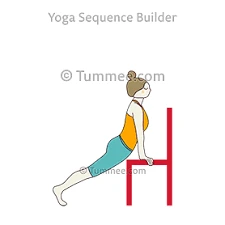
- Start by moving your body weight onto your left hand and flat feet to start in the achieved upward dog position.
- Tilt your head back and glance up a little as you gently raise your right hand back.
- Keep the stance as comfortable as possible and repeat the asana in a similar way with the other hand.
One-Legged Upward-Facing Dog Pose:
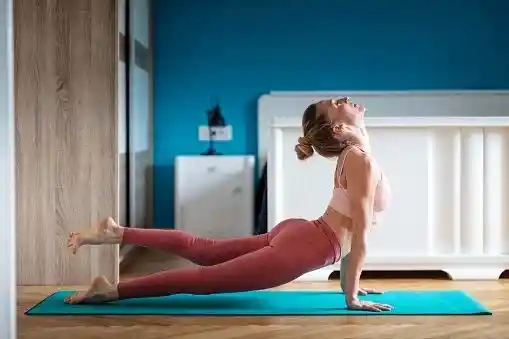
- Change your body weight to your left foot and two hands to transition into this variation of the basic pose.
- While keeping your head and chest straight, slowly raise your leg and bend it so that the big toes point towards the back of your head.
- After as long as you can stay in the pose, switch to the other leg and repeat the same process.
Contraindications:
- Because the upward dog posture stretches the abdomen and may cause constriction, pregnant women should avoid it.
- When practicing the up dog posture, practitioners who suffer from carpal tunnel syndrome (numbness, tingling, or weakness in the hand) should seek guidance from a specialist.
- If you have recently sustained an injury to your shoulder, wrist, back, or abdomen, do not practice.
Common Mistakes:
Bringing the Shoulders Down:
Maintaining the shoulders drawn back is one of the most difficult aspects of Upward-Facing Dog. Allowing them to move up towards the ears is more typical. Pull your shoulder blades together and down your back to keep the posture strong and upright.
Allowing the Mat to Support the Thighs:
Although leaving the thighs on the mat isn’t technically dangerous or incorrect, raising them is a characteristic feature of the position; lowering them indicates that you’re doing Cobra position (Bhujangasana), which is a separate asana.
Entering the Lower Back:
Overarching the lower back, which can compress and strain the lumbar spine, is one of the most frequent and painful mistakes made by upward-facing dogs. Use your legs and core to equally distribute the backbend to combat that tendency.
FAQs
What are the benefits of the upward-facing dog pose?
By stretching the diaphragm and upper chest, the Upward Facing Dog pose increases lung capacity. By encouraging deeper and more relaxed breathing, this enhanced lung function can help those with asthma. This pose tightens and strengthens the muscles in your lower back by pressing it towards the floor.
What is the difference between the upward-facing dog pose and the cobra pose?
The goal of Cobra Pose is to raise the chest while maintaining a grounded lower body. The entire upper body, including the thighs, is raised in the upward-facing dog pose. While Upward Facing Dog mostly extends the chest, arms, and shoulders, Cobra strengthens the lower back and abdomen.
How long should I hold Upward-Facing Dog?
Raise your heart and spread it across your collarbones. Moving your shoulders away from your ears, glide them. The backbend’s length should be uniformly distributed throughout your entire spine. Maintain the position for a maximum of 30 seconds.
What are some common upward dog mistakes?
Avoid these mistakes when performing the upward dog: collapsing into the shoulders; letting the thighs rest on the mat; dumping into the lower back; sphinx pose (also known as salamba bhujangasana) or baby cobra; cobra pose (also known as bhujangasana); and upward-facing dog with props.
Is Upward-Facing Dog good for beginners?
Generally speaking, this is a decent position to start, but if, once you’re in updog, you find that your shoulders are passing your wrists, lower yourself and begin again with your wrists slightly ahead of your elbows.
What is the Upward-Facing Dog called?
Mukha Urdhva. The Sanskrit terms Urdhva, which means upward, Mukha, which means face, and Svana, which means dog, are the origin of Svanasana. Thus, the name is “Upward Facing Dog Pose.” Strengthening the arms, shoulders, and lower back is greatly enhanced by this backbend pose.
What should you avoid in the upward dog?
Avoid flattening the back, obstructing spinal extension, squeezing the shoulders and neck, and lowering the weight for a healthy upward-facing dog.
References:
- Allen, W. (2025m, August 28). Urdhva Mukha Shvanasana. https://myyogateacher.com/yoga-asana/urdhva-mukha-shvanasana
- Konstantinovsky, M. (1970, January 1). How to finally do Upward-Facing Dog the right way. https://www.onepeloton.com/blog/upward-facing-dog
- Upward Facing Dog (Urdhva Mukha Svanasana): Steps, Benefits & Precautions – Fitsri Yoga. https://www.fitsri.com/poses/upward-facing-dog
- Upward-Facing Dog Yoga Pose (Urdhva Mukha Svanasana). Tummee. https://www.tummee.com/yoga-poses/Urdhva Mukha Svanasana.