Cool-Down Exercises
Cool-Down stretching exercises is an easy, short, and nearly effortless post-workout exercise that can help you lower your risk of injury, improve recovery by increasing blood flow, and restore balance to your body. Sadly, a lot of us are guilty of immediately going to the shower after getting off the treadmill or racking up weights.
However, doing cooldown stretches for a little while can have a big positive impact on your body and mind. You also don’t require a complex regimen. You can achieve a more seamless transition from exercise to your everyday routine by using cooldown stretching to help your body return to homeostasis after a workout.
The next time you work out, you might want to attempt this cooling routine. Depending on the muscles you exercised that day, you can either perform the full routine or mix and match your stretches. Depending on how many times you perform each motion, the entire program should only take ten to twenty minutes. Do not be scared to stretch for a longer period of time if you have the time, so that your body may unwind and recuperate after your workout.
Stages of col-down exercise
The three phases of a cool-down are typically as follows:
- Motion: Walking around the block or riding a stationary bike for a short while can do this.
- Stretching: Stretching improves your general range of motion and reduces soreness over the day.
- Awareness: You might meditate or concentrate on breathwork for a little while. Feakes argues that focusing on your breathing can help you relax both your muscles and your mind.
Cool down exercises
Butterfly Stretch

- Position: Sitting position.
- Take a seat with your legs outstretched on the floor.
- If needed, use your hands to pull the heel of your right foot up toward your groin.
- Bring the soles of your feet together by drawing your left heel toward your groin.
- Gently place your elbows on your knees while holding your feet with your hands.
- Maintain a straight back while sitting up straight and lowering your knees to the floor.
- Ten to fifteen repetitions per session are recommended.
- Hold duration: 5 seconds is enough.
Figure-four stretch

- Position: Supine lying position.
- Make a figure four by bringing your right ankle to your left knee with the sole of your foot facing left. Put one arm around the outside of your bent knee and the other through the centre of your figure four to clasp your hands behind your hamstring.
- Keeping your knee from going inward, gently bring the bent leg toward your chest with your hands.
- Ten to fifteen repetitions per session are recommended.
- Hold duration: 5 seconds is enough.
Shoulder rolls

- Position: Sitting or standing position.
- Prepare to begin the shoulder roll exercise by standing up straight.
- Try to pinch your shoulder blades together as you shrug your shoulders up towards your ears and then slowly roll them down and back.
- As instructed, relax, go back to the beginning posture, and repeat.
- Ten to fifteen repetitions per session are recommended.
- Hold duration: 5 seconds is enough.
Shoulder blade squeeze
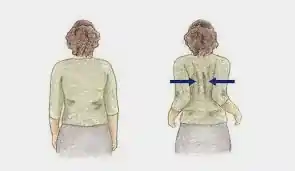
- Position: Sitting or standing.
- To begin, place your elbows at your sides and bend them to a 90-degree angle.
- Squeeze your shoulder blades together and move your shoulders and elbows back.
- Return to your starting position with your shoulders relaxed.
- Ten to fifteen repetitions per session are recommended.
- Hold duration: 5 seconds is enough.
Knee to chest
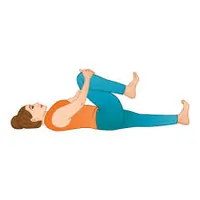
- Position: Supine lying position.
- Bend or extend your left leg while lying on your back.
- Interlacing your fingers around the front of your shin, bring your right knee closer to your chest.
- Ten to fifteen repetitions per session are recommended.
- Hold duration: 5 seconds is enough.
Standing quadriceps stretch

- Position: Standing position.
- Bend your right knee while standing so that your heel is closer to your buttocks.
- Use one or both hands to grasp your ankle.
- Don’t pull your knee out to the side; instead, keep your knees in line with one another.
- For thirty seconds, maintain this posture. On the other side, repeat.
- Ten to fifteen repetitions per session are recommended.
- Hold duration: 5 seconds is enough.
Downward-facing dog

- Position: Standing position.
- While maintaining a straight and balanced spine, raise and lower your hips from a tabletop or plank position.
- Press your weight equally between your hands while spreading your fingers.
- Press one heel into the ground at a time to pedal out your legs.
- Ten to fifteen repetitions per session are recommended.
- Hold duration: 5 seconds is enough.
Forward bending

- Position: Standing position.
- To bend forward, slowly hinge at your hips while standing.
- Maintaining a small bend in your knees, extend your spine, and let your head drop heavily toward the floor.
- Put your hands on the ground, interlace your hands behind your back, or hold opposing elbows in front of or behind your thighs.
- Ten to fifteen repetitions per session are recommended.
- Hold duration: 5 seconds is enough.
Triceps stretch
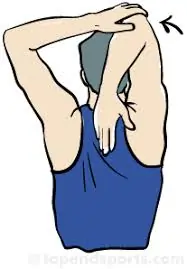
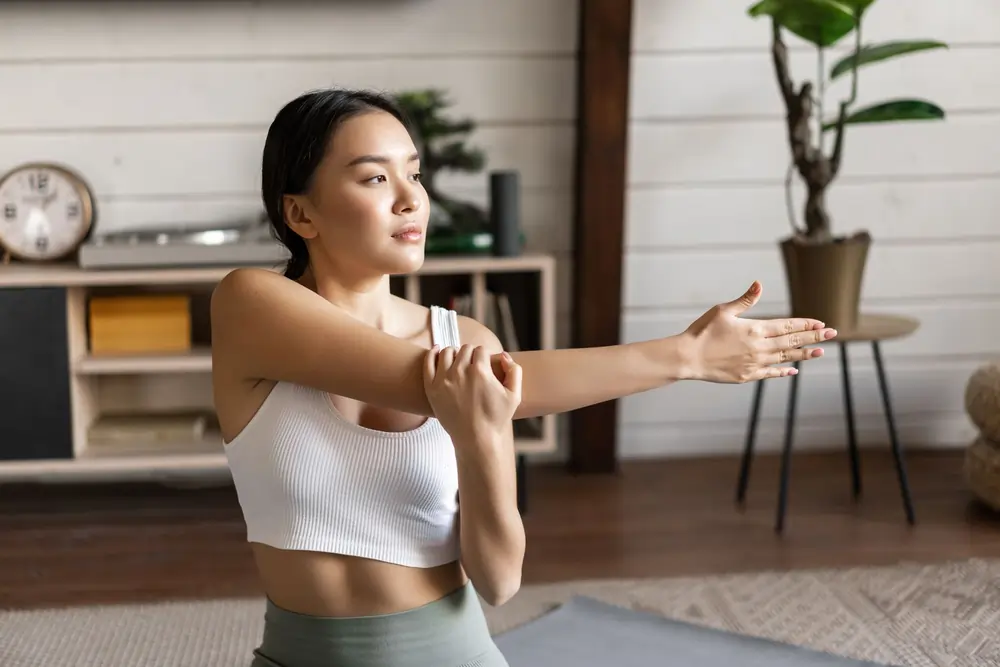
Overhead-triceps-stretch
- Position: Sitting or standing position.
- Holding a towel or strap in your right hand, begin in the same position as the overhead triceps stretch.
- Reach up to grasp the towel’s bottom while maintaining the back of your hand against your back. Bring your left elbow down along your side torso.
- Ten to fifteen repetitions per session are recommended.
- Hold duration: 5 seconds is enough.
Child pose
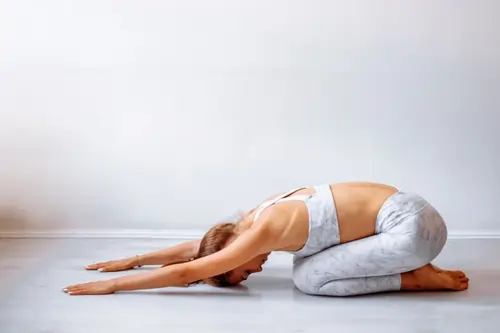
- Position: Prone lying position.
- Keeping the tops of your feet on the floor and your big toes in contact, spread your knees as wide as your mat.
- With your forehead rooted to the ground, place your belly between your thighs.
- Body should all be relaxed.
- Place your forehead on a block or two stacked fists if it hurts to put it on the ground.
- Ten to fifteen repetitions per session are recommended.
- Hold duration: 5 seconds is enough.
Pelvic rotation
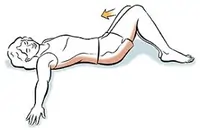
- Position: Supine lying position.
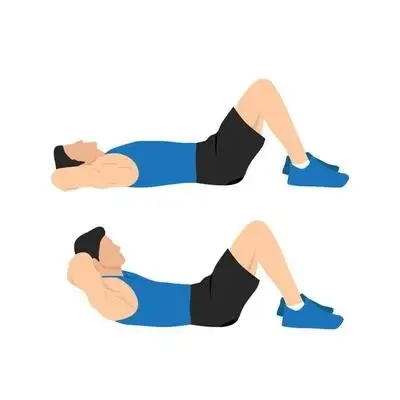
- To develop your abdominal muscles, perform the pelvic tilt.
- Lie on your back on the ground.
- Bend your knees.
- Tighten your abdominal muscles and slightly raise your pelvis to flatten your back against the floor.
- Ten to fifteen repetitions per session are recommended.
- Hold duration: 5 seconds is enough.
Neck flexion and neck extension

- Position: Sitting or standing position.
- To stabilise your spine, place your arms beside your body and contract your core muscles.
- Raise and lower your shoulder blades. Bring your chin closer to your chest gradually.
- Start by sitting down. Bend your neck back slowly and look up at the ceiling.
- Ten to fifteen repetitions per session are recommended.
- Hold duration: 5 seconds is enough.
Neck rotation

- Position: Sitting or standing position.
- Maintain a straight back and a head that is exactly over your shoulders.
- Turn your head slowly to the right until your shoulder and the side of your neck start to stretch.
- Ten to fifteen repetitions per session are recommended.
- Hold duration: 5 seconds is enough.
Place marching

- Position: Standing position.
- Place yourself near a counter or chair. If you start to fall, you can use this for support. If you need assistance, you can also use the walls while standing with your back to a corner.
- As usual, stand with your arms by your sides and your feet slightly apart.
- Lift each knee high toward the ceiling as you march in place.
- Ten to fifteen repetitions per session are recommended.
- Hold duration: 5 seconds is enough.
Heel raise

- Position: Standing position.
- Start by standing and leaning against a wall. To raise your heels off the ground, lean on the wall, and bend your knee.
- Raise both heels slowly into the air.
- After holding your heels up for three to five seconds, gradually lower them. Your calf muscles should extend as you descend, but your heel shouldn’t come into contact with the ground.
- Ten to fifteen repetitions per session are recommended.
- Hold duration: 5 seconds is enough.
Legs-Up-the-Wall Pose

- Position: Supine lying position.
- Place the right side of your body against a wall while you sit.
- Lying on your back, swing your legs up along the wall.
- Put your hips a few inches away from the wall or against it.
- Put your arms over your head, on your stomach, or beside your body.
- Ten to fifteen repetitions per session are recommended.
- Hold duration: 5 seconds is enough.
90/90 with Forward Fold
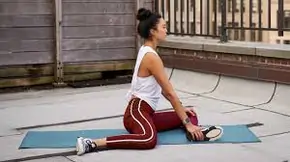
- Position: long sitting position.
- Make a 90-degree angle with your left leg bent in front of your torso, with the sole of your foot facing right and your hip rotating outward.
- Bend your right leg at a 90-degree angle to place your shin and ankle on the ground as your hip moves inward.
- Maintain alignment between your right knee and hip.
- Once both legs are at a 90-degree angle, sit up straight to maintain a straight back.
- Stretch your arms out from your head, lean forward, and maintain equal weight on both hips.
- Ten to fifteen repetitions per session are recommended.
- Hold duration: 5 seconds is enough.
Cat-camel stretch

- Position: Tabletop position.
- Make sure your hands are behind your shoulders, your knees are beneath your hips, and your back is in a neutral position as you drop to your hands and knees.
- Cat: As you raise your head and lower your back toward the floor, extend your tailbone to create a curve in your spine. At the same moment, exhale deeply.
- Camel: To simulate a camel hump, tuck your head and tailbone in and arch your spine. Inhale deeply at the same moment.
- Ten to fifteen repetitions per session are recommended.
- Hold duration: 5 seconds is enough.
Corpse pose

- Position: Supine lying position.
- After your workout, find a quiet place with enough room to lie down and set aside a few minutes.
- Make sure your legs are comfortably separated while you unwind. With your toes pointing outward toward the sides of your body, let your feet rest naturally.
- Alongside your body, extend your arms straight out. Open your palms to face the sky, leaving a small gap between your arms and torso. Observe the sensations in every part of your body.
- Let go of your problems and thoughts and concentrate on your breathing. Breathe smoothly, deeply, and slowly. Try to focus on the here and now and get rid of all the clutter in your head.
- Maintain the position for 10 to 20 minutes.
Walking or jogging

- Position: Standing position.
- Walking vigorously and quickly while attempting to reach a minimum speed of three to four miles per hour is known as brisk walking.
- To put it another way, quick walking is not a stroll or a leisurely stroll and typically permits talking but not singing.
Be mindful of your body.
It might be challenging to find time for regular aerobic exercise, as well as for warming up and cooling down. However, you can definitely squeeze everything in with a little ingenuity. For instance, you can warm up and cool down by walking to and from the gym.
Benefits of cool-down exercises
- For the body to heal after a sport or exercise, a suitable cool-down is crucial. An efficient cool-down will help lessen muscular discomfort in the days that follow, as well as lessen the chance of injury and muscle shortening. Additionally, if the sport or activity is necessary soon after, a successful cool-down will enhance performance for the subsequent session.
- Reducing exercise intensity and easing out of a session with static stretches speeds up workout recovery. As you relax, your heart rate, blood pressure, and breathing rate all gradually return to their pre-exercise levels. This helps remove metabolic waste that builds up in your muscles during exercise and speeds up the healing process. It may also help you avoid post-workout adverse effects like vertigo or headaches.
- Reduces muscle pain and stiffness: DOMS, or delayed-onset muscle soreness, is another unexpected side effect of exercise. The effect of stretching on painful muscles is analysed differently. Stretching after exercise should also be static. However, research suggests that mild cardio cooling down may lessen delayed onset muscular soreness.
- Stretch the tight and core muscles: If you execute the overhead side reach correctly, your upper and lower back, as well as your core, will be fully stretched. There should be a noticeable stretch down the sides of your torso in your latissimus dorsi and obliques.
Tips for cool-down exercise
- To slow down your heart rate, walk more slowly for five to ten minutes.
- For ten to thirty seconds, hold each stretch. Stretch the other side and come back for another round if you think you need more.
- Strong yet not painful is the ideal stretch.
- As you stretch, take a breath. Breathe out while stretching, then inhale while maintaining the stretch.
Conclusion
A cooldown routine will help your heart rate return to resting levels after exercise, encourage recovery from the session, ease muscle soreness, and lower your pulse rate. Your cool-down activities should include lower-intensity aerobics and passive or static stretches that target the muscles you worked during your workout.
Cool-down movements include the knee-to-chest stretch, the seated forward bend, and the overhead triceps stretch. Cooling down is the last thing you should do after working out. Fitting in a workout is difficult enough, after all. For your post-workout recovery, however, you must spend more time cooling down. If you miss it, your fitness goals may be ruined by injuries and tense muscles.
FAQs
What does “cool down” mean when working out?
Warming up and cooling down are comparable. Usually, you continue working out for about five minutes. However, you move more slowly and with less vigour. Try these suggestions for cool-down exercises: stroll slowly for five to ten minutes to cool down after a strenuous walk.
Which four categories of exercise are there?
Four Exercise Types for the Best Health and Performance…
Aerobic (endurance), strength training, balance, and flexibility are the four primary forms of exercise for a well-rounded fitness regimen. Each type of exercise has special advantages for heart health, muscle, stability, and mobility—all of which are critical for general physical function and injury prevention.
How can I lower my body temperature after working out?
After a workout, wear breathable clothing, take a cool shower, or apply cold compresses to your pulse points, cool down gradually with mild exercise like strolling, drink cool water, and rest in a cool, shaded area to help drop your heart rate and core temperature.
Which cool-down activity is the best?
The Greatest Stretches for Cooling Down
Static stretches for the major muscle groups (legs, back, arms, and chest) should be performed for 5 to 10 minutes to improve flexibility and aid in recovery. Hold duration: 30 seconds is enough.
An active cool-down exercise: what is it?
Walking, jogging, or rowing are examples of dynamic whole-body exercises that require more muscle mass. It is advised to engage in low- to moderate-intensity exercise to increase blood flow and promote the reduction of blood pooling in the extremities.
A passive cool-down: what is it?
Sitting, standing, lying down, resting, stretching, foam rolling, vibration treatment, immersion in hot or cold water, and wearing compression garments are all examples of passive cooldown procedures.
References
- LaMarco, N. M. (2024, August 26). 14 Cool down stretches to add to your workout routine. Verywell Fit. https://www.verywellfit.com/cool-down-stretches-to-add-to-your-workout-routine-6748990
- Warm up and cool down – Warming up – Cooling down – PhysioAdvisor. (2022, June 30). PhysioAdvisor. https://physioadvisor.com.au/health/injury-prevention/warm-up-cool-down
- Physiotherapy exercise. (n.d.-b). [Video]. https://www.physitrack.com/exercise-library/how-to-perform-shoulder-rolls-exercise
- Cronkleton, E. (2019, May 23). 4 Triceps stretches for tight muscles. Healthline. https://www.healthline.com/health/exercise-fitness/tricep-stretches
- Ryt, A. P. (2024, July 7). How to Do Child’s Pose in Yoga. Verywell Fit. https://www.verywellfit.com/childs-pose-balasana-3567066
- Pelvic tilt exercise. (n.d.). Mayo Clinic. https://www.mayoclinic.org/healthy-lifestyle/labor-and-delivery/multimedia/pelvic-tilt-exercise/img-20006410
- Cronkleton, E. (2019b, September 9). What is neck flexion? plus exercises for improving your range of motion. Healthline. https://www.healthline.com/health/neck-flexion#extension-exercises
- Gray, J. (2023, November 13). Heel raise exercise progressions – my rehab connection. My Rehab Connection. https://myrehabconnection.com/heel-raise-exercise-progressions/
- Marching-in-Place exercise to improve balance | NYP. (n.d.). NewYork-Presbyterian. https://www.nyp.org/healthlibrary/multimedia/marching-in-place-exercise-to-improve-balance
- The right way to warm up and cool down. (n.d.-b). Mayo Clinic. https://www.mayoclinic.org/healthy-lifestyle/fitness/in-depth/exercise/art-20045517
- Clinic, C. (2024, June 10). Why you shouldn’t skip cool down exercises. Cleveland Clinic. https://health.clevelandclinic.org/why-you-shouldnt-skip-cool-down-exercises
- Neck stretches for pain relief: How to stretch your neck. (2024, June 30). WebMD. https://www.webmd.com/fitness-exercise/fitness-neck-stretches
- Uniyal, P. (2022, December 22). Brisk walking vs jogging; which is better for weight loss? Expert take | Health. Hindustan Times. https://www.hindustantimes.com/lifestyle/health/brisk-walking-vs-jogging-which-is-better-for-weight-loss-expert-take-101671707125779.html
- Brown, K. (2024, August 5). How to do a corpse yoga pose. WebMD. https://www.webmd.com/fitness-exercise/how-to-corpse-yoga-pose
- Scapular squeezes. (n.d.). [Video]. Hingehealth. https://www.hingehealth.com/resources/articles/scapular-squeezes/