Hip Thrust Exercise
Introduction
The Hip Thrust Exercise is an effective lower-body strengthening movement that primarily targets the glute muscles. It helps improve hip power, pelvic stability, and overall lower-body strength, making it beneficial for posture correction, athletic performance, and injury prevention.
- Also known as: weighted glute bridge, weighted hip bridge, and hip thruster
- Targets include the hamstrings, adductors, quadriceps, gluteus minimus, gluteus medius, and gluteus maximus.
- Equipment Required: kettlebell, dumbbell, weight plates, or barbell
- Level: Average
The hip thrust, also known as the hip thruster, is a variation of the glute bridge exercise in which the body is raised off the ground and a barbell is used. Compared to many other lower-body exercises, it targets the gluteal muscles more effectively.
By using the hamstrings and gluteal muscles, the hip thrust efficiently increases hip extension. Your hips shift from a flexed position, in which they are behind or lower than your knees and shoulders, to a fully extended position, in which your knees, shoulders, and hips are in alignment.
Some common variations of hip thrust also work the abductors, which are muscles that cover the sides of the hips. To execute these exercises, you’ll need a circular resistance band, also known as a hip thruster band.
You can strengthen your hamstrings and glutes by performing hip thrusts. To maximize the benefits, perform this exercise using suitable foot spacing and finish the entire range of motion.
The hip thrust definitely needs to be a part of your training schedule if you want to increase the size and strength of your lower body.
The hip thrust, a bent-leg hip extension exercise with your back elevated, is a favorite among lifters worldwide because it targets the posterior chain, particularly the glutes.
What muscles are worked?
The glutes (gluteus maximus and gluteus medius), as well as the hamstrings, are primarily targeted by the hip thrust motion. Additionally, your hip adductors, core, and quadriceps will be active.
What’s the point?
Hip thrusts increase the size and strength of your glutes in a way that many other exercises cannot, and experts indicate that they are beneficial for a wide range of individuals, from athletes to senior citizens over 65.
The stability of your lower body, pelvis, and core depends on the strength of your glutes. Without it, you’re more likely to experience low back pain, knee pain, and other injuries.
Athletic skills like jumping, running, and changing directions are also enhanced by strong glutes. Generally speaking, good mobility depends on having strong glutes. An extra benefit? a round, well-lifted posterior.
How do you do a hip thrust?
Follow these steps to perform a hip thrust:
- Position yourself with your feet flat on the ground, your knees bent, and your back against an elevated surface (such as a box or bench).
- Your feet should be shoulder-width apart, and the bench should strike just below your shoulder blades. The bench is a good place to rest your elbows.
- Push through your heels until your thighs are parallel to the floor, keeping your chin tucked. Your legs should form a 90-degree angle.
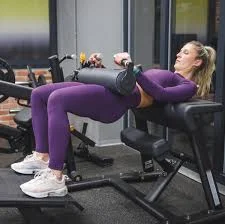
If you’re just starting, start with three sets of twelve repetitions and work your way up to twenty using body weight.
Next, advance the exercise by trying a single-leg variation or safely adding weight using a dumbbell, plate, or barbell (more on that below).
It’s important to remember that while hip thrusts and glute bridges are similar, they are not the same.
Although the exercise is essentially the same, glute bridges are executed from the ground and focus more on the quadriceps and less on the hamstrings than hip thrusts.
Make sure your weight bench is set up correctly for safety, especially if you intend to lift a lot of weight. The bench you use should not be higher than your knees. To prevent it from moving while you are lifting, place the bench’s long end against a solid surface, such as a wall.
Additionally, you might want to use a sponge or pad on the bar. To protect both hip bones, place the pad in the middle of the bar. A towel is used by some exercisers, but it is less secure and can slip.
What Is a Hip Thrust Machine?
A special piece of equipment, known as a thruster, may be available at some gyms specifically for this exercise. It is an L-shaped apparatus with a padded bar that you rest your upper back on and a connected platform on the floor. For many people, this device is the most reliable and comfortable way to execute the move.
You can use an exercise step with four or five risers if your gym lacks a bench and a thruster. Once the bench is in place, you should add weight to the bar. Always use a barbell collar to secure weight plates.
- Begin by sitting on the floor with your feet slightly wider than hip-distance apart and your knees bent. It is possible to slightly turn out the toes. The lower scapula, or upper back, should be leaning against the weight bench’s edge in the middle.
- Spread the weight bar over your hips. Avoid lifting the bar with your arms; instead, hold onto it to keep it in place.
- Press the bar straight up while squeezing your glutes until your hips line up with your shoulders and knees. The mid-scapula region should be supported by the bench. Focus on your body (a few inches above the bar) while keeping your core taut and your chin slightly tucked.
- Lower the bar gradually until the hips are only a few inches off the ground.
- Lift again after tightening your glutes.
- Make any necessary adjustments to your feet after finishing your first repetition. When the hips are fully extended, you want the knee to bend about 90 degrees.
The top barbell collars have been tried, tested, and evaluated by us. If you’re looking for a barbell collar, consider your options.
Barbell Hip Thrust Tips
- You can either have your arms straight out to the sides or cross them in front of your chest if you’re just using your bodyweight. Whichever approach is more comfortable, use it.
- As you extend the hip, make sure the lower back does not arch. Instead, concentrate on tightening your glutes and tilting your pelvis slightly posteriorly.
- At the peak of contraction, you should ideally focus on creating a straight line from your knees through your shoulders.
- As you bridge the hips up, keep them from dropping or rotating.
- As you bridge the hips up, concentrate on exhaling. Your lower back shouldn’t feel any movement at all.
- Palpate the muscles with your hands and concentrate on stopping the movement at the peak of contraction if you are unable to feel your glutes activating.
Benefits of Hip Thrusts
The hip thrust is an essential workout for leg day at the gym for a few good reasons.
Increases Power Generation
For everyday tasks like walking, standing, and climbing stairs, the hip extensors are vital muscles. However, producing power for optimal athletic performance also depends on these muscles. Exercises like weighted squats, lunges, and deadlifts are frequently used by athletes who wish to strengthen their hip muscles.
However, studies reveal that as the movement approaches lockout and the hips reach a neutral position (standing), there is less strain on the hip extensors during standing barbell strength exercises. You can maintain maximum tension on the hip muscles throughout the entire range of motion when performing a hip thrust because you’re in a horizontal position.
Additionally, studies have shown that the hip thrust is superior to the barbell squat, the deadlift, or the Romanian deadlift in terms of activating the hip extensor muscles. For athletes who need to produce speed, this might be particularly important.
- Improved posture and reduced pain
- Improved bone density
- Activities of daily life become easier.
- Glutes are linked to your pelvic floor.
- Improved mobility and speed
Offers Safer Squat Alternative
Barbell squats are a great way to strengthen the lower body, but some people find it unsafe or uncomfortable to place a barbell on their upper back. For example, a weighted barbell squat may be too difficult (or even dangerous) for people with shoulder, neck, or lower back problems. Without putting unnecessary stress on the upper body, the hip thrust or one of its variations strengthens the glutes.
Squat vs. Hip Thrust
For the most part, a squat is superior to a hip thrust. Hip thrusts are not a basic human movement, but squats are. While hip thrusts mainly work the glutes with some hamstring action, squats work the entire lower body and core.
How can you add this to your routine?
A leg-specific training day or a full-body workout can benefit from the addition of hip thrusts.
Make sure you’re giving yourself and your gams enough rest in between workouts if you’re doing hip thrusts along with other leg exercises like squats and deadlifts.
As usual, prior to strength training, make sure you are adequately warmed up. Dynamic stretches should come after a 5–10 minute moderate cardio warm-up.
What are the most common mistakes?
When executing a hip thrust, there are a few aspects to be aware of.
You aren’t completing the full range of motion.
- Your glutes won’t be fully activated if you stop before your thighs are parallel. Make sure your legs are at a 90-degree angle in order to correct this.
Your foot placement is incorrect.
- Your hamstrings will be more affected by the hip thrust if your feet are too far forward. You will experience greater quad engagement if they are too close to your body.
- Similar to the golden rule, you’ll need to position your feet “just right” to feel the hip thrust mainly in your glutes.
Your lower back isn’t neutral.
- You won’t be able to fully extend your hips for glute activation if you start the exercise with your ribs up and your lower back arched or hyperextended.
- To fully extend your hips, make sure your lower back is neutral and your ribs are down.
You’re coming up onto your toes.
- At the peak of the thrust, some people tend to stand up on the balls of their feet. Either your foot placement is incorrect, or you are quad-dominant.
- Make sure your legs form a 90-degree angle at the top by checking where your feet are. Then, throughout the exercise, pay attention to heel contact.
Can you add weight?
Try increasing the resistance in the following ways once the bodyweight hip thrust is comfortable:
With a dumbbell or weighted plate
During the thrust, gently place a weighted plate or dumbbell on your hip bones.
With a barbell
- Here, you have a few choices.
- You can just roll it over your feet if you’re using Olympic-sized plates on a barbell.
- If your barbell is lighter, you can load it onto your hips with the help of a partner. Another option is to deadlift the bar, sit on a bench, and then return to the starting position.
- The barbell should be positioned in the hip crease with hands on either side to stabilize it throughout the exercise, regardless of how you start.
With a hip thrust machine
With a very simple setup, you can hip thrust with a barbell or resistance bands on this particular kind of bench.
You might experience pain where the bar is located when you begin to add a lot of weight to your hip thrust. To protect your hips and avoid discomfort, think about using specialty pads or rolling up a yoga mat or towel.
What variations can you try?
To keep things interesting and to keep pushing yourself, try these hip thrust variations!
Glute bridge

- As was already mentioned, the hip thrust and glute bridge are similar exercises that target different muscles.
- Instead of using a bench, perform a glute bridge with your upper body on the ground.
- The glute bridge would be a good substitute if you feel that your quadriceps are working hard during a hip thrust, so that you can concentrate on your glutes.
Single-leg hip thrust

- One leg should be straightened and held at a 45-degree angle during the hip thrust progression.
Hip thrust off the bench

- With your feet raised, execute the hip thrust on a different bench or box that is the same height or slightly higher.
- During the hip thruster exercise, both the eccentric (lowering) and concentric (lifting) phases are important. In order to begin another repetition, some individuals exert significant effort during the lifting phase and proceed rapidly through the lowering phase.
- However, you want to control the eccentric phase if you want to get the most out of this exercise. Lowering the bar should take the same amount of time as raising it. The glutes will have to stay active and put in more effort as a result.
Safety and Precautions
Before attempting the hip thruster, anyone with hip or back issues should consult a medical professional. Your healthcare provider might recommend changes or different workouts.
Next, when performing this exercise, be especially careful not to hyperextend the spine. When learning the exercise, it could be beneficial to work with a trainer or, at the very least, have a friend observe your form to ensure that the chest does not arch up and create excessive curvature through the lower spine.
Finally, some people attempt to use a hamstring curl machine to execute the hip thruster. But the gym’s exercise equipment is made for particular purposes. Generally speaking, using the equipment in ways not specified by the manufacturer is not recommended.
Conclusion
- Hip thrusts are an excellent exercise to strengthen your lower body and develop stronger glutes. To learn the form, begin with bodyweight. As you gain comfort, gradually increase the weight.
- However, self-defense is just as vital as consistency. Selecting an individual health insurance plan under the appropriate insurance policy guarantees coverage that is customized to meet your needs. In this manner, you can continue to concentrate on increasing your strength and maintain your financial stability in the event of an accidental injury. Simply complete the form on this page, and an expert will assist you in exploring the best options.
FAQs
What are hip thrusts good for?
Glute Strength & Mass: Excellent for increasing the size and strength of the gluteus maximus, a crucial muscle for stability and power.
Enhanced Athletic Performance: Increases explosive power for jumping, sprinting, and direction changes.
Decreased Back Pain: Reduces strain on the lower back and helps with proper pelvic alignment by strengthening supporting muscles.
Improved Posture: Reduces muscle imbalances, improves alignment, and counteracts tightness from extended sitting.
Improved Stability & Mobility: Enhances overall functional movement by supporting the ankles, knees, and pelvis.
Spine-Friendly Loading: Compared to squats, it permits heavy glute loading with less spinal compression.
Complements Other Lifts: strengthening hip extension improves squats, deadlifts, and Olympic lifts.
Boosts the Density of bone. Weight-bearing exercises like hip thrusts can help build stronger bones.
Encourages Daily Activities: Facilitates daily activities such as walking, standing, and jumping.
Why do girls always do hip thrusts?
Increased hip and gluteal strength and power, enhanced athletic performance, and better posture are all advantages of hip thrusts. Because hip thrusts strengthen the muscles that support the lower back, they can also help prevent lower back pain and injuries.
Are squats better than hip thrusts for glutes?
The squat is a more effective exercise for improving general strength and power as well as athletic performance. For targeted glute activation, the hip thrust works better. Squat derivatives work better if performance is the main objective.
Does hip thrust reduce hip size?
Yes! You can definitely reduce the size of your hips by performing hip thrusts. You gain more muscle mass by strengthening your glutes with this exercise. Even when you’re at rest, your body burns more calories when you have more muscle.
What will happen if I do hip thrusts every day?
What are the potential effects of 100 hip thrusts per day? Toning the glutes and increasing muscular endurance can be achieved by performing 100 hip thrusts daily, especially with good form and intensity. For long-term strength and muscle growth, this strategy might not be practical or successful.
Can you grow glutes in 2 weeks?
It usually takes 6–8 weeks for glute growth to become noticeable, but depending on diet, exercise, and body type, some people may find it takes 10–12 weeks. You should train your glutes two to three times a week and make sure you are consuming enough calories to gain muscle if you want to grow them more quickly.
What are the disadvantages of hip thrusts?
Equipment needed: A barbell and a bench or other elevated surface are needed for barbell hip thrusts, which may not be available in every gym. Danger of harm: The hip thrust demands good form to prevent injury because it can strain the hips and lower back.
What is the 888 rule for glutes?
Squeeze your glutes to maintain the highest position for eight complete seconds at the peak of your final partial rep, then gradually lower your hips back down. One set consists of two sets of eight repetitions followed by an eight-second hold without any breaks. Each training session would normally consist of three to four sets.
What are the signs of weak glutes?
Because other muscles overcompensate for the inactive glutes, weak glutes often appear as low back, hip, knee, or hamstring pain, poor balance, a Trendelenburg gait, knee valgus (knees caving in during squats), tight hip flexors, or trouble performing single-leg activities. You may struggle with everyday activities like getting out of a car or climbing stairs, and you may experience tightness, restricted motion, or pain in the buttock/hip area.
Typical Symptoms:
Pain: Tight hamstrings, knee pain, groin pain, low back pain, and hip pain, particularly on the side or top of the hip bone.
Problems with Movement:
Wobbly Gait: When walking, the hips dip or sway (Trendelenburg gait).
Knee issues: When performing lunges or squats, the knees may cave inward.
Balance issues include the inability to stand on one leg without lowering the hip.
When attempting to raise your leg, compensatory movements include tilting your hip or arching your back.
Functional Weakness: Having trouble walking long distances, climbing stairs, or getting out of a chair.
When performing exercises like glute bridges, your hamstrings may cramp because they are working too hard.
Tightness: As other muscles attempt to stabilize, there may be tight hip flexors or a general sense of tightness in the hip/buttock region.
What are the negatives of hip thrusts?
Hip thrusts result in hyperextension of the hips, which strains the joint and puts the hips in strange positions. A posterior pelvic tilt brought on by hip thrust may result in back problems. For every lift, you should keep your back neutral.
References
- Ashok, A. (2020, September 30). Hip Thrusts | Why and how men should be doing it – MYPROTEINTM. MYPROTEIN. https://www.myprotein.co.in/blog/training/hip-thruster-exercise-variations-glute-strength/
- Barbell Hip Thrust Exercise Tutorial | Runna Support | #1 running coaching app & plans. (n.d.). https://support.runna.com/en/articles/6379778-barbell-hip-thrust-exercise-tutorial
- Cpt, M. F. M. A. (2024, May 20). How to do a hip thrust: proper form, variations, and common mistakes. Verywell Fit. https://www.verywellfit.com/how-to-do-a-hip-thrust-techniques-benefits-variations-5076783
- Duffield, Y. (2023, February 25). How to do the hip thrust – Benefits, variations & common mistakes. STRONGERWELLNESS.COM. https://strongerwellness.com/blogs/most-popular-3/how-to-do-the-hip-thrust-benefits-variations-common-mistakes
- How to do hip thrusts the right way. (2020, October 23). Healthline. https://www.healthline.com/health/fitness-exercise/hip-thrusts
- Payne, A. (2025, June 17). 5 Reasons to hip thrust |Three Pillars of Fitness. Three Pillars of Fitness. https://www.threepillarsoffitness.com/blog/5-reasons-to-hip-thrust