Low-Intensity Aerobic Home Exercises
Introduction
Low-Intensity Aerobic Home Exercises are gentle, easy-to-follow movements designed to improve heart health, boost circulation, and increase daily activity—without putting stress on your joints.
You should perform the exercises listed below for one minute each, switching straight to the next one when the allotted time is over.
Take a one-minute break after finishing all exercises in sequence and then repeat the circuit. For a low-impact, butt-kicking aerobic workout, repeat three times.
What is aerobic exercise?
Exercise that uses your body’s vast muscular groups is called aerobic exercise. Your workout’s intensity, or how hard your body works during this kind of exercise, can be changed.
Your heart rate and the amount of oxygen your body requires both rise with aerobic activity. “With oxygen” is what the term aerobic refers to. Your breathing regulates how much oxygen enters your muscles during aerobic exercise, allowing you to move and burn energy.
Aerobic and Anaerobic Exercise
The terms “aerobic” and “anaerobic” describe the two ways your body generates energy.
Aerobic translates to “with oxygen.” Your cells use oxygen to create energy when you engage in a continuous activity that raises your heart rate. Walking is an example of aerobic exercise.
Meaning “without oxygen,” anaerobic. During a brief, intense exercise, your cells are not utilizing oxygen to generate energy.
Low-Intensity Aerobic Home Exercises
Low impact jumping jack

Low-impact jumping jacks are a great warm-up activity that will get your heart rate up and your muscles going. To burn as many calories as possible, you might intensify the arm motions.
To move:
- First standing.
- As you extend your right foot, raise your arms above your head. Throughout this exercise, maintain your weight in your right foot.
- Go back to where you were.
- Step out with your left foot right away. Bring your arms above your head once more while maintaining your weight on your left foot.
Skaters
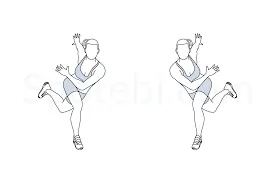
When you finish this move, channel a speed skater. Although the jump is not included in the low-impact version, you will still have to work.
To move:
- With both knees bent and your right leg behind and across your body, begin with a curtsy lunge. For balance, keep your right arm gently curved up at your side and your left arm straight down.
- Start standing by pushing off your left leg, moving your right leg forward, and swinging your left leg back and across while swapping arms. Work fast, but avoid jumping to keep the low-impact strategy.
Squat to jab

You will be bobbing and weaving for low-impact fame if you combine a bodyweight squat with boxing.
To move:
- Start with your arm at your side anf foot apart at shoulder level.
- You should put your leg out and butt in.
Standing oblique crunch
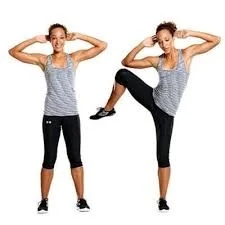
For good measure, we had to include some core work. For best results, make sure your core is active, and your movement is regulated.
To move:
- To begin, place your feet shoulder-width apart, bend your arms, place your hands behind your head, and extend your elbows to the side.
- To start the exercise, lean to your right side and raise your right knee to contact while lowering your elbow.
- Go back to where you were. On the left side, use the same procedure.
Lateral shuffle
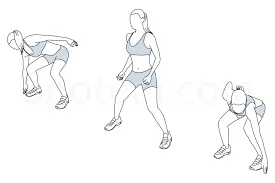
By engaging in both frontal and sagittal (side-to-side) exercises, you can develop a more well-rounded physical strength.
To make sure you’re exercising both legs equally, shuffle right for a certain period of time, then left for the same amount of time, completing your one minute of working time.
To move:
- To begin, stand with your feet shoulder-width apart, your arms comfortably in front of you, your knees slightly bent, and your hips slightly bent to maintain a forward stance.
- To move your body to the right, shift your weight to your right, lift your right foot, and push off with your left foot. During this movement, go as fast as you can without losing form.
- Rebuild your feet and continue, using your left foot to move yourself forward as you “shuffle” to the right.
Reverse-lunge front kick
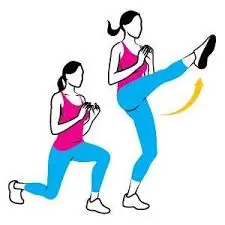
This combo move will melt you. We advise dividing the minute in half and lunging for 30 seconds with your right leg and another 30 seconds with your left.
To move:
- Your arms should be bent and held at chest level as you stand with your feet shoulder-width apart.
- Kick your right leg straight out in front of you to start, then step back into a reverse lunge as you descend.
- Get up and immediately begin another kick, followed by another reverse lunge.
7. Walking

- A great low-impact aerobic activity that helps with weight management, cardiovascular health, and muscle strength without overtaxing joints is brisk walking. Aim for at least 150 minutes of moderate-intensity walking at 3 or more miles per week. This can be accomplished through interval training, brisk walking, or the Walk at Home – DLCC3 – Steel City walking at-home, 2-mile workout.
- Important Walking Factors for Cardio:
- Intensity: A “brisk” pace (roughly 2.5 to 4 mph) allows you to continue talking while your heart rate rises and your breathing quickens.
- Benefits: Frequent brisk walking lowers blood pressure, increases energy, helps people lose weight (burning more than 150 calories in 30 minutes), and lowers the risk of heart disease and stroke.
8. Swimming

This full-body exercise is possibly the best joint-friendly workout, thanks to the water’s buoyancy.
What are the benefits of aerobic exercise?
Among the advantages of aerobic exercise are:
- Strengthening the bones.
- Increasing the flexibility, strength, and endurance of your muscles.
- Enhancing your equilibrium.
- Boosting your cognitive abilities.
- Supporting weight loss and/or weight management.
Furthermore, aerobic exercise can:
- Lower your chance of getting diabetes, heart disease, hypertension, or stroke.
- Boost the function of your lungs.
- Reduce your blood pressure.
- Boost “good” or HDL cholesterol.
- Aid in improving blood sugar control.
FAQs
What are the benefits of low-impact aerobics?
You could achieve your fitness objectives with low-impact exercise without worsening an existing injury or developing a new one. Your body can burn calories even when you’re at rest if you have higher muscle mass.
What are the benefits of low aerobic exercise?
Your energy systems are activated by low-intensity aerobic exercise, which gradually increases their effectiveness. In addition to doing all of that, it also minimizes the effects of stress on the body and hormones. To put it mildly, the impact is amazing.
What are the low-impact aerobic exercises?
Walking can be done outdoors, as on a nature walk or in the neighborhood, or indoors, like in a mall or on a treadmill. step machine or elliptical trainer.
What are the benefits of aerobic exercise?
Which five advantages come with aerobic exercise?
The health benefits of aerobic exercise
Avoid gaining too many pounds.
Boost your strength, fitness, and endurance.
Prevent viral diseases.
Lower the hazards to your health.
Control long-term illnesses.
Maintain clean arteries.
Elevate your mood.
Can you lose weight doing low-impact aerobics?
Indeed, low-impact workouts can help you lose weight. These exercises are less likely to result in joint pain or damage because they don’t require a lot of hopping and bouncing. In addition to strengthening the heart, low-impact workouts can increase general fitness.
Is 20 minutes of aerobics enough?
Yes, 20 minutes of aerobic exercise can be sufficient, particularly if it’s high-intensity, but consistency and intensity are key. According to health guidelines, 150 minutes of moderate or 75 minutes of vigorous activity per week can be achieved with 20–30 minutes of moderate or 10–15 minutes of vigorous activity per day, with shorter bursts providing more benefits than nothing.
Why is twenty minutes sufficient?
Intensity: A 20-minute intense workout, such as HIIT or running, can offer superior advantages and be just as effective as 40–45 minutes of moderate exercise.
Consistency: When done consistently, even quick workouts of 10 to 15 minutes can add up to weekly goals (e.g., 20-30 minutes daily).
Health Benefits: Even brief periods of exercise can lower the risk of developing several diseases and enhance mood, heart health, and cognitive function.
How to maximize twenty minutes:
For moderate intensity, try to get in 20 to 30 minutes of vigorous swimming, cycling, or walking.
Running, high-intensity sports, or HIIT (High-Intensity Interval Training) are excellent options for 20 minutes of vigorous intensity.
For Novices: To progress to longer sessions, divide them into smaller portions, such as 10-minute intervals.
Key takeaway: 20 minutes has major health benefits, so don’t let time constraints stop you. Anything is better than nothing.
Align time and intensity: A higher level of intensity requires less time to achieve health objectives.
What are the 7 basic steps of aerobics?
In order to create cardiovascular workouts, the seven basic steps of aerobics—the March, Jog, Knee Lift, Kick, Jack (Jumping Jack), Lunge, and Skip—involve simple, repeatable movements like stepping, lifting knees, kicking, and jumping. These movements are frequently combined with arm motions.
The seven fundamental steps are as follows:
March: A basic step-together, usually with a neutral spine, that involves stepping in place with a “toe-ball-heel” motion.
Jog: A quick, easy step that involves raising the knees a little more forcefully than a march.
Knee Lift: Bending one knee and raising it high toward the chest (hip flexion), frequently with alternating legs.
Kick: Kicking out from the hip with a straight or slightly bent knee while extending a leg forward, sideways, or backward.
Jack (Jumping Jack): Jumping back to the starting position after flying feet apart and extending arms overhead.
Stepping forward or backward while maintaining the front knee over the ankle and bending both knees to roughly a 90-degree angle is known as lunging.
Skip: A quick, bouncy motion that involves hopping and stepping on the same foot, frequently while traveling or lifting one’s knees.
Can I do low-impact cardio every day?
Yes, however, to avoid fatigue, burnout, and injury, think about alternating between moderate and high-intensity workouts throughout the week. Chronically ill people might not be able to engage in as much aerobic exercise.
Which condition applies to low-impact aerobics?
For those who have arthritis, are just beginning to exercise, or are pregnant, low-impact activities are ideal. A vital aspect to understand is that low-impact exercises do not necessarily require low intensity.
Are low-impact workouts good for bad knees?
Strengthening your muscles is essential to maintaining the mobility and health of your joints. Because three to nine times your body weight flows through the lower extremities, low-impact exercise can also help maintain weight down, which relieves pressure on those areas. Even if you have knee discomfort, you can still perform several healthy workouts.
How quickly can I see results from aerobic exercise?
With consistent training, you may usually increase your aerobic or cardiorespiratory fitness in 8–12 weeks. However, effects could appear as early as four to six weeks. Given that it might only take two to three weeks of idleness to impede your progress, that’s good news.
References
- Davis, N. (2020, April 1). Try this: 6 Low-Impact cardio exercises in 20 minutes or less. Healthline. https://www.healthline.com/health/fitness-exercise/low-impact-cardio
- Professional, C. C. M. (2025, December 22). Aerobic exercise. Cleveland Clinic. https://my.clevelandclinic.org/health/articles/7050-aerobic-exercise