

Box Jumps Exercise
Introduction:
Box Jump is a powerful plyometric exercise that helps build explosive strength, speed, and lower-body power. It involves jumping from the ground onto a sturdy elevated platform or box using both feet, engaging the muscles of the legs, hips, and core.
It’s crucial to remember that box jumps are a more challenging workout that should be performed carefully. You should feel at ease performing box jumps with a low step or box if you’ve established a solid baseline of leg strength and practiced more beginner-friendly jumping routines.
Box should be included near the start of the routine, following a thorough warm-up, and can be utilised in strength- or power-focused exercises. This makes the exercise safer by ensuring the targeted muscles don’t become overly fatigued.
Muscle Work During Box Jumps:
- Core Muscles
- Gluteus Muscle
- Quadriceps Muscle
- Hamstrings Muscle
- Calves
How to Perform?
- Place your feet about six inches from the side of the box as you face it. In an athletic stance, place your feet hip-distance apart and bend your knees and hips slightly.
- Swing your arms smoothly behind you while bending your knees and pressing your hips back.
- Leap as high as you can with your jump by exploding into the balls of your feet, jumping straight into the air, and swinging your arms forward and upward while completely extending your hips and knees.
- To land on top of the box, bend your hips and knees at the height of your jump and pull them forward.
- Lead with the balls of your feet and follow with your heels as you simultaneously land both feet on top of the box. To help absorb the landing pressure, try to do this “softly,” allowing your hips and knees to bend naturally.
- Verify your feet are approximately hip-width apart while you are on top of the box.
- Carefully step—don’t jump—off the box, then reset for the subsequent repetition.
Benefits:
Box jumps are a fantastic way to develop explosive muscle power, muscular endurance, and cardiovascular fitness, while also enhancing other aspects of your fitness, such as balance, mobility, coordination, stability, agility, and speed. They belong to the plyometric training category, also known as jumping exercises.
Increase the amount of repetitions and try to shorten the rest intervals to increase cardiovascular endurance.
Increase the height of your box and reduce your repetitions (or take more breaks) if necessary to develop explosive muscle power.
Focus on perfecting your form if you want to strengthen your lower body. With each repetition, you should be using the appropriate muscles and landing with control.
Tips for Beginners:
- To gain strength and self-assurance, practise leaping onto a low box.
- When you are stable on the box, stand up after landing with soft knees.
- Don’t jump down; instead, gradually step backwards off the box.
Variations:
Step-ups:

The exercise will work the same muscle groups on both sides of your body, but it won’t increase explosive power or vertical leap height like a box jump. To generate some of the force that translates more successfully to a complete box jump, try adding a small hop at the top of each step up.
Increase Box Height:
Just grab a taller box to make box jumps more difficult! You may keep raising the bar by moving up to the next box level as you gain more strength, power, hip mobility, and vertical leap height.
A dumbbell box jump:
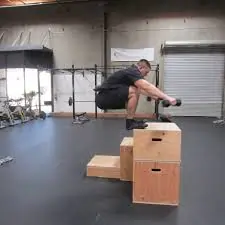
Advance to this exercise by jumping while grasping a dumbbell in each hand.
A kettlebell box jump:
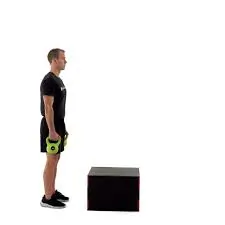
Once dumbbells are comfortable, perform the box jump while holding a kettlebell at chest height with both hands.
One-legged box jump:
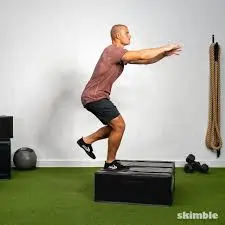
Leap from a height of two feet and land on the box with one foot. As you proceed, switch legs.
Seated box jump:
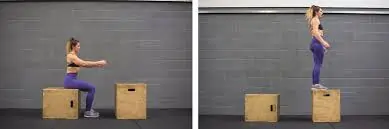
Place the box in front of a bench. After taking a seat on the bench, leap straight up onto the box.
Safety & Precautions:
Above all, before trying box jumps, you should have a solid baseline of lower-body strength.
Before you begin, spend a few weeks incorporating less strenuous plyometric exercises into your warm-up, such as skipping drills or jumping rope.
These exercises can help your muscles adjust to higher-impact, power-producing motions before you attempt box jumps. It’s crucial to wear appropriate sportswear, such as a sports bra for large breasts, to assist in controlling bounce, just like with most high-impact workouts. Additionally, as said earlier, begin with a low box.
Box jumps are normally safe for well-conditioned athletes, but if you have back pain or lower-extremity issues, wait to try them until the problem is resolved.
Common Mistakes:
Selecting an excessively tall box:
There are two possible results if your box is too high:
- If you don’t make it to the top, you could get harmed.
- Instead of landing in a quarter squat, which is what you should aim for in a box jump, you will land in a deep squat.
Jumping off the box:
While the landing of a box jump can be effectively absorbed by your body, this is not the case when you jump backward from the box. Your risk of injury will rise if you do this.
Making an incorrect landing:
A correct box jump landing requires a soft landing on the entire foot while in a little crouch with the knees slightly out.
FAQs
What are box jumps good for?
Box jumps are a fantastic way to develop explosive muscle power, muscular endurance, and cardiovascular fitness, while also enhancing other aspects of your fitness, such as balance, mobility, coordination, stability, agility, and speed. They belong to the plyometric training category, also known as jumping exercises.
Are box jumps better than squats?
The box’s function is to lessen landing forces. All of the major leg muscular groups—the glutes, quadriceps, hamstrings, and calves—are targeted when done correctly. Box jump exercises, however, closely resemble the power and muscle activation patterns required in most sports, unlike squats or deadlifts.
Which Muscles Do Box Jumps Work?
Lower body strength, fitness, and confidence are necessary for box jumps. Start with basic workouts like step-ups, squat jumps, and practice landing mechanics. Before raising your box height, start with a lower one (12–18 inches) and practice landing. To strengthen your lower body, incorporate exercises such as lunges and squats. To avoid injury, warm up completely and move slowly.
Is A Box Jump A Plyometric Exercise?
Indeed, box jumps are a traditional plyometric workout that works the muscles’ stretch-shortening cycle. Plyometric exercises train the nervous system to generate force by rapidly extending muscles and then contracting them violently. In particular, box jumps strengthen the lower body.
What equipment is needed for box jumps?
Select a soft plyo box that offers a secure landing surface and lowers the danger of injuries, or pick from a variety of strong hardwood plyo jump boxes. Additionally, we provide cutting-edge 3-in-1 physical plyo boxes that allow you to change the height and intensity of your workouts with only one piece of equipment.
References:
- How to do box jumps the right way — and why you should – 2020 – Davis/www.healthline.com/health/fitness-exercise/box-jump
- How to do box jumps: proper form, variations, and common mistakes – 2023 – Ascm-Cep/www.verywellfit.com/how-to-do-box-jumps-4588131
- How to do box jumps: Technique, benefits & common mistakes/sweat.com/blogs/fitness/box-jumps