A Complete Upper Body Workout Routine For Beginners
Introduction
If you’re new to lifting weights, you are surely aware that you must lift weights for every muscle group in your body, including your lower body, core, shoulders, biceps, triceps, and chest. That may seem like a lot, but lifting weights can help you lose body fat, gain strength, feel more confident, and make other activities easier without requiring many exercises. It’s simple to divide your workouts, so you work different muscle groups on separate days, such as an upper-body workout.
If you want to start strength training, this upper-body exercise is ideal for beginners. It consists of simple dumbbell exercises that work the core and all of the upper body muscles.
The goal is to start gaining muscle and strength in order to build a strong basis that will enable you to advance to more difficult exercises.
Carefully selecting your weights is important. When you’re just starting, utilize lesser weights to improve your form and err on the side of safety. Pay attention to performing the exercises correctly. You might attempt utilizing larger weights once your body gets used to them.
Beginner Upper Body Workout
- Chestpush-upp
- Chest flies
- Lat pulls
- Back extensions
- Bicep curls
- Bent arm lateral raises
- Overhead presses
- Triceps kickbacks
Getting Started With An Upper Body Workout
Before attempting this or any other workout, please consult your physician if you have any injuries or other issues. A resistance band and a variety of weighted dumbbells are required. Do this exercise two or three times a week, taking at least one day off in between.
Start with a 5-minute aerobic warm-up, such as utilizing a folding exercise bike, or warm up the entire body with very low weights for each activity. Do one set of fifteen repetitions of each exercise. The final rep should feel difficult yet possible. Any workout that hurts or is uncomfortable should be changed or avoided.
Modified Push-Ups (Chest)

Walk your hands forward while on your hands and knees until your hands are wider than your shoulders, and your back is flat.
Lower yourself as low as you can into a push-up while bending your elbows. If you can only go a few inches at first, that’s okay. Make sure your neck and head line up and that your chin isn’t leading.
Walk the hands back to relieve part of the upper body’s weight if this feels extremely difficult. If floor push-ups are difficult, you can also try a modified form like a wall push-up or an upward push-up. To go to more difficult push-ups, you might need to strengthen your upper body and core.
Chest Flies (Chest)
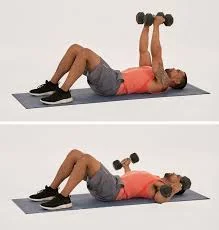
Hold weights (about 5 to 8 pounds for women and 8 to 15 pounds for men; however, use a weight that works for you) while lying on a step, bench, or floor. With your palms facing inward, hold the weights straight up above your chest.
As you progressively lower your arms to the sides, bend your elbows slightly and brace your core to maintain body stability.
Extend and lower the arms till they are slightly below chest level. You want to maintain the focus on the chest since going too low can affect the shoulders. Additionally, if you go too low, your shoulder muscles may be stretched because the chest is often stronger than the shoulders. Raise your arms back to the beginning position to finish the workout.
Lat Pulls With Band (Back)

Hold a resistance band in both hands while sitting or standing. To produce greater or less tension, you may need to change the distance between your hands, but they should be roughly two or three feet apart. The exercise will be more difficult if your hands are closer together.
To begin, raise your arms straight, squeeze the right side of your back, open the band, and reach your right elbow down toward your ribs while holding your left hand in position. Perform 15 repetitions with your right arm before switching to your left.
Back Extensions (Back)
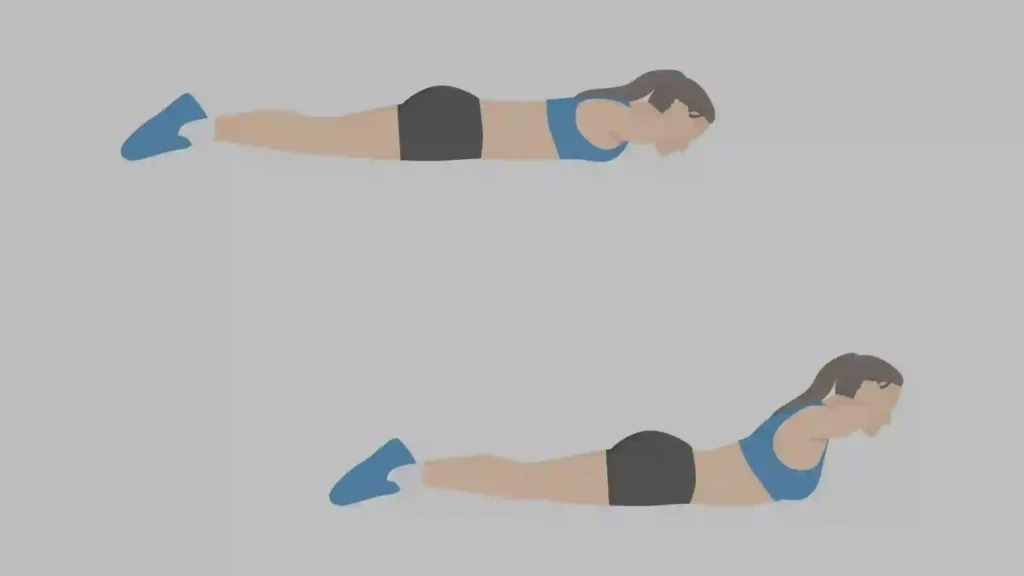
Bend your elbows and place your hands on the floor near your ears while lying face down on a mat. Using your lower back muscles, continue to raise your chest off the floor while contracting your abs.
Try to use your back muscles as much as you can, but if necessary, you can gently support yourself with your hands. Repeat after lowering.
The more difficult alternative is to place the hands behind the head. Even harder: Raise your chest off the ground while keeping your arms straight out in front of you.
Biceps Curls (Biceps)

You might be able to utilize a heavier weight for bicep curls. Hold weights in front of your thighs with your palms facing out while standing with your feet about hip-distance apart.
Curling the weights toward your shoulders requires bending your elbows and stabilizing your abdomen. Make sure your elbows remain at your torso rather than moving forward. Repeat, slowly lowering back down without releasing the muscle’s tension.
Bent Arm Lateral Raises (Shoulders)
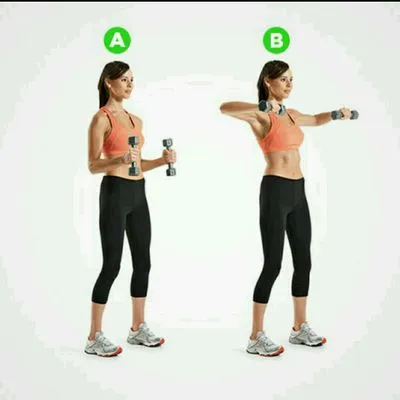
You should use a little less force for the lateral lift exercise. Hold dumbbells with your arms bent at a 90-degree angle and your palms facing in while standing with your feet hip-width apart.
Lift the arms straight to the sides while maintaining the 90-degree angle and keeping the elbows stationary. Raise to shoulder height. Your arms should be parallel to the floor at the peak of the action. Repeat after lowering.
Overhead Presses (Shoulders)

Start with a smaller weight because overhead presses are difficult. Place your feet hip-width apart. Start by raising the weights so that their hands are facing out. Make sure to maintain a firm core instead of arching your back. You could require smaller weights if you do arch your back.
Lower the weights until they are almost level with your ears while bending your elbows. Your arms need to be like a goal post. Repeat by pressing the weights back up.
Triceps Kickbacks (Triceps)

You can support your body with one hand while using the other to perform the triceps kickback exercise by placing your foot on a step or platform.
If not, grasp a weight in your right hand and tip it from your hips until your torso is parallel to the floor or at a 45-degree angle. To support your lower back, place your left hand on your thigh.
To begin, raise your right elbow till it is directly below your back. Squeeze the rear of the arm while extending the right arm straight back, while maintaining that position. Repeat after lowering.
FAQs
What’s a good beginner upper-body routine?
1. Beginner’s Upper Body Exercise (All Upper Body)
Bench Press (Barbell): 3 sets of 8–12 repetitions
Dumbbell shoulder press: two sets of eight to fifteen repetitions
Lat Pulldown (Cable): 12–15 repetitions in two sets
Dumbbell Hammer Curl: 2 sets of 12–20 repetitions
Two sets of 12 to 20 repetitions of the triceps rope pushdown.
Is a 20-minute upper body workout enough?
Strength training doesn’t require you to lift weights for hours every day. Just two or three 20- or 30-minute strength training sessions per week can significantly increase your strength.
Is 3 hours at the gym enough?
The World Health Organization’s baseline health criteria can be met by three hours of exercise per week if it is planned well and includes both strength and aerobic training. However, most adults will benefit from longer training time for objectives like major weight loss, muscle building, or athletic performance.
What are the golden rules of the gym?
Always bring your own towel, clean the equipment, and re-rack the weights. Maintain a minimum of three feet between you and other people while lifting to show respect for their personal space. Use headphones, avoid making calls on the floor, and only record if it’s secure and private. Examine the stated gym rules; each facility has different policies regarding the usage of chalk, drops, and equipment.
How to tell if a muscle is overtrained?
Typical warning signs of overtraining consist of:
prolonged joint pain and muscle soreness. reduced stamina, strength, and speed. increased blood pressure, heart rate, and even palpitations at rest. elevated risk of illnesses, including infections or colds, as well as overuse injuries.
How to build max strength?
To get the most strength, lift heavy weights (80–90% or more of your 1-rep max) for low reps (1–5 reps) using compound movements like squats, deadlifts, and presses. Put progressive overload, enough recovery time, and 3–5 minute breaks between sets at the top of your list. This will give your nervous system time to recover.
Important Rules for Getting Stronger
Intensity and Volume: Use heavy weights (at least 60–80% of your 1RM) and do 3–6 sets of 1–8 reps, trying to get as close to muscle failure as possible.
Compound Exercises: Focus on multi-joint exercises like squats, deadlifts, bench presses, and overhead presses. These exercises work multiple muscle groups at the same time and get the most neural output.
Progressive Overload: Always try to lift more weight over time so that your muscles have to work harder to get used to the extra resistance.
For building strength, the best rep/set structures are 3 sets of 5 reps (3×5) or 5 sets of 3 reps (5×3) at 75–80% of your 1RM.
Intensive Cluster Sets: Take 10 to 30 seconds of rest between reps in a set (for example, 4 to 15 total reps at 90%+ 1RM) to handle higher, higher-intensity volume.
Training and Getting Better
Rest Times: Between heavy sets, take longer breaks (3 to 5 minutes) to let your ATP (energy) levels fully recover. This is important for keeping your maximum strength during a workout.
Recovery: Don’t work out the same muscles two days in a row. Muscles grow and get stronger when they rest.
How often: Beginners should do 2 to 3 strength-focused workouts a week, with full-body sessions or high-intensity split routines being the best options.
Dynamic Warmup: To avoid losing power, do dynamic stretching (like light cardio or bodyweight movements) instead of static stretching before training.
Other Ways to Get Strong
Push against things that can’t move (like a barbell against pins) to improve your neuromuscular coordination and strength at certain sticking points.
Bodyweight Progressions: If you don’t have a lot of equipment, try harder variations like pistol squats or one-arm push-ups.
Post-Activation Potentiation (PAP): Do a heavy lift and an explosive movement together to make your body produce more force overall (for example, heavy back squats followed by jump squats).
Do deadlifts help with bone density?
Particularly popular compound weightlifting exercises, like the traditional squat and deadlift, have been demonstrated to be successful in high-intensity progressive resistance because they apply significant loads and tensions to the hip and lumbar spine, increasing both muscle mass and BMD in these particular regions.
Which exercise burns the most belly fat?
High-resistance, moderate-endurance exercises are the most effective in reducing belly fat, according to studies. Exercises like circuit training and high-intensity interval training (HIIT) fall under this category. Additionally, you can combine high-resistance exercise with endurance training.
How should I train my upper body?
To train your upper body effectively, focus on a mix of compound pushing (chest/shoulders/triceps) and pulling (back/biceps) movements 2-3 times per week, utilizing dumbbells, machines, or bodyweight. Push-ups, dumbbell bench presses, rows, overhead presses, and pull-ups are some of the most important exercises. For hypertrophy, you should do 3 sets of 8–12 reps of each.
Important Exercises for the Upper Body
Bench press, incline press, push-ups, and chest flies are all good exercises for the chest.
For your back, do bent-over rows, lat pulldowns, pull-ups, and renegade rows.
Shoulders: lateral raises, front raises, and the overhead press (military press).
Bicep curls, tricep dips, and skull crushers are all good exercises for your arms.
Ways to Train
Compound Movements: To get the most out of your workouts, focus on exercises like rows and presses that work more than one joint and muscle at a time.
Progressive Overload: To keep your muscles challenged and growing, you should gradually increase the weight, reps, or sets.
Supersets: To save time and make your workout harder, do a pushing exercise and a pulling exercise at the same time (for example, do a chest press and then rows).
Frequency: Try to do it 2–3 times a week, with at least one day of rest between sessions to give your muscles time to recover.
Mind-Muscle Connection: Instead of just moving the weight, pay attention to how the muscle group feels while working.
A workout for beginners that doesn’t need any equipment
Three sets of push-ups (standard, wide, or narrow) until you can’t do any more.
Three sets of floor tricep dips.
Three sets of back extensions.
Three sets of plank raises.
Three sets of inchworms.
A Sample Workout at the Gym
Dumbbell bench press: 3 sets of 8 to 12 reps.
Do 3 sets of 8 to 12 reps of the bent-over row.
Three sets of 8 to 12 reps of the overhead press.
Lat Pulldown: Do 3 sets of 10 to 12 reps.
Bicep Curls: 3 sets of 10-12 reps.
Tricep Extensions: 3 sets of 10-12 reps.
Are 5 exercises enough for an upper body day?
Really depends on time, aim, and split. If you’re practicing an upper/lower routine, a lower day can simply consist of three to four workouts. On an upper day, however, you’re looking at at least five exercises (or eight minutes if you want to be comprehensive) if you’re working your arms, shoulders, back, and chest.
How many days should I train my upper body?
To get the most out of your workouts, isolate your muscles and use correct form. If you don’t use the appropriate form when lifting high weights, you won’t gain anything. I suggest doing upper body exercises three days a week and lower body exercises three days a week, with one day off.
How much rest is needed to avoid overtraining?
You can take fewer rest days if you schedule your workouts to target different muscle groups on different days of the week, but even so, you should set aside at least one or two days each week for rest, active rest, or active recovery.
References
- Cscs, D. P. R. (2024, September 2). Workout routines for men: How to reach your fitness goals. Healthline. https://www.healthline.com/nutrition/workout-routine-for-men
- Gonzalez, B. (2024, June 12). Ultimate upper body workout for beginners. Get Raw Nutrition. https://getrawnutrition.com/blogs/workouts/ultimate-upper-body-workout-for-beginners?srsltid=AfmBOopqNtjsJ3H-NvQX1z0YITwn211csSYbXjdTrVTAz7h5nzW57yUp
- Ros, G. (2026, February 12). Upper body workouts for beginners (+3 and 4-Day splits). Hevy – #1 Workout Tracker & Planner Gym Log App. https://www.hevyapp.com/upper-body-workout-exercises/
- The best gym workout plans for beginners. (2023, November 8). PureGym. https://www.puregym.com/blog/the-best-gym-workout-plans-for-beginners/
- Upper body workouts for women | The Gym Group. (n.d.). https://www.thegymgroup.com/blog/upper-body-workout-for-women/