Push-Ups Exercise
Introduction:
Push-up is a closed kinetic chain workout that does not require any instruments and relies on human weight for resistance. It has various versions, so that it may be tailored to your fitness level.
They target the triceps, pectorals, and shoulders. By stimulating the abdominal muscles, they can aid in strengthening the core and lower back. A quick and efficient method of building strength is to perform push-ups.
Muscles Involved:
The primary mover muscle, or agonist, is the pectoralis Major muscle.
The primary antagonists (muscles that resist the agonist): Rhomboids, Posterior deltoids, and Middle fibers of the Trapezius muscle.
The triceps and anterior deltoids are the primary synergists or assistive muscles used in the push-up.
Fixators: The muscles in the upper traps, rotator cuff, and core (primarily the rectus abdominus and transversus abdominis) that help rotate the scapulae upward. The latissimus dorsi, which helps stabilize your shoulders, and the quadriceps, which keep your legs straight and strong, are further fixators.
How to do Push-ups?
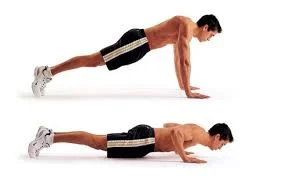
You must lie on all four limbs with your hands somewhat wider than your shoulders in order to perform a push-up. Keep the elbows slightly bent rather than locked out. Lean your legs back until your feet are hip-width apart so that you can balance on your hands and toes. Once you are in this position, here’s how to do a push-up.
- Take a deep breath.
- After taking a breath, slowly bend your elbows until they are at a 90-degree angle, then drop to the ground.
- Exhale, tense your chest muscles, and push back up through your hands to return to the beginning position.
Push-Ups Exercise Video
Benefits of Push-ups:
- While performing push-ups, your core maintains your body in an upright position. This eventually improves balance, lessens lower back pain, and strengthens and stabilizes the core muscles for other motions.
- Anyone’s heart can be made healthier by doing push-ups. Chest-press-based strength training, which incorporates bodyweight movements like push-ups, may actually enhance cardiovascular well-being for people with cardiovascular disease.
- Push-ups can enhance proprioception (the awareness of your body’s movement in space), promote muscular co-contraction for dynamic joint stability, particularly via the core, and enhance athletic performance.
- When you don’t have a lot of time to spend at the gym, exercises like push-ups (along with lunges, squats, and other compound motions) are good and practicable at home.
- May promote bone health: Bone density can be maintained and even increased with resistance training. This includes both weight-bearing and bodyweight exercises. Resistance training is particularly helpful for postmenopausal women, whose decreased oestrogen levels put them at higher risk of bone loss.
- Improves the ability to function: For regular activities like moving items off the ground or performing housework, functional fitness is essential.
Disadvantages of Push-ups:
- Incorrect form or excessive repetition can strain the shoulder, elbow, wrists, and back, leading to pain or injury.
- The main muscles worked by push-ups are the triceps, anterior deltoids, and chest. Push-ups alone may cause imbalances if you don’t include exercises for other muscle groups, such as your back.
- Once you reach a certain level of strength, push-ups may lose their effectiveness if you don’t add resistance (such as resistance bands or a weight vest) or try harder varieties.
- Daily high-volume push-ups can result in overuse problems, particularly if proper rest and recuperation aren’t allowed.
Variations of Push-ups:
Bent Knee Push-Up

- This version of the standard push-up is done on the knees rather than the toes.
- Maintaining a straight line between the knees, hips, and shoulders is necessary.
- You should avoid bending at the hips.
Incline Push-Up
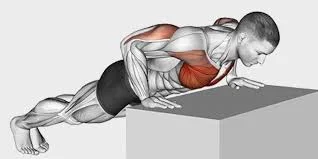
- To make this exercise a little bit simpler, you can also perform incline push-ups.
- Place yourself a few steps away from the bench or table.
- Use the same push-up technique to raise yourself back up after lowering yourself until your elbows are at a 90-degree angle.
- Throughout the exercise, maintain an active core.
Decline Push-Up
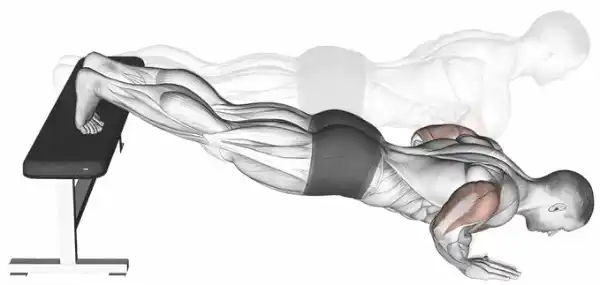
- A more difficult form of push-up is the decline push-up, which involves raising the feet on a box or bench.
- Using only your body weight, you may change the box height to increase or decrease the resistance.
Wall Push-Up

- Position your hands against a wall and shoulder-width apart while facing a solid wall.
- In order to lean forward, move your feet approximately an arm’s length away from the wall.
- Perform a push-up against the wall while bending your elbows.
Diamond Push-Up
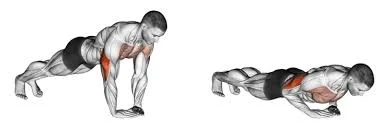
- The main focus of the diamond push-up is on the triceps brachii muscle.
- Make a diamond shape on the floor by touching the thumbs and index fingers of one hand to the other while keeping your hands close together.
- Next, you do push-ups, making sure your palms meet the middle of your chest with each repetition and your elbows close to your sides.
Strict (Military) Push-Up

- As previously mentioned, begin in the typical push-up position, which consists of your arms straight, hands flat on the floor below your shoulders, and your feet together or no more than 12 inches apart.
- For one repetition, raise your chest to just below the level of your bent elbow while taking a deep breath and bending your elbows while maintaining their motion back alongside your body.
- When you’re done, release your breath and return to the starting position.
Wide Hand Push-Up
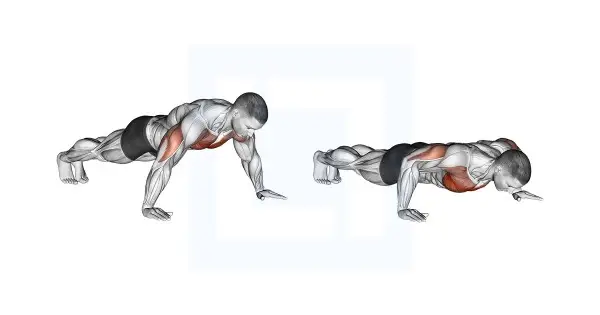
- Do a strict push-up as described above, but spread your hands approximately 2.5 to 3 feet apart on each side.
- Keep your elbows back while you complete the exercise.
Medicine ball Push-Up
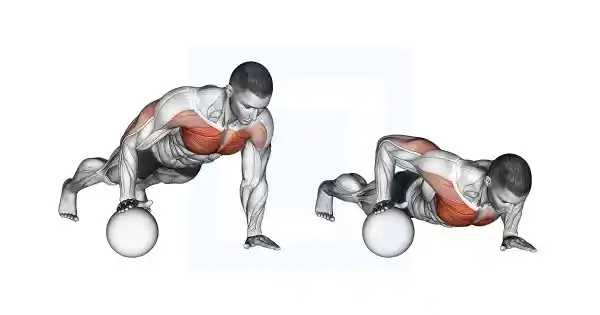
- Do a standard push-up with one hand on top of a medicine ball.
- This uses the shoulder in a slightly different range of motion, which increases shoulder stability.
- You can also do an alternate medical-ball push-up, which is rolling the medicine ball between each hand after a repetition, to improve your balance.
Pike Push-Up
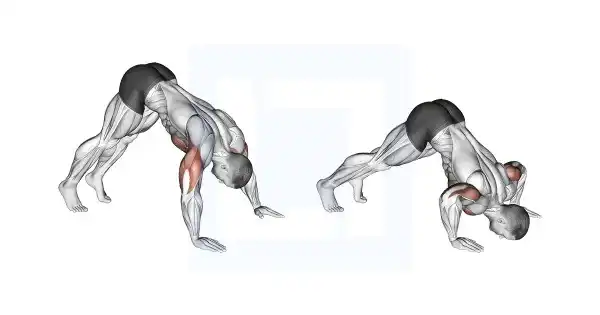
- The downward dog yoga pose starts with your hands and feet shoulder-width apart.
- Maintaining the inverted-V position requires bending your elbows and lowering your head between your hands toward the floor.
- Hold your hips high and your heels low.
- Go back to the beginning position after completing the movement once in reverse.
Staggered Hands Push-Up
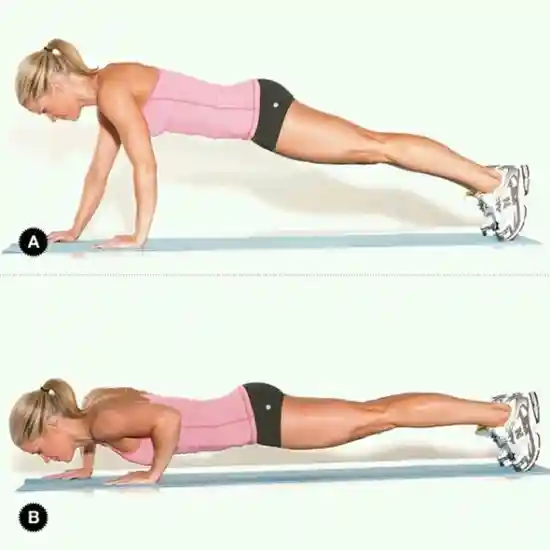
- With one hand extended six to twelve inches forward and the other hand brought backward, assume a normal push-up position.
- Bend your elbows until your chest is just below the level of your bent elbow, then extend them to push yourself back up to the starting position.
- To work each side equally, alternate your hands between front and behind positions after one or more repetitions.
Spiderman (Side Kick) Push-Up
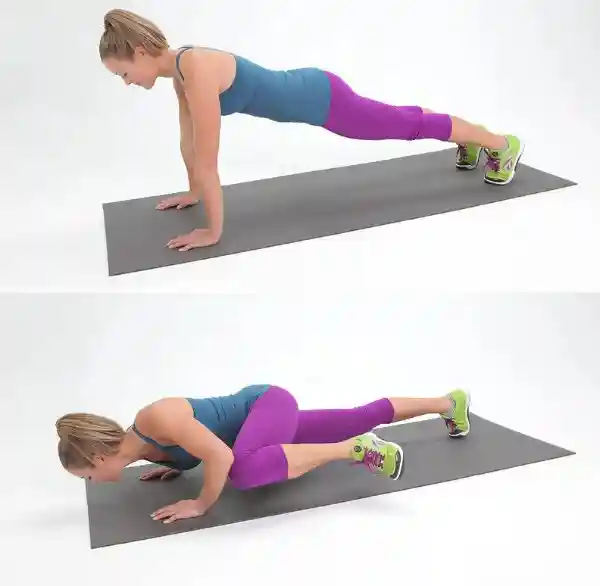
- Put yourself in the standard push-up position.
- Raise one knee to meet your elbow and out to the side as you drop yourself toward the ground, keeping your leg parallel to the floor.
- Your knee should touch your elbow when the push-up reaches its lowest position.
- Repeat on the opposite side after reversing the motion to its initial position.
One Arm Push-Up
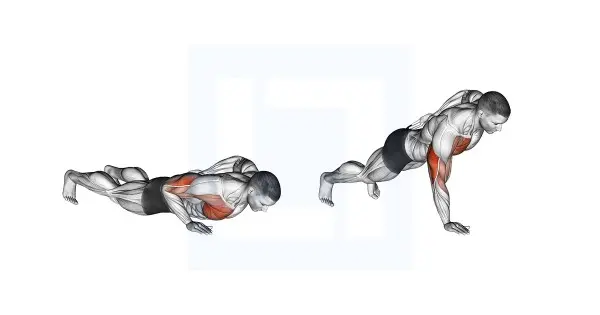
- The unweighted arm should be centred behind your chest, and one arm should be behind your bag.
- Keeping your feet wider helps with this one, which requires a little more balance.
- Throughout the exercise, keep your hips level and your back flat; avoid twisting them in either direction.
- For an extra challenge, try a two-point push-up, which involves assuming a conventional push-up position with your feet wide apart, then raising the opposing hand and leg to create a two-point plank.
Flying Push-Up
- In the standard push-up position, begin with your chest down to slightly below the level of your bent elbow.
- Then take your hands and feet off the ground and fly upward.
- Keep your back as flat as you can, but in order to gain momentum, you might need to gently raise your hips.
- Additionally, it keeps your feet wider. Continue descending toward the floor after landing with soft elbows in push-up form. Repeat.
Clap Push-Up

- Perform a standard push-up.
- Make sure you have enough energy to clap your hands together before you fall.
- The power and explosiveness of the upper body are improved by this plyometric version.
Shoulder Tap Push-Up
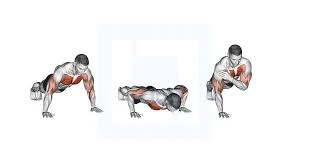
- With each standard push-up repetition, raise one hand off the floor and touch the opposing shoulder.
- Use your core to balance your body and avoid swaying.
- This variant strengthens your core and shoulder muscles while also adding a sense of balance.
Weighted Push-Up
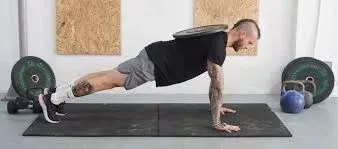
- Put a weight plate on your upper back between your shoulder blades or wear a weighted vest.
- Perform a standard push-up.
- During exercise, maintain a straight body alignment.
- While keeping control, lower your chest toward the floor and then raise it again.
- Strength and muscle growth are encouraged by the weight’s extra resistance, which puts more strain on your shoulders, triceps, and chest.
Common Mistakes:
- The most common mistake is sagging in the midsection, which is brought on by improper core bracing or maintaining an erect spine during the exercise.
- Improper alignment of the neck.
- When you’re tired and want to take a short break, you can make the mistake of locking your elbows at the top of the exercise. However, this puts an excessive amount of tension or harm on the joints.
- Putting more strain on your shoulders.
- The whole benefit of doing push-ups is not being obtained if you are only partially going down. Alternating to a simpler adaptation that allows you to use your entire range of motion, such as knee or incline push-ups, is preferable.
Conclusion:
A basic upper body workout for bodybuilders, athletes, casual gym-goers, and those rehabilitating from certain injuries is the push-up. Although it is frequently linked to the chest, it also works the triceps, anterior deltoids, pectoralis major and minor, and core muscles.
Push-ups have several notable advantages, including improving body composition, reducing the risk of cardiac events, and strengthening the upper body. By doing any of the several variations, you can modify the basic push-up’s difficulty according to your strength and degree of experience.
FAQs
What type of exercise is a push-up?
This closed kinetic chain exercise employs body weight as resistance and doesn’t require any instruments. Because of its many variations, it may be tailored to the individual’s levels of fitness. They aid in strengthening the pectoral, shoulder, and tricep muscles.
What are the benefits of push-ups?
Strengthens the upper body.
Increases the core’s stability and strength.
It could enhance cardiovascular health.
boosts athletic performance.
Engages several muscles at once.
It could promote bone health.
How many pushups should I do per day?
You don’t have to do a certain number of push-ups every day. Try working your way up to 1–3 sets of 10–20 repetitions to strengthen your upper body. If you want to build bigger chest muscles, doing more push-ups could seem like the ideal solution.
Do push-ups burn belly fat?
Push-ups primarily target the muscles in the upper body; therefore, their immediate impact on the belly region is minimal. Only when exercise consumes enough calories to support both muscle growth and belly fat reduction may push-ups help reduce belly fat.
Which pushup works the most muscles?
WIDE PUSH-UP
Your chest muscles will be well-targeted by the wide push-up. Push-ups may help reduce belly fat only if training includes enough calories to support both muscle building and belly fat reduction.
Do push-ups have side effects?
It’s particularly important to have good form if you aim to perform push-ups every day. If the exercise is performed improperly, it might cause serious damage. For example, improper push-up technique can cause lower back or shoulder pain.
References:
- Carpenter, H., & Carpenter, H. (2024, December 6). 14 Types of Push-Ups—and How They Help you. Outside Online. https://www.outsideonline.com/health/training-performance/types-of-pushups/
- Thomason, K. (1970, January 1). 15 Push-Up variations to master at every level of your fitness journey. https://www.onepeloton.com/blog/push-up-variations
- Seven benefits of doing push-ups. (n.d.). Nike.com. https://www.nike.com/in/a/benefits-of-pushups-everyday
- Physiopedia contributors. (9 February 2024). ‘Pushups’. Physiopedia. https://www.physio-pedia.com/Pushups
- Ms, E. Q. (2024, May 12). How to do Push-Ups: proper form, variations, and common mistakes. Verywell Fit. https://www.verywellfit.com/the-push-up-exercise-3120574
- Cscs, D. P. R. (2023, July 10). What muscles do Push-Ups work? Healthline. https://www.healthline.com/health/fitness-exercise/muscles-worked-push-ups#bottom-line