How To Improve Flexibility At Home
Introduction
Flexibility is an essential component of overall fitness and physical well-being. It refers to the ability of your muscles and joints to move through their full range of motion without discomfort or restriction. Improving flexibility at home is a simple and effective way to enhance mobility, reduce muscle stiffness, and support better posture. Regular stretching exercises can help relieve tension caused by long hours of sitting, physical activity, or everyday stress while promoting relaxation and improved body awareness.
A consistent flexibility routine can benefit people of all ages and fitness levels. Whether you are an athlete looking to improve performance, a physiotherapy patient recovering from an injury, or someone seeking greater comfort in daily movements, stretching can play an important role in achieving your goals. Flexible muscles and joints are less prone to injuries and can contribute to smoother, more efficient movement patterns.
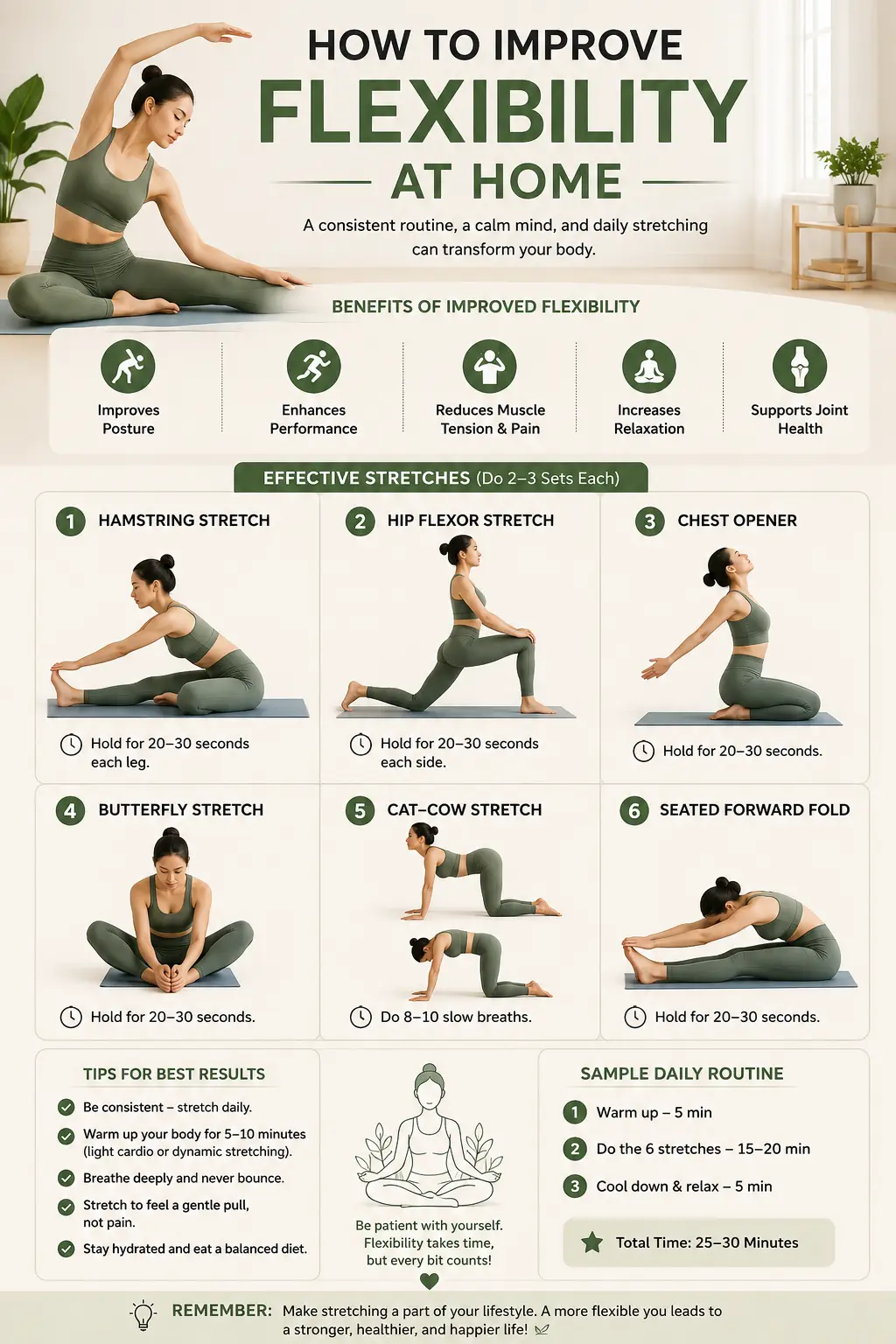
Home-based flexibility training requires little to no equipment and can easily fit into a busy schedule. Simple stretches such as hamstring stretches, hip flexor stretches, butterfly stretches, chest openers, cat-cow stretches, and seated forward folds can effectively target major muscle groups throughout the body. Performing these exercises regularly can improve circulation, reduce muscle tightness, and increase overall mobility.
For the best results, warm up your body before stretching, move slowly, and avoid forcing any position that causes pain. Focus on deep breathing and hold each stretch for an appropriate amount of time to allow your muscles to relax. With patience and consistency, daily stretching can help you develop better flexibility, improved posture, enhanced physical performance, and a healthier, more active lifestyle from the comfort of your home.
Stretching Exercises
Stretching exercises can help avoid injuries, improve rehabilitation, and increase flexibility. Stretching after an exercise while your muscles are still warm provides several advantages, such as increased flexibility, stress reduction, healing, and decreased soreness.
Benefits of Stretching Exercises
- Increases general flexibility
- Reduces tension
- Aids in returning your body to its pre-exercise state
- Allows your body and mind to think back on the exercise.
- May lessen stiffness and soreness in the muscles after exercise.
The benefits of stretching exercises don’t require a lot of time. The stretches in this entire body flexibility workout are so easy to perform that you may do them at any time or place, such as while watching TV, at work, or after a workout.
These stretching exercises target all of the body’s major muscles, including those that are chronically tense, such as the arms, legs, shoulders, back, chest, and hips. They also encourage flexibility and relaxation. For better outcomes, try stretching every day if you can.
To release any excess tension you may be carrying around, try these stretches. If you have any illnesses, injuries, or medical conditions that could limit your ability to stretch, consult your physician.
You’ll need a bench, chair, or exercise ball to sit on. After a workout or a bath, while your muscles are warm, perform these stretching exercises or warm up with five to ten minutes of gentle cardio.
Repeat one to three times, holding each stretch for ten to thirty seconds. Stretch as deeply as you can and stay away from any painful or uncomfortable workouts. The stretch should be painless and enjoyable. You should take a step back and allow your muscles to relax if they are trembling.
What is flexibility?
The ease with which you may move your muscles and joints in various directions is known as flexibility. Being flexible allows you to reach, bend, and extend without feeling constricted or uncomfortable, whether you’re playing sports or retrieving something off the shelf.
Flexibility aids in muscular stretching rather than muscle growth. Flexibility is the result of improving the range of motion, mobility, or muscle extension.
Benefits of flexibility
There are more benefits to being adaptable than just impressing someone with a cartwheel or the splits. It can support maintaining your body’s strength, flexibility, and readiness for any challenge.
Among the advantages of flexibility is that it
- Increases the range of motion.
- Lowers the possibility of harm.
- Improves posture.
Improves range of motion
Being flexible makes it easier for you to move. This indicates that when engaging in specific physical activities, you are experiencing less strain and stiffness. This can assist with motions like swinging a golf club or pitching a baseball if you’re an athlete or even just a casual hobbyist.
Furthermore, the advantages of flexibility extend beyond your capacity for exercise or sports. Additionally, it can assist you in going around during the day and finish daily chores like cleaning, gardening, and grocery shopping.
It improves your general mood when performing daily tasks.
Maintaining your flexibility as you get older is crucial to your continued independence and mobility. Flexibility is needed for basic tasks like lifting, bending over, and reaching.
Reduces the risk of injuries
In the end, being flexible can help you avoid injuries. Your body may be at risk for strained muscles and ligaments, particularly if you participate in sports or heavy lifting. By assisting your body in managing the strain of physical exercise, flexibility can help lower your risk of certain types of injuries.
You will begin overcompensating with other muscle groups, such as your shoulders or lower back, if your mobility and flexibility are poor. And that’s where it can result in hamstring strains or other joint problems.
Helps with posture
Your posture can also be improved by increasing your flexibility. In the same way that a solid foundation keeps a structure erect, proper posture maintains your body’s alignment and balance. Because it lengthens your muscles, increases joint mobility, aligns your spine, and strengthens your core, flexibility is essential for maintaining proper posture.
How To Improve Flexibility At Home
Quad Stretch

- Stand and grasp onto a wall or the back of a chair for balance if needed.
- Bend your knee while holding onto the top of your left foot, bringing it closer to your glutes while keeping your knee pointed straight down. The front of your leg should feel stretched.
- For a more thorough stretch, push your hips forward.
- Repeat one to three times per leg, holding for 15 to 30 seconds before switching sides.
Standing Hamstring Stretch

- With your back flat, advance your left foot with the heel on the ground and the toes from the hips.
- Lower yourself till the rear of your leg starts to stretch.
- Repeat one to three times, holding for 15 to 30 seconds before switching sides.
- Use a resistance band for greater leverage if your hamstrings are tight or you feel unbalanced.
Chest and Shoulder Stretch
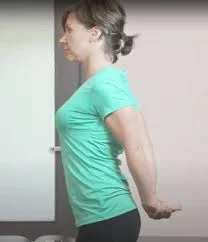
- Sit or stand with your arms straight and your hands clasped behind your back.
- Raise your hands as high as is comfortable in relation to the ceiling. Your chest and shoulders should feel stretched.
- Repeat one to three times while holding for 15 to 30 seconds.
- Try extending your arms behind you and out to the sides like an airplane if your shoulders are tense.
Upper Back Stretch

- To feel a stretch in your upper back, put your hands together in front of you, round your back, and press your arms away from your body.
- To maximize the benefits of this stretch, contract your abs.
- Repeat one to three times while holding for 15 to 30 seconds.
Biceps Stretch

- Like a hitchhiker, extend your arms to the sides, slightly behind you, and raise your thumbs.
- To stretch your biceps, turn your thumbs back and forth until they point toward the rear wall.
- Repeat one to three times while holding for 15 to 30 seconds.
Shoulder Stretch

- To deepen the shoulder stretch, place your right arm straight across your chest, curl your left hand above your elbow, and gently pull on the right arm.
- If you don’t feel a stretch, try lowering your shoulder.
- Repeat one to three times on each side after holding for 15 to 30 seconds.
Seated Side Stretch
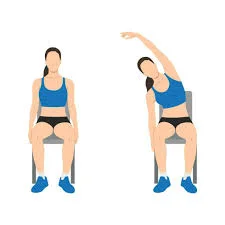
- Place your hands straight up overhead, palms facing the ceiling, whether you are sitting or standing.
- Stretch up and then across to the right, feeling a stretch down your left side.
- Repeat one to three times, holding for 15 to 30 seconds before switching sides.
Triceps Stretch
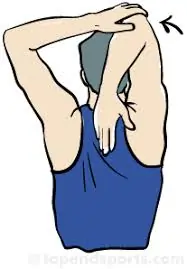
Overhead-triceps-stretch
- After bending your right elbow behind your head, slowly draw your left elbow in closer with your right hand until your triceps start to stretch.
- Repeat one to three times, holding for 15 to 30 seconds before switching sides.
What are the 7 types of stretching?
Here are 7 basic types of stretching, each one is designed for a specific reason within your body. The best option depends on what you’re trying to accomplish: getting ready for a workout, recovering post-workout, or building long-term mobility.
1. Stretching Static
You take a fixed stretch, which is hard but comfortable, and hold for 15 to 60 seconds.
Best for: Cooling down and post-workout recovery.
Example: Reaching down to your toes and holding them to stretch your hamstrings.
2. Active Stretching
Your movements are active, controlled, and take you through your full range of motion for repetitions and not holding a pose.
Best for: Warm-ups; boosts blood flow and joint mobility.
Example: Walking lunges or leg swings.
3. PNF Stretching
Proprioceptive neuromuscular facilitation involves a passive stretch and an isometric contraction of a muscle. Usually done with a partner or a strap, you stretch a muscle, contract it against resistance, relax it, and stretch it more.
Best for: Improving flexibility and correcting muscle imbalances.
Your partner holds your leg in a hamstring stretch, you push against them for 5-10 seconds, relax, and your partner pushes your leg further back.
4. Stretching Ballistic
Uses momentum from a bouncing or swinging body part to push the muscle beyond its normal comfortable range of motion.
Best for: Advanced athletes (mainly martial artists or gymnasts)
Example: Bouncing at the bottom of a toe touch repeatedly. (Note: This carries a higher risk of injury and should be used with caution.
5. Stretching Dynamic
You are in a stretch, and you are holding it using only the strength of the muscles on the opposite side (no outside help such as a band, gravity, or a partner).
Great for: Improving flexibility and active muscle strength.
Example: Raise your leg as high as you can and then hang on using your hip and core strength.
6. Passive Stretching
You let the targeted muscle relax and turn to an outside force to stretch you. This force can be gravity, a pulling strap, a prop, or a partner.
Ideal for: Loosening deep tissue and relaxing tight muscles.
For example, lying on the floor and pulling your extended leg towards you with a yoga strap.
7. Isometric Stretching
This kind of static stretching involves holding the stretch while tensing or contracting the stretched muscles.
Ideal for: Reducing pain and increasing strength at severe ranges of motion.
Example: Stretching your calf while pressing your foot up against a wall.
What causes poor flexibility?
Poor flexibility is usually caused by tight muscles that limit the normal range of motion in your joints.
Poor flexibility is not just about tight muscles; many physiological and lifestyle factors contribute to it:
Sedentary Lifestyle: Sitting for long periods and a lack of movement cause the shortening and stiffness of muscles (especially in the hips, legs, and calves) and connective tissues over time.
Aging: The normal aging process causes tendons to become dehydrated and muscles to shrink, leading to a natural reduction in overall elasticity.
Muscle Weakness: If the opposing muscle groups are not strong enough, the body will compensate, leading to imbalances in the joints and decreased overall mobility.
Not Stretching Enough: If you leave stretching and mobility out of your routine, your muscles lose their ability to lengthen out to their full capacity.
Scar Tissue and Injuries: Scar tissue and fascial restriction can develop from previous injuries or surgeries. This can physically tether the muscle, limiting movement.
Joint Structure: The genetic shape and structure of your bones and joints (such as the ball and socket design of your hips) determine the anatomical limits of your range of motion.
What is the fastest way to gain flexibility?
PNF (Proprioceptive Neuromuscular Facilitation) stretching on warm muscles 4-6 times a week is the best way to improve flexibility. This technique temporarily overrides your brain’s “stretch reflex” and results in immediate and dramatic gains in range of motion.
The 4-Step PNF Method
Treat your stretching just like a gym workout for the muscle groups you want to target ( e.g., hamstrings or hip flexors ) and do this cycle :
- Stretch: Switch to a gentle stretch, and hold for 10 seconds.
- Contract: Isometrically push the muscle into an immovable object (wall, strap, or your own hand) at about 20-30% effort for 10 seconds.
- Relax: Release the contraction, allow the muscle to fully relax for 5 seconds.
- Deepen: Slowly drift deeper into the new range of motion and hold for 20-30 seconds.
Making the Most of Your Progress
Flexibility training as effective as possible:
Train Often: Research shows that 4-6 shorter, high-quality 10-minute stretching sessions per week will get you results much faster than one long, painful 45-minute session on the weekend.
Warm Up First: Don’t stretch cold muscles. Go for a hot shower, or do some light dynamic stretching (leg swings, walking lunges) beforehand to get the circulation going.
Control Your Breath: Deep diaphragmatic breathing sends a message to your nervous system that your body is safe in these new positions, preventing your muscles from tensing up.
Use Self-Myofascial Release Foam rolling tight spots (like your thighs) for a few minutes before stretching provides the same short-term flexibility benefits as static stretching.
What causes us to lose flexibility?
When you were younger, you might recall being more adaptable. You may therefore believe that growing older is the primary cause of stiffness. Indeed, age has a role. However, as Lawton notes, you may also lose flexibility due to a number of other issues. Our lives change as we get older, which may have an impact on how much flexibility we use.
I’m not sure if a lot of that tightness is caused by age or the amount of work we do when seated in front of a computer.
- Sitting for long periods of time.
- Aging.
- Injury.
- Inactivity.
- Stress.
- Genetics.
- Medical conditions.
Over time, one may lose flexibility for a variety of causes, such as:
Long durations of sitting really cause many of those muscles to shorten. Our hips, hamstrings, and even our mid-back or chest muscles may become less flexible as a result.
Exercises and stretches to improve flexibility
Stretching or flexibility exercise twice a day, if at all possible, depending on how tight you feel. Additionally, this doesn’t have to take up a significant portion of your day. Try to adhere to it and work it in wherever you can.
Other ways to improve flexibility
In addition to stretching, you can increase your flexibility by performing particular exercises or even by incorporating particular equipment into your training.
Among them are, to name a few:
- Yoga.
- Foam rolling.
- Tai chi.
- Use stretch bands.
- Get a massage.
Sometimes we simply develop muscle knots that stretching won’t necessarily help. Therefore, we also need to release the knots in those muscles.
Avoid sitting too much.
We are all aware of the dangers of excessive sitting. One of them is losing flexibility. Range of motion is aided by flexibility. If you’re not moving enough, that range of motion grows reduced.
You can stretch as much as you like, but your muscles will probably tighten again if you spend eight to ten hours a day behind a desk.
During the day, try to get up from your chair at least once per hour. To change up your posture and keep yourself moving while working, consider using a walking pad or a standing desk.
Stretch after working out.
Generally speaking, if you’re just getting started with your flexibility challenge, you can start by holding each of the previous stretches for 20 to 30 seconds. However, if you want to improve your flexibility even further, lengthen each stretch instead of making it tougher. Stretching for longer is one approach, I believe. Each stretch can be held for a maximum of one or two minutes.
Adds that when stretching, you shouldn’t push yourself too hard. Pay attention to your body, and if you experience any pain, stop. It could be a little unpleasant to stretch. Additionally, you need to enter that uncomfortable zone a little bit if you truly want to stretch that muscle, but it shouldn’t hurt.
FAQs
What are the methods to improve flexibility?
A regular, consistent stretching regimen is essential for improving flexibility. Stretching should be done at least twice a week. Even so, it’s best to stretch after each session. Stretching the main muscle groups—especially those engaged during exercise—should be your main priority.
How does age affect flexibility?
This occurs as a result of both lifestyle modifications and biological alterations in our connective tissues. The majority of our tendons, ligaments, and joint cushions are composed of water. These tissues naturally lose moisture as we age, which causes them to become less flexible and more brittle.
Which yoga is for flexibility?
1. Yin Yoga (Deep Connective Tissue)
The Style: Slow, passive style, with poses held on the floor for 3 to 5 minutes.
Why it works: Gravity and muscle relaxation are used to reach the deeper connective tissues (ligaments, joints, and fascia).
Ideal for: Deep hip, pelvic, and lower spine flexibility.
2. Hatha Yoga (Fundamental Alignment)
The style is about holding individual poses (asanas) for a few breaths rather than flowing from one to another.
Why it works: The longer, mindful holds allow your muscles time to lengthen and safely release tension.
Best for: Beginners, building foundational flexibility,y and learning proper body alignment.
3. Vinyasa Yoga (Movement)
The Style A kinetic, fast-moving practice that coordinates movement with the rhythm of your breath.Why it works: Keeping moving warms up your muscles and joints, making them more pliable and easier to stretch.
Great for: Active mobility, dynamic stretching, ng and loosening up a stiff body.
Top Poses to Get You Started
If you are stretching at home, you can focus on these 4 very effective poses:
Cat-Cow Pose: Excellent for waking up your spine and improving your overall flexibility in your back.
Downward Facing Dog: Opens hamstrings, calves, and shoulders.
Standing Forward Fold: A deep stretch for the hamstrings and lower back.
What is a 7-day stretch?
Every day of the week, a separate 10-minute stretching class is offered as part of the one-week program, totaling seven programs. The program hints at highlighting the flexibility and suppleness of your entire body.
Which fruit is good for flexibility?
The formation of collagen, which is necessary for healthy cartilage and connective tissue, is aided by vitamin C, one of several vital nutrients that work in the background to maintain the optimal function of joints and muscles. Kiwis, bell peppers, and citrus fruits are excellent options.
Is there a vitamin that helps with flexibility?
Vitamins and supplements won’t directly lengthen muscles, which requires consistent stretching to adapt the nervous system, but they are important to keep connective tissues, cartilage, and joints healthy so your body can move freely.
Best Vitamins and Supplements for Flexibility
Vitamin C: Needed for your body to make collagen, the structural protein that makes your tendons, ligaments, and fascia.
Vitamin D: Helps you absorb calcium so that your bones and joints can provide you with a solid and healthy foundation for movement and stretching.
Collagen: Taking 10-15g of Collagen Supplements just before stretching will assist in the remodeling of connective tissue. Take with Vitamin C for Better Absorption.
Magnesium – Known as “nature’s relaxant”, this mineral helps to ease residual muscle tension, cramping, and stiffness, easing stress on your joints.
Omega-3s: Fatty acids in fish oil or flaxseed help reduce inflammation, which helps with better joint comfort and faster recovery from deep stretching.
Joint Mobility Boosters
Glucosamine & Chondroitin: These two compounds are often taken together, and they help to maintain the structure of cartilage and promote water retention,n which improves the elasticity of joint cushions.
Turmeric: A natural source of curcumin, which is known for its anti-inflammatory benefits that may assist with occasional joint stiffness.
References
- https://www.gym-flooring.com/blogs/news/how-to-improve-flexibility-at-home-fast-10-beginner-exercises-for-stronger-legs-hips
- How to improve your stretching and flexibility for better health | Cultivating Health. (2025, August 25). cultivating-health. https://health.ucdavis.edu/blog/cultivating-health/how-to-improve-your-stretching-and-flexibility-for-better-health/2024/10
- McKay, R. (2025, September 17). How to improve flexibility at home Fast: 10 Beginner exercises for stronger legs & hips. Sprung Gym Flooring. https://www.gym-flooring.com/blogs/news/how-to-improve-flexibility-at-home-fast-10-beginner-exercises-for-stronger-legs-hips
- Specialist, A. S. C. R. (2026, January 13). Stretching exercises. British Heart Foundation. https://www.bhf.org.uk/informationsupport/heart-matters-magazine/activity/stretching-exercises
- Website, N. (2024, February 15). How to improve your strength and flexibility. nhs.uk. https://www.nhs.uk/live-well/exercise/how-to-improve-strength-flexibility/