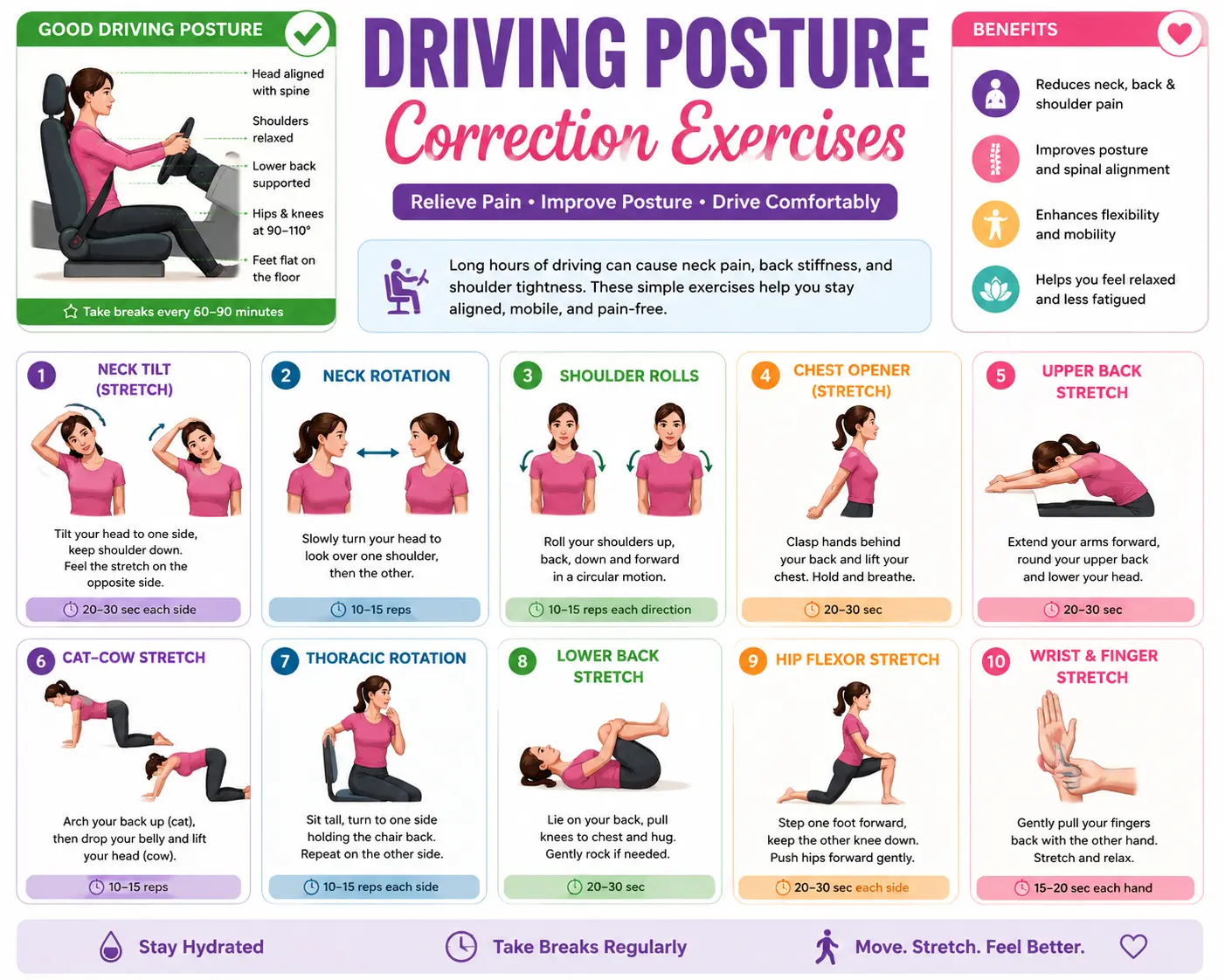
Driving Posture Correction Exercises
Introduction
Spending long hours behind the wheel can place significant stress on your neck, shoulders, upper back, and lower back. Whether you drive to work every day, travel long distances, or work as a professional driver, maintaining the same seated position for extended periods often leads to muscle tightness, poor posture, stiffness, and discomfort. Over time, these issues may contribute to chronic neck pain, lower back pain, shoulder tension, reduced flexibility, and fatigue.
Driving posture correction exercises are simple, physiotherapy-based movements designed to improve spinal alignment, reduce muscle strain, and increase joint mobility. Gentle stretches such as neck tilts, shoulder rolls, chest openers, thoracic rotations, and hip flexor stretches help relax tight muscles while strengthening the muscles that support good posture. Performing these exercises regularly can improve comfort during driving, reduce the risk of musculoskeletal injuries, and make long journeys less tiring.
In addition to exercise, proper driving ergonomics play an important role. Adjust your seat so your knees are slightly bent, keep your back fully supported against the seat, position the steering wheel within comfortable reach, and maintain a relaxed grip on the wheel. Taking a short break every 60–90 minutes to stand, stretch, and walk for a few minutes can also help improve circulation and prevent stiffness.
Adding these driving posture correction exercises to your daily routine requires only a few minutes but can make a noticeable difference in your comfort, posture, and overall spinal health. Whether you’re a daily commuter or a long-distance driver, these exercises are an effective way to stay flexible, reduce pain, and enjoy a healthier driving experience.
Driving Posture Correction Exercises
Doorway Stretch

- The doorway stretch will help loosen up your chest and abdomen, which become extremely tight when you sit.
- How to do it:
- Align your hands and elbows with a doorframe.
- Proceed cautiously through the door until you experience a stretch.
- Before going back to the beginning position, hold this end position for 15 to 20 seconds.
- Do this stretch three times.
Trigger point release for chest muscles
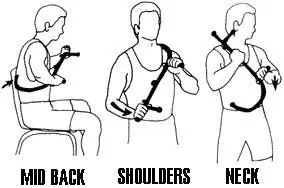
- The pectoralis major and minor (chest muscles), which are typically extremely tense in rounded shoulder posture, will be released as a result.
- How to do it:
- Take hold of the Theracane’s hook and place the knob in the groove directly beneath your collarbone.
- To assist in releasing the trigger point, apply downward pressure to the hook.
- Hold it there for at least 30 seconds once you’ve located a tight location.
- To work the entire muscle, move the hook to provide pressure at various angles.
- Perform on all sides.
Wall Slides

- Try to maintain your buttocks and upper back in contact with the wall while standing with your back to it.
- To prevent an excessive arch in your low back, draw your tummy in nearer the wall.
- Try pressing your forearms against the wall while bending your elbows to a 90-degree angle so that your hands are pointing up (this may be an uncomfortable posture when you first start performing this exercise).
- Slide your arms slowly up the wall and back down.
- Work your way up to three sets of ten repetitions, starting with one set.
Band Pull-Aparts

All of the main back muscles are strengthened by this exercise, including the Rhomboids and Mid Trapezius, which will aid in repositioning the shoulders.
How to Do It:
- Start standing with proper posture.
- Straighten your elbows and extend your arms in front of you while holding a resistance band with both hands; the amount of resistance you use will depend on your own strength level.
- Slowly extend your arms behind your body while keeping your elbows locked. The muscles that are between your shoulder blades should contract or squeeze.
- Go only as far outside as you feel comfortable. While some heat in the muscles is ok, neck or arm pain is not.
- Don’t shrug your shoulders in the direction of your ears.
- Repeat 2×10, then progressively increase to 3×10.
- This should be difficult by the time you reach repetition numbers 8, 9, and 10. If not, up the band’s resistance level.
Thoracic Spine Foam Rolling

This is an excellent method for releasing tension in the upper back.
- Place a foam roller beneath your upper back while lying on your back with your hands behind your head.
- Starting at your mid-back and working your way up to the top of your shoulders, continue to gently roll up and down.
- Roll with your legs while maintaining a tight core.
- Roll gently and slowly; don’t rush.
Easy Ways To Improve Your Driving Posture
Make your car seat do the hard work.
Your automotive setup may be made to work for you rather than against you with a few easy adjustments.
Stretching everything out is a fantastic general rule of thumb. Forget about maintaining a 90-degree angle between your knees and your feet and hips. Your joints are immediately less stressed when you open them up.
Recline your backrest
Yes, you might feel it’s how teenage lads who have just passed their driving test sit when they are trying to look cool, but putting your car seat back helps to loosen up your hips, relax your shoulders, and spread your weight across your back more evenly.
To avoid slouching, make sure your seat supports your lower back and change the height of your chair.
Balance your lumbar support.
Your car seat’s lower back support should have a curvature. This is frequently adjustable so you can make sure your back’s curve is well supported. If there isn’t a lumbar support in your car, consider purchasing one (they are reasonably priced) and fastening it to the appropriate area of your car seat.
By lessening the tension on your discs and joints, a lumbar support helps you feel less tired and in pain. A support keeps your back from sagging and effortlessly maintains its shape.
Straighten your legs
If your seat is too far forward, you risk bending your knees excessively. With your feet extended, place them at a comfortable, low angle on the pedals. Use the footrest to extend your leg even farther if you drive an automatic.
The prevalence of knee osteoarthritis has risen over the past 60 years, and recent research has linked the condition to excessive sitting, weight, and food.
The pressure and wear and tear on your joints might be decreased by simply stretching things out.
The bottom of your seat
Although not all automobiles have the ability to adjust the angle at which your buttocks rest on the seat, if it does, attempt to tilt it so that your knees are at a lower angle. This lessens the strain on your hips and lower back by increasing the angle between your thighs and upper torso.
Adjust the angle of your steering wheel.
Although not everyone is aware that it is possible to modify the steering wheel’s position, it should be inclined slightly downward to help keep your shoulders dropped and relaxed.
However, you might find it difficult to reach the steering wheel in this new, more relaxed posture. You can either adjust your seat forward a few spots or slide the steering wheel out toward you. You want to be near enough to hold the wheel securely without having to bend your elbows too much.
You can avoid raising your shoulders too high by keeping the steering wheel somewhat lower. Because your arms are heavy, raising them higher puts more strain on your upper body. Your shoulders will eventually become fatigued, so you will use your chest and upper back muscles to support them. You are more inclined to adopt a head-forward posture when your upper back and chest muscles become fatigued and tense. Tension, soreness, and wear and tear on the neck and upper back joints might result from this.
Take a break
It’s simple to find an excuse to continue driving instead of taking a break if you drive for a living or just occasionally for extended periods of time, but is it worth it? Our focus typically decreases after 14 minutes. Your focus can be at its peak for 29 minutes, even if you are completely absorbed in what you are doing.6 Even a short pause may refresh your focus and improve your posture.
After a lengthy drive, you should definitely consider making a few additional stops if you feel stiff after getting out of the car. Additionally, remember to always have water with you to stay hydrated. You need water to stay hydrated and for your cells, including your brain, to continue functioning at their best because air conditioning is inherently drying. Another excellent method to stretch your legs and revitalize your body and mind is to take a toilet break during the services.
Is posture damage permanent?
Poor posture is usually not a permanent state. Muscular imbalances, in which certain muscles are overly tense and others are weak, are the main cause of slouching, rounded shoulders, and forward head posture. Soft tissues and muscles are flexible,e and you can actively undo postural deviations through specific stretching, specific strengthening, ng and mindful ergonomic adjustments.
However, very poor alignment, left uncorrected for years, can lead to accelerated spinal degeneration, compressed vertebrae, and irreversible structural deformities. Long-term disc damage can result in a permanent spinal curve, but pain, tension, mobility problems, and associated problems can still be managed and improved.
There are a few key steps to correcting poor posture:
Loosen Up Tight Muscles: Stretch tight, overactive chest and neck muscles to let your shoulders sit in proper alignment.
Strengthen Postural Muscles: To keep your body naturally upright, develop strength and endurance in your shoulders, upper back, and core.
Improve Your Ergonomics: Modify your everyday routine and workspace. Use lumbar support in your chair, make sure your screen is at eye level, and take regular pauses to move and walk.
What problems can bad posture cause?
This will, over time, lead to chronic back, neck, and shoulder pain, tension headaches, and long-term joint degeneration. It can also lead to breathing problems, digestive issues, and chronic fatigue.
Apart from muscle aches and pressure on the spine, chronic slouching causes a series of unexpected health problems throughout your body:
Breathing Difficulties: Slumping compresses the chest cavity and restricts the movement of your diaphragm, resulting in shallow breaths and less total oxygen intake.
Digestive Problems: Slouching puts pressure on your abdominal organs. This can slow digestion, cause constipation, and cause stomach acid to back up, causing heartburn or acid reflux.
Nerve Compression: Forward head posture and rounded shoulders mean putting more pressure on your spine. This can lead to pinched nerves that can cause numbness or tingling in your arms and legs.
Jaw & Circulation Problems: A forward head posture can strain the temporomandibular joint (TMJ) in your jaw. And pinched blood vessels can affect healthy circulation in your limbs.
Bladder Control: Bending over increases intra-abdominal pressure and may strain the bladder more, possibly causing stress incontinence.
Why do people sit so far back when driving?
Many people drive with the seat all the way back for comfort, especially if they are tall. Many drivers just feel more natural hunched over. Some do it for stylistic reasons; others so they don’t have to head-butt the roof in cars with low clearance.
But that makes it less safe to drive like that. When your seat is all the way back, your reaction time to hit the brakes is reduced, and you may be forced to overextend your arms to steer your vehicle. Also, sitting too far back can make you “submarine” ( go under the seatbelt in a crash ), and the steering wheel airbag will not deploy properly if you’re not at the proper distance.
Can lifting weights improve posture?
Yes. Weight training is great for posture because it develops the muscles that support your spine and pelvis, particularly your core, upper back, and shoulders. But the benefit is dependent on proper form and a balanced routine. Neglecting certain areas can actually cause tightness and worsen postural issues.
To make sure weightlifting enhances your posture and doesn’t cause harm, adhere to these essential guidelines:
Focus on the Upper Back: Weak muscles in the upper back cause slumping and rounded shoulders. Incorporate exercises like Low Rows and Reverse Flys to pull your shoulders down and back.
Strengthen Your Core: Your abdominal and lower back muscles are a natural brace. Exercises like Plank Holds and Dead Bugs work to stabilize your spine and fix issues such as anterior pelvic tilt.
Don’t Forget Your Muscles: Chest presses can tighten your chest muscles and pull your shoulders forward if you do too many. Make sure to balance your pushing exercises with a lot of pulling exercises and stretch your abdominal muscles often.
Proper Form When Lifting: Lifting weights that are too heavy can lead to a loss of form and put a strain on your back. Maintain a neutral spine throughout at all times (not overly arched) and be mindful of your posture in every exercise.
Can you reverse years of bad posture?
Yes, you can totally fix years of bad posture. The trick is getting into a routine of stretching tight muscles, strengthening your core and upper back,k and changing your daily habits to prevent relapse.
A long-term postural problem: targeted approach
1. Loosen up tight muscles
Years of slouching and hunching over desks shorten and tighten chest and shoulder muscles.
Chest Openers: rs Interlace your hands behind your back, straighten the arms, draw the shoulder blades together, and lift the chest. Hold for 10 to 15 seconds several times a day.
2. Build Postural Muscles
Scapula Squeezes: Sit or stand, squeeze shoulder blades together as if trying to hold a pencil between them, hold for five seconds, relax.
Core Exercises: Modified planks and abdominal tightening exercises build core stability to support a straight spine.
3. Change Your Daily Routine
How you sit and move throughout the day is just as important as targeted exercises.
Ergonomic Adjustments: When sitting down, place a lumbar support pillow in the natural curve of your lower back, and position your computer monitor at eye level to avoid a forward head slump.
Frequent Movement: Set a timer to stand up, stretch, and reset your posture every 30 minutes.
FAQs
How can I fix my posture while driving?
To reduce fatigue, improve reaction time, and lower your risk of injury during abrupt stops, adjust your seat height, pedal distance, and backrest angle. During long journeys, neck and back pain can be prevented with proper hand placement, lumbar support, and frequent pauses.
What is the best sleeping position for posture?
For optimal spinal alignment, sleeping on your back is frequently regarded as the best position. How to Make It Better: To keep your head aligned with your spine, place a supportive pillow beneath it.
Can bad posture cause neurological problems?
Long-term nerve injury or neuropathy can result from prolonged slouching or forward head posture, which compresses the spinal cord and surrounding nerves. Tingling, numbness, or even limb muscle weakening are possible symptoms of this injury.
How to stop slouching while driving?
Using a tiny rolled-up towel in the curve of your lower back is the easiest solution if you don’t have lumbar support built in. You can roll the towel more or less to produce different curve sizes until you discover the one that works best for you.
Can posture affect the vagus nerve?
Yes, posture directly affects the vagus nerve. Slouching or a forward-head posture can physically compress nerve pathways in your neck and limit your diaphragm, activating your sympathetic “fight or flight” response instead of the vagus nerve’s calming “rest and digest” state.
There are two different connections between your posture and the vagus nerve:
Mechanical Compression: The vagus nerve leaves the brainstem and ascends through the upper cervical spine in the neck. Nerve signals carry communication between your brain and your major organs. When your head is constantly forward,d or your spine is misaligned, those nerves can be stretched, pinched, or physically irritated, interfering with the communication between your brain and your major organs.
The Posture-Breath Loop: op When you slump, your chest collapses and restricts the diaphragm, forcing you to breathe shallowly with your upper chest. This pattern of fast breathing tells your body you are stressed, actively suppressing vagal tone.
References
- Betterhood. (2026, May 13). Best posture correction exercises to improve your posture and spinal health. Betterhood. https://betterhood.in/learn/best-posture-correction-exercises/
- Clinic, C. (2024, April 5). 8 Posture exercises to sit and stand straighter. Cleveland Clinic. https://health.clevelandclinic.org/posture-exercises
- Cronkleton, E. (2026, April 1). 12 exercises to improve your posture. Healthline. https://www.healthline.com/health/posture-exercises
- Mansueto, R. (2026, March 4). Posture correction exercises you can do at home (Desk + driving) – Vital Connection Chiropractic. Vital Connection Chiropractic. https://vcchiro.com/blog/posture-correction-exercises-you-can-do/
- McQuilkie, S., DC, & McQuilkie, S., DC. (2024, November 21). How to fix rounded shoulders posture – 5 Effective exercises. Back Intelligence (Creators of PostureFlow App). https://backintelligence.com/how-to-fix-rounded-shoulders-with-exercises/
- Physio Multiservices. (2026, May 17). 8 exercises to improve posture. https://physiomultiservices.com/en/8-exercises-to-improve-posture/
- Vibhanshu-Axeno. (2026, February 10). Importance of driving in a convenient posture and post-driving exercises – MG Motor. MG Motor India. https://www.mgmotor.co.in/blogs/importance-of-driving-in-a-convenient-posture-and-post-driving-exercises