
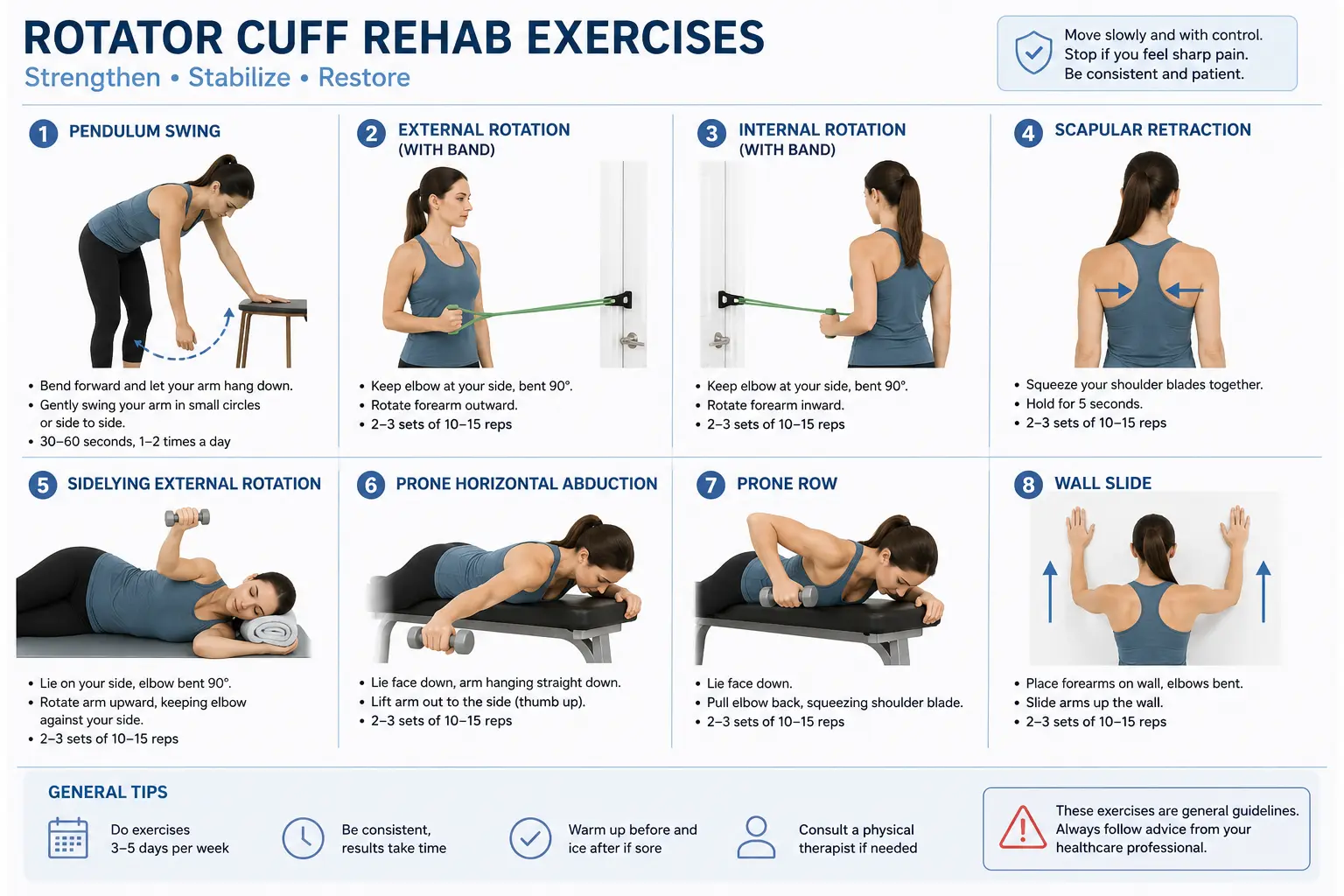
Rotator Cuff Rehab Exercises
Introduction
The rotator cuff is a group of four muscles and their tendons that surround the shoulder joint, helping to stabilize the shoulder and control arm movements. Sports activities, repetitive overhead motions, age, bad posture, and unexpected trauma can all cause rotator cuff injuries. Common symptoms include shoulder pain, weakness, stiffness, reduced range of motion, and difficulty performing daily tasks such as lifting, reaching, or carrying objects.
Exercises for rotator cuff rehabilitation are essential for healing from shoulder injuries and avoiding further issues. These exercises have the goal of lessening discomfort, increasing muscular strength, improving joint stability, and eventually restoring shoulder mobility. A well-designed rehabilitation program enables patients to safely resume their regular activities, jobs, and sports after regaining normal shoulder function.
To retain flexibility and lessen stiffness, the rehabilitation procedure usually starts with mild range-of-motion exercises. To increase flexibility and ease tense muscles, stretching exercises may also be used. To get the greatest outcomes and prevent more injuries, consistency and good technique are crucial.
Rotator cuff rehab exercises can benefit individuals recovering from tendonitis, impingement syndrome, partial tears, post-surgical repair, or general shoulder weakness. However, especially in the initial phases of recuperation, it is crucial to carry out these exercises under the supervision of a physiotherapist or other medical expert.
Most people may greatly increase shoulder strength, mobility, and function with perseverance, commitment, and a systematic rehabilitation program. Frequent exercise promotes healing as well as long-term shoulder health, lowering the chance of reinjury and enhancing general quality of life. A successful and crucial part of managing and recovering from shoulder injuries is rotator cuff therapy.
What is the Rotator Cuff?
One rotator cuff surrounds each of your shoulders. It joins the scapula, or shoulder blade, to the humerus, or upper arm bone. Raising your arm overhead and rotating it toward and away from your body are both accomplished with the help of your rotator cuff.
Rotator cuff injuries are common, especially among athletes. If you have arm weakness, shoulder pain, or are unable to move your shoulder painlessly, see a doctor.
Function
What does the rotator cuff do?
The rotator cuff stabilizes your upper arm and shoulder as you move and use them. It aids in shoulder rotation and turning, as you can obviously infer from its name.
Your shoulder joint is surrounded by the tendons and muscles of your rotator cuff, which hold the bones together. The joint in your shoulder is a ball and socket. Your humerus’s ball-shaped head fits into a socket in your scapula like a golf ball sitting on a tee.
Anatomy
Where is the rotator cuff?
The tiny gap between your humerus and the upper portion of your shoulder blade is where the rotator cuff is located. It covers both your shoulder and the top of your humerus.
What is the rotator cuff anatomy?
Four shoulder muscles make up the rotator cuff:
- Your arm may be raised and rotated thanks to the supraspinatus. It reaches from the top of your scapula to the upper end of your humerus, or its head.
- You can hold your arm extended and distant from your body thanks to the subscapularis. It extends from the base of your scapula and joins to your humerus behind the supraspinatus.
- The infraspinatus facilitates arm rotation.
- The teres minor also makes it easier to turn and rotate the arms. It attaches to your humerus between the outer edge of your scapula and the infraspinatus.
- Tendons connect your rotator cuff muscles to the surrounding bones. Tendons operate as levers to move your bones as your muscles contract and expand. When you contract (squeeze) the muscles in your rotator cuff, tendons pull the connected bones to move your shoulder and upper arm.
Conditions and Disorders
What are common rotator cuff injuries?
Rotator cuff injuries are common because you utilize your rotator cuff for so many tasks throughout the day. Injuries can happen quickly or build up over time.
The following are the most typical rotator cuff injuries:
- Overuse syndrome.
- Shoulder impingement syndrome (rotator cuff tendinitis).
- Rotator cuff tears.
- Shoulder sprains.
- Swimmer’s shoulder.
Tears in the rotator cuff cause shoulder pain. The pain could be severe and piercing, or it could be a dull ache deep in your shoulder. Sudden tears from injuries cause immediate, severe shoulder discomfort and arm weakness.
If your shoulder pain doesn’t go away after a few days, see a doctor.
What is a rotator cuff injury?
Four muscles make up the rotator cuff, which stabilizes and permits movement of the shoulder. Visualize the shoulder blade as a golf tee and the head of the arm bone as a golf ball.
Impingement: Impingement happens when the rotator cuff tendon is compressed in the small gap between the humerus, the upper arm bone, and the acromion, the front of the shoulder blade. Pain and edema may result from the tendon being compressed.
Tear: When a rotator cuff tendon or muscle is damaged, a less frequent injury known as a rotator cuff tear (sometimes called a strain) results. Surgery won’t be necessary for most tears.
The rotator cuff muscles are frequently injured because repetitive overhead motions can weaken them. This explains why shoulder problems are common among athletes like baseball pitchers.
Injuries might also result from severe events like falling on your arm. Regardless of how it occurs, as we age and acquire body wear, the likelihood of a rotator cuff tear rises.
Can the rotator cuff be fixed with exercise?
Once the swelling has subsided and moving your arm no longer aches, some exercises can help you heal and prevent issues like a “frozen shoulder” or loss of range of motion. These exercises include:
If you feel comfortable adding weight to these exercises, try performing reps with a light dumbbell or resistance band. If you don’t have a light dumbbell, try using a can of soup.
Rotator Cuff Rehab Exercises
Doorway stretch

To warm up your muscles, stand in an open doorway and extend your arms to the side.
Holding onto its sides with each hand at or below shoulder height, bend forward into the doorway until you feel a mild strain. Don’t strain too much.
Hold each repetition for 15 to 30 seconds three times a day.
Side-lying external rotation
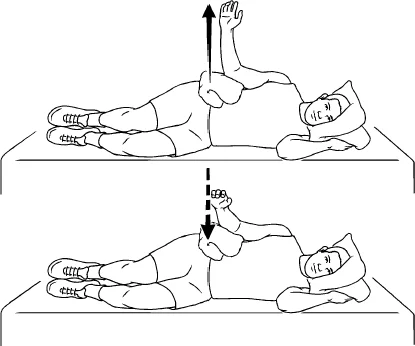
On the side opposite your damaged arm, lie down.
You should place your forearm over your abdomen.
With your elbow pressed to your side, slowly elevate a light dumbbell toward the ceiling while holding it in the palm of the afflicted side.
After a few seconds of holding the dumbbell, return your arm to its initial position.
Repeat three sets of ten once a day. Increase the number of repetitions to fifteen once a set of ten becomes easy.
High to low rows
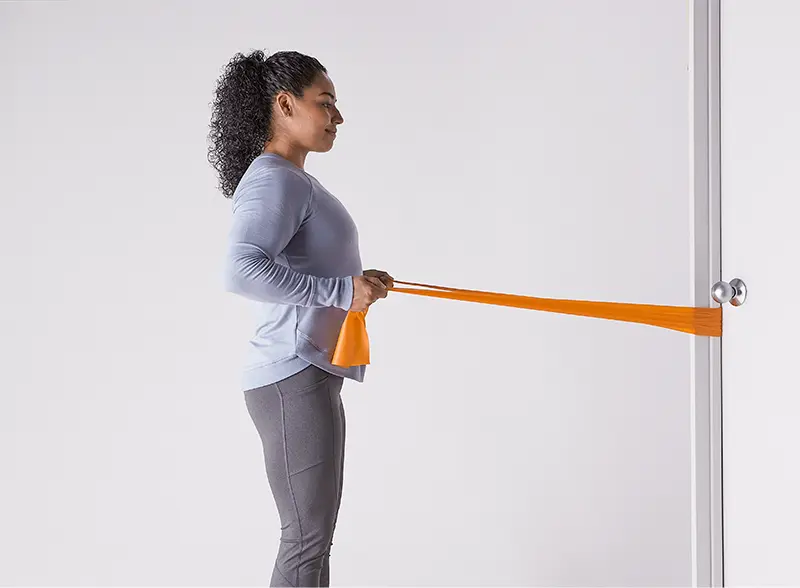
A resistance band should be fastened to a rigid object that is at least shoulder height. To prevent it from coming free when you tug on it, make sure it is secure.
Drop to one knee and elevate the knee across from the damaged arm. Put your other hand on your raised knee.
Maintain a straight back while pulling, and bring your shoulder blades together and down. You shouldn’t shift your body or twist your arm.
Return to the starting point and perform three sets of ten.
Reverse fly

As you stand, bend your knees slightly and set your feet shoulder-width apart. Keep your back straight while bending forward a little at the waist.
Holding a small amount of weight in each hand, extend your arms and raise them away from your body. Don’t lock your elbow. Don’t raise your arms above your shoulders.
Return to the starting point and perform three sets of ten.
Lawnmower pull
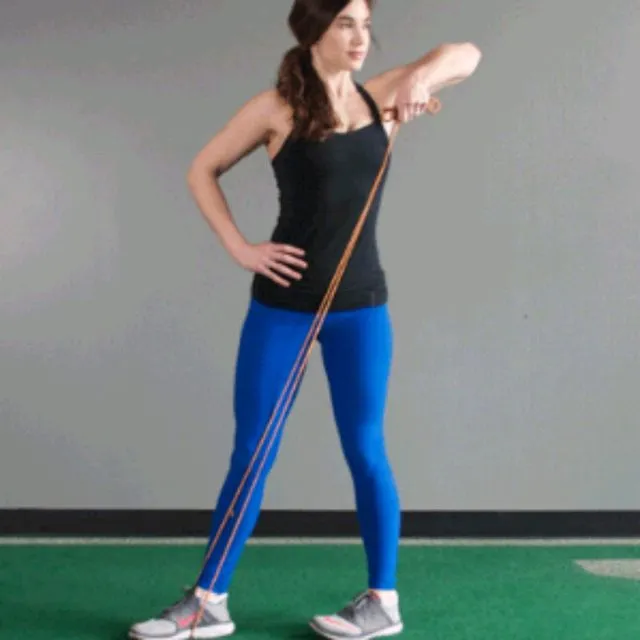
Place your feet shoulder-width apart as you stand. Put one end of a resistance band under the foot opposite the affected arm. Hold the other end of the band with the injured arm to ensure it crosses your body diagonally.
Keeping your other hand on your hip and avoiding locking your knees, bend slightly at the waist so that the hand holding the band is parallel to the opposing knee.
Straighten up like you’re starting a lawnmower in slow motion by pulling your elbow across your body to your outside ribs. Press your shoulder blades together while maintaining a loose posture.
Repeat three sets of ten.
Are there any safer workouts for injuries to the rotator cuff?
You can perform extra activities to hasten healing and lessen further harm. Among them are:
- Trapezius and rhomboid self‐myofascial release (SMR)
- Posterior shoulder tennis ball SMR
- Pectoralis major and minor SMR with a tennis ball
- Cross-body stretch
Why is rotator cuff recovery so long?
Rotator cuff injuries take months to heal, usually 6 to 12 months for full recovery, because tendons have poor blood circulation and the highly mobile shoulder joint is difficult to immobilize completely, leaving it susceptible to micro-strains during daily activities.
The main reasons for slower healing are:
Limited Blood Supply: Rotator cuff tendons are naturally poorly vascularized (especially the supraspinatus). Without a good blood flow, oxygen, and healing nutrients, tissue repair is very slow.
Constant Use: The shoulder is involved in nearly every upper-body movement, so the injured area is under constant stress. It’s almost impossible to put the joint on “bed rest,t” and this increases the risk of re-injury to the healing tissue.
Collagen Remodeling Slow: Tough collagen fibers make up tendon tissue. When they tear the body has to fill the space with scar tissue, which is weaker than the original tendon. This new tissue requires a minimum of 3 months to mature and strengthen to full load-bearing capacity. Structural remodeling may continue for up to 6 months.
Age and General Health: Naturally, blood flow to tendons declines with age. Systemic health problems such as diabetes, poor nutrition, smoking, or chronic stress can also have a very negative impact on microcirculation and collagen production.
The extent and magnitude of the harm are crucial. Minor tears may heal on their own in a few months, but large, full-thickness tears will require surgery and a longer rehabilitation period.
Can I train my rotator cuff every day?
Can I train my rotator cuff every day?
Heavy rotator cuff strengthening should not normally be done daily. But the frequency depends on what type of exercise you are doing.
1. Daily (Stretch & Range of Motion)
Every day, you can (and should) perform mild stretches such as doorway stretches, cross-body reaches, and pendulum swings. These help maintain flexibility and blood flow.
2. Every Other Day (Low-Weight Strengthening)
If you’re doing light strengthening (using a 1 to 3 pound weight or light external rotations with a resistance band, for example), 3 to 4 times a week or every other day is ideal. This allows the small stabilizing muscles of the rotator cuff to recover without the risk of overtraining or impingement.
3. 2-3 times a week (Heavy strength training)
When using heavy resistance bands or lifting heavier weights, strength training should be done 2 to 3 days per week.
Key Tips for Success:
Follow a plan: For a guided routine, refer to the physical therapy protocol recommended by the American Academy of Orthopaedic Surgeons.
Receive professional advice: Always follow the specific timeline provided by your local physical therapist or doctor before starting or progressing your exercise frequency if you are currently recovering from an injury or surgery.
How to lubricate joints naturally?
How to lubricate joints naturally?
How to Lubricate Your Joints Naturally:y Focus on regular low-impact movement, staying properly hydrated, and eating an anti-inflammatory diet. These habits encourage the production of synovial fluid (your body’s natural joint lubricant) and reduce the friction that leads to stiffness and pain.
1. Move frequently
Low-Impact Exercise: Swimming, cycling, yoga, and walking are all activities to increase circulation and synovial fluid production, without adding too much stress to the joints.
Strength training: Increasing the strength of the muscles surrounding your joints acts as a natural “shock absorber,” supporting the joint and reducing deterioration.
Dynamic Warm-ups: Always warm up for five minutes before vigorous activity (e.g., marching in place or arm circles) instead of static stretching.
2. Mind hydration and nutrition
Stay Hydrated – Synovial fluid is mostly water; drinking lots of water ensures that the fluid is of the right consistency to properly cushion your joints.
Omega-3 Fatty Acids: Healthy fats such as those found in salmon, sardines, walnuts, chia seeds, and avocados may help reduce inflammation and improve the composition of your joint fluid.
Extra Virgin Olive Oil: Including olive oil in your diet can help prevent joint degeneration because it contains biologically active chemicals like oleocanthal.
Protein: Make sure you’re getting enough protein to help maintain and repair the cartilage, ligaments, and tendons around your joints.
3. Keep a Healthy Weight
Extra weight causes a lot of mechanical stress on weight-bearing joints like knees and hips. A healthy body weight helps prevent the rapid wearing out of cartilage and takes the pressure off your joints.
4. Organic Supplements
Many people find relief with specific, doctor-approved supplements that support joint health and lubrication if diet doesn’t work. Typical choices include:
Glucosamine & Chondroitin
Turmeric (Curcuma longa)
Fish oil (rich in Omega-3s)
Which tests do providers use to diagnose injuries?
A physical examination and certain imaging tests will be used by a medical professional to diagnose a rotator cuff injury. They will check your shoulder and inquire about any problems you might be experiencing. Tell them when you first became aware of your discomfort and whether any activities help or worsen your symptoms.
A few tests may be necessary, such as:
- Shoulder X-ray.
- Magnetic resonance imaging (MRI).
- Ultrasound.
What are common treatments for rotator cuff injuries?
The type and severity of your injury will determine the therapies you require. Your doctor will recommend the following therapies to assist your rotator cuff repair and reduce pain:
- Take a break and refrain from the action that caused the injury.
- Put some ice on your shoulder. How often and for how long you should ice your shoulder will be determined by your healthcare provider. Wrap the ice packs in a small towel to avoid putting them directly on your skin.
- Acetaminophen and over-the-counter NSAIDs (nonsteroidal anti-inflammatory medications) both reduce inflammation and ease pain. Avoid taking painkillers for longer than ten days in a row without first consulting your doctor.
- Particularly following an injury, physical therapy can help you restore your mobility and strengthen your shoulder muscles.
- Injections of corticosteroids, which are prescription anti-inflammatory drugs, may be administered to your rotator cuff by your physician.
- If various nonsurgical therapies fail to improve your symptoms after a few months, you may require surgery to correct major problems.
FAQs
What’s the best sleeping position for rotator cuff pain?
You can even elevate your injured shoulder in this position with a folded towel or pillow below to lessen swelling and inflammation.
How much time does it take to make a rotator cuff stronger?
Strains or tendonitis are usually minor and can be helped by 4-6 weeks of consistent, targeted physical therapy to strengthen the rotator cuff. Significant tears, however, or post-surgical rehab can take 3 to 6 months to rebuild muscle strength and 12 to 18 months for full recovery.
Phases, exercises & warning signs for a stronger rotator cuff
Normal Timeline
Minor strain/tendonitis: 4–6 weeks of daily to tri-weekly exercises to reduce pain and restore full function.
Significant tear (non-surgical): 3-6 months to get significantly stronger.
Rehabilitation Procedure
Physical therapy and strengthening typically follow a structured progression:
Pain Control & Range of Motion: The first step is to avoid lifting heavy. Initially, gentle, pain-free stretches and passive range-of-motion exercises (pendulum swings or wall-walking, for example) are used.
Isometrics (Static Contractions): Pushing your arm against a wall without moving the joint.
Resistive strengthening: External and internal rotation with resistance using light bands or small dumbbells.
Maintenance: A lifelong maintenance program of 2-3 times a week will prevent re-injury.
What is the new treatment for rotator cuffs?
The InSpace balloon implant is one fairly new treatment for irreversible rotator cuff injuries. For older persons who might not be able to tolerate more invasive surgeries, this method is particularly beneficial. It can lessen symptoms and enhance function throughout rehabilitation, according to studies.
Which vitamin is best for shoulder pain?
Depending on the underlying cause, vitamins C and D are usually the most effective in relieving shoulder pain. Omega-3 fatty acids and B-complex vitamins also promote neurological health and lessen joint pain.
What can be mistaken for rotator cuff pain?
The shoulder joint is a complicated joint, and other conditions can imitate rotator cuff pain. Common look-alikes are shoulder impingement syndrome, frozen shoulder (adhesive capsulitis), biceps tendinitis, and shoulder arthritis. Many conditions exhibit similar symptoms, but there are important differences that can help distinguish them:
Strength is generally preserved, but overhead motion hurts, unlike a full rotator cuff tear.
Frozen Shoulder (Adhesive Capsulitis): Causes stiffness and a severe, global loss of range of motion in all directions. Often, the arm is difficult to move at all.
Injuries to the rotator cuff usually restrict active movement but permit passive movement (e.g., someone else can lift your arm for you).
Biceps tendinitis: The pain may radiate down the biceps from the front of the shoulder. It is often associated with rotator cuff problems.
Arthritis: Deep, excruciating joint pain is typically the result of shoulder arthritis. In contrast to rotator cuff injuries, arthritis is more likely to induce morning stiffness and can limit both passive and active movement.
Cervical Radiculopathy (Pinched Nerve): When a nerve in the neck is squeezed, it can cause radiating, acute pain that travels down the arm and mimics shoulder pain.
Should a 70-year-old have rotator cuff surgery?
Patients 65 years of age and older have been proven to benefit from open rotator cuff repair, which was the gold standard for treating symptomatic, full-thickness rotator cuff tears before the advent of arthroscopy.
References
- American Academy of Orthopaedic Surgeons. (n.d.). Rotator cuff and shoulder conditioning program. https://orthoinfo.aaos.org/globalassets/pdfs/2017-rehab_shoulder.pdf
- Barta, K. (2024, February 13). Rotator Cuff exercises to help heal or strengthen. Healthline. https://www.healthline.com/health/rotator-cuff-injury-stretches
- Comella, T. (2023, December 13). Rotator cuff exercises. E3 Rehab. https://e3rehab.com/rotator-cuff-exercises/
- Professional, C. C. M. (2026, April 27). Rotator Cuff. Cleveland Clinic. https://my.clevelandclinic.org/health/body/rotator-cuff
- Rotator cuff and shoulder conditioning program – OrthoInfo – AAOS. (n.d.). https://orthoinfo.aaos.org/en/recovery/rotator-cuff-and-shoulder-conditioning-program/
- Shoulder exercises for rotator cuff tear :: Shoulder exercises for rotator cuff tear :: Kingston and Richmond NHS Foundation Trust. (n.d.). Kingston and Richmond NHS Foundation Trust. https://www.kingstonandrichmond.nhs.uk/patients-and-families/patient-leaflets/shoulder-exercises-rotator-cuff-tear


