Jumping Lunge Exercise
Introduction
Jumping Lunge Exercise is a powerful plyometric move that boosts lower-body strength, balance, and explosive power. It elevates your heart rate quickly, making it excellent for building endurance and burning calories while targeting the glutes, quads, hamstrings, and core.
Targets: core and lower body
Level: Advanced
By adding a jump, the jump lunge is a more difficult variation of the basic walking lunge exercise. Jumping high into the air and switching your forward foot before landing is the plyometric transition. You can use the jump lunge exercise to increase your heart rate during basic floor work or exercise, or you can incorporate it into your high-intensity interval training method. You can perform this exercise anywhere and at any time since it doesn’t require any equipment.
A high-intensity plyometric exercise that includes cardiovascular and strength training is the jumping lunge. In order to switch legs in midair, this dynamic move includes alternating lunges while jumping with great force. It improves balance and coordination while working the glutes, quadriceps, hamstrings, calves, and core, among other muscle groups. Jumping lunges are a difficult but useful addition to any program of exercise because they are a more difficult version of standard lunges. They are especially helpful for increasing athletic performance, strengthening the lower body, and burning calories.
The lower body can be strengthened and made more mobile with jumping lunges. They provide an excellent cardio workout in addition to assisting in the development of leg strength and stability.
It’s essential to understand how to perform this exercise correctly if you want to get the most out of it. To help you get the most out of this exercise and maximize its benefits, we’ll explain how to perform jumping lunges correctly in this article.
Lean legs are the aim of many athletes and gym clients. Although many lower-body workouts include classic exercises like squats and deadlifts, you can also incorporate other leg exercises that target the leg muscles into your training program.
The Secret Weapon for Stronger Legs and Better Speed
Have you ever tried to run up the stairs because the lift is broken or chased after your bus in traffic?
Do you notice the burning sensation in your thighs?
Your body is telling your legs to strengthen. Jump Lunges can be beneficial! The jump lunge’s fundamental motion increases your speed and balance while strengthening your lower body.
Jump lunges should be a part of your everyday routine if you’re a fitness trainer or a beginner athlete because they will strengthen your body to perform daily tasks more effectively.
What Are Jump Lunges?
A dynamic variation of standard lunge exercise motions is offered by jump lunges. Leaping and switching between legs while in flight are both part of the exercise.
An all-around workout is produced by the explosive plyometric exercise, which simultaneously tests your cardiovascular system and muscles.
Jumping lunges, sometimes referred to as plyometric lunges or plyo lunges, are well-known bodyweight exercises that improve lower-body strength. It consists of repeatedly stretching and contracting the muscles. Because it involves jumping, it enhances cardiovascular health and balance. Additionally, it increases bone density and encourages physical activity. This unilateral exercise improves body mechanics and leg strength. Jumping lunges are easier than Burpees and raise heart rate.
Remember that in order to gain short but explosive movements, try performing side lunges or walking lunges before jumping lunges.
What Muscles Do Jumping Lunges Work?
Jumping lunges are a type of exercise that works every part of the lower body. All of the main lower body muscles, including the quadriceps, glutes, hamstrings, calves, and hip flexors, are engaged during the jumping motion.
When performing jumping lunges between takeoffs and landings, the core muscles contract to keep the body in a stable position.
How to Do the Jump Lunge?
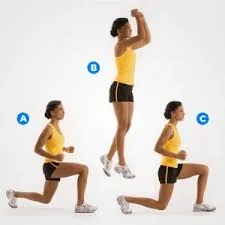
With one leg forward and one leg back, assume the ready position. Using alternating arms to legs, hold your arms in a ready position with the elbows bent at a 90-degree angle, one arm in front of your body and the other back. Put your right leg in front, for example, if your left leg is leading.
- Bend your knees and descend into a deep lunge to get ready to jump. Contract your core muscles while bending slightly forward.
- Throughout the exercise, your core muscles will remain engaged.
- Sink your weight quickly, then drive both feet hard into the ground to push your body upward while fully extending your hips and knees.
- Quickly bring your feet together as you raise yourself into the air, then change positions as you start to land. As you do this, you should also switch arms.
- Keep your feet in a balanced position as you land.
- Your forward knee should not be higher than your forward foot. Try to land gently on the forward midfoot, allowing your heel to touch the floor.
- Don’t stay on the forward foot’s toes. To absorb the landing, keep your hips back and let your knees and hips bend deeply. Avoid locking your knees.
- As you get ready to begin the next jump lunge, drop into a deep lunge position.
- Start with a few repetitions and work your way up to 60 seconds.
Common Mistakes of the Jumping Lunge
To get the most out of this exercise without strain or injury, keep clear of these mistakes.
Lack of Warmup
The jump lunge is an advanced plyometric exercise, so you shouldn’t do it until you’ve finished a complete warm-up or some basic movement preparation, like a glute activation exercise or a quick core workout. This move demands a slower progression from mild jumps to higher jumps, even after a thorough warm-up. For the first few transitions, go slowly.
Knee Too Far Forward
Avoid putting too much strain on your knee by not letting your forward knee extend past your foot. Practice landing with your knees in the proper position.
Locking Knees
Your knees and hips are less able to absorb the force of the landing if you lock your knees, which puts excessive stress on them.
Staying on Your Toes
As you start and finish each lunge, make sure your forward heel remains in contact with the ground. If you lose your footing or balance, stop and start over more slowly.
Tips for doing jumping lunges
- To prevent injuries, always perform warm-up exercises or brief core exercises.
- Start slowly and work your way up to a faster pace.
- Take a break in between each jump.
- Avoid extending your forward knee past your foot, as this will exacerbate your knee pain.
- Avoid locking your knees, as this could cause issues when you land.
- Make sure you have a good footing on the ground at all times. You will hurt yourself if you land on your toes.
- Always start with very small jumps.
- After the exercise, stretch your muscles and relax.
Modifications and Variations
By altering the speed at which you carry out the transitions, the depth of each lunge, and the height of each jump, you can make this exercise much more difficult or slightly easier and less unexpected.
Need a Modification?
It’s necessary to become confident in the standing lunge technique before taking off. Before connecting the lunges, it’s beneficial to practice this exercise one small jump at a time to develop the proper balance and control once you can execute a basic lunge. Pay attention to landing with control and in the right position on the forward foot.
Return to the fundamentals and repeat the walking lunge exercise until you gain control and strength in your lower body. If this is still too challenging.
Before attempting an alternating jump lunge landing, it’s also beneficial to learn how to perform a basic tuck jump landing. You can learn how to land gently and smoothly by practicing the basic tuck jump. Additionally, it supports proper hip, knee, and ankle mechanics. It will be much simpler to land the jump lunge once you have good hip mobility and control. However, always start with small jumps, maintain proper body mechanics and landing position, and then add more forceful and explosive jump lunges.
Up for a Challenge?
You can start increasing the difficulty of the jump lunge once you can perform it with flawless form. One thing at a time, make a change. It will be more of a high-intensity cardio exercise since you can complete the transitions more quickly. For a more difficult plyometric exercise, jump higher. Alternatively, lower yourself with each lunge.
Doing jump lunges with dumbbells is an additional challenge.
Alternating jumping lunges
Jumping lunges with dumbbells
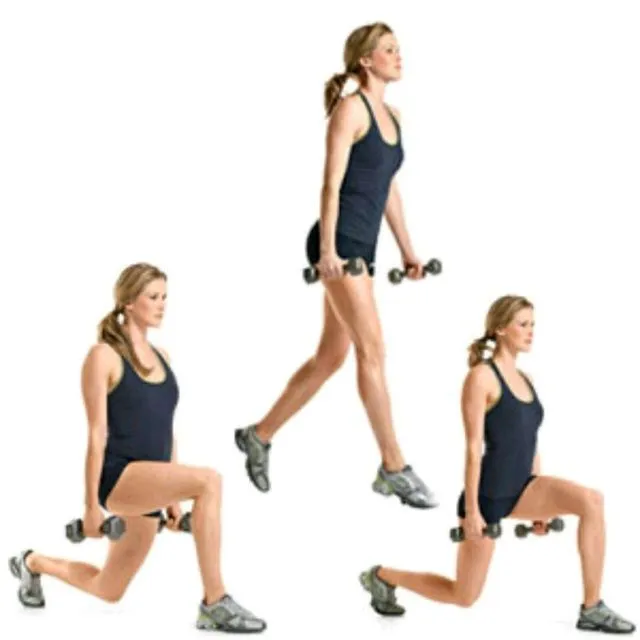
You can attempt holding dumbbells in each hand once you are comfortable landing safely on the ground and have finished the jumping lunge exercise. This makes things more challenging for your legs. You start with a small amount of weight and increase it based on how comfortable you are.
Try these alternatives if you are unable to perform jumping lunges with awareness, body balance, or a high degree of confidence.
Listed below are five alternating jumping lunges:
Jumping Bulgarian Split Squat: This is the same as jumping lunges. To support your back leg, you can use a box, a support stand, or other equipment. It will improve your stability and provide you with balance.
Power March/Skipping: This is the fundamental explosive skill needed to perform jumping lunges. This exercise gives the hip strength, power, and leg drive.
Speed Split Squat: The position looks similar to jumping lunges. You won’t get off the ground here. There isn’t a jump. You can repeat as quickly as you can without pausing or taking a break.
Jump Squat: You can improve your body’s strength and control with this bilateral plyometric exercise. It gets you ready for exercises like jumping lunges.
Assisted Jumping Lunge: It has the jumping lunge setup and supportive equipment, such as straps or a band, to help you maintain your balance. When you are falling, you can keep your equilibrium. For those who have been injured, the exercise is beneficial.
Benefits of Jumping Lunges
This is a great cardiovascular workout that also challenges dynamic stability and coordination while strengthening and enhancing lower-body power and strength. When done properly, you will work the calves, hip flexors, hamstrings, quadriceps, and glutes. Additionally, you will work the muscles used for rotational movements, hip and core stability, and even ankle stability.
When you load your foot, ankles, knees, and hips with your body weight during each push-off phase and then fast drive upward during the transition to the next lunge, you generate power. During each movement’s landing phase, the jump lunge tests an athlete’s proprioception, balance, and coordination. You can improve your power and coordination in sports like tennis, basketball, volleyball, and sprinting.
- You can do it at a comfortable location during your free time. There is no equipment needed for these at-home workouts.
- The lower body is strengthened by it.
- It makes your muscles more flexible and is highly practical.
- Additionally, it reduces mental tension.
- Leg power is increased by this unilateral leg movement.
- Jumping lunges put additional strain on the muscles and joints.
- It improves the muscles, joints, and connective tissues of the lower body.
- It speeds up the body’s metabolism.
- It strengthens the hamstrings, glutes, and quadriceps.
- It strengthens your core, allowing you to move more quickly.
- Your body and mind can be stabilized by shifting the position of your legs in midair.
- It clears your body and mind of all tension.
- There is double strength in the ankles, knees, and hips.
- The main muscles in your body are strengthened by doing lunges as part of a regular workout.
Strengthens Lower Body Muscles
- The quadriceps, hamstrings, glutes, and calves are the main muscle fibers used in jump lunges. Jump lunges will increase your muscular strength and endurance while utilizing your explosive potential.
- You will gain muscle, tone, and strength with continued practice, which could help you get off the couch or participate in a sport or other competition.
Enhances Cardiovascular Fitness
- Your heart rate will slightly rise during jump lunges, giving you strength and conditioning.
- Cardio has many advantages for heart health, and combining cardio and strength training into one workout can help you burn calories.
Improves Balance and Coordination
- A jump lunge clearly requires balance and coordination because the legs switch places in the air.
- When you switch legs during a jump, using your core will help you stay balanced and give your limbs more overall control, which will improve your overall balance and lower your chance of falling.
Increases Explosive Power
- Fast-twitch muscle fibers can be effectively trained with this plyometric exercise.
- Sprinting, jumping, and other explosive movements require the development of fast-twitch muscle fibers, which you must train!
Aids in Weight Management
- Jump lunges effectively burn calories by meeting cardiac and strength requirements. Including jump lunges in your workout regimen aids in weight loss and the development of a balanced body.
Add Jumping Lunges To Your Workout
A high-intensity plyometric exercise that includes cardiovascular and strength training is the jumping lunge. In order to switch legs in midair, this dynamic move includes alternating lunges while running with great force. It improves balance and coordination while working the glutes, quadriceps, hamstrings, calves, and core, among other muscle groups. Jumping lunges are a difficult but useful addition to any program of exercise because they are a more difficult version of standard lunges. They are especially helpful for increasing athletic performance, strengthening the lower body, and burning calories. Continue reading to learn more about the numerous advantages of jumping lunges.
1. Enhances cardiovascular fitness
Plyometric exercises like jumping lunges raise your heart rate rapidly, giving you a cardio boost and helping you gain muscle at the same time. They are perfect for enhancing heart health, endurance, and general stamina because of this combination, particularly in high-intensity interval training (HIIT).
2. Builds explosive power
Your fast-twitch muscle fibers, which produce power, are trained by the forceful jumping motion. Athletes and anyone else trying to increase their speed, agility, and vertical leap performance will particularly benefit from this.
3. Strengthens the lower body
The quadriceps, hamstrings, glutes, and calves are the main muscles worked during jumping lunges. You can enhance your overall lower-body strength and definition by strengthening and toning your legs by repeatedly loading and unloading these muscles during the jump.
4. Improves core stability
The primary muscles used in jumping lunges are the quadriceps, hamstrings, glutes, and calves. By repeatedly loading and unloading your legs during the jump, you can improve your overall lower-body strength and definition.
5. Burns high calories
Jumping lunges are a high-intensity, compound exercise that burns more calories than individual strength training. They are great for burning fat and boosting metabolism because they work several muscle groups while maintaining an elevated heart rate.
6. Boosts coordination and balance
It tests your balance and coordination to switch legs in midair while keeping correct form. This improves your proprioception, or awareness of your body’s position and movement, which lowers your risk of falling or getting hurt while doing everyday tasks or participating in sports.
7. Improves flexibility and mobility
The hip flexors are stretched in the lunge position, which gradually increases their flexibility. This helps increase range of motion and lessen stiffness, which is especially helpful for people who have tight hips from prolonged sitting or inactivity.
8. Requires no equipment
Because they can be done anywhere, jumping lunges are a flexible workout that can be done at home, outside, or even while traveling. To safely lunge and jump, all you need is your body weight and enough room.
9. Time-efficient exercise
Jumping lunges provide a quick full-body workout because they work several muscle groups and raise your heart rate. Because of this, they’re a fantastic addition to circuit training or short workouts when time is of the essence.
10. Builds mental resilience
The physical demands of jumping lunges test your strength, endurance, and coordination. By incorporating them into your exercise routine, you can develop mental toughness as you remove this challenge, which will ultimately increase confidence and self-control.
Jumping lunges are a great addition to any exercise routine, particularly if you’re searching for a quick, full-body workout that blends cardio and strength. They work best, though, for people who have a strong foundation in fitness. Before adding jumping lunges to their workouts, beginners or people with joint problems should start with basic lunges or speak with a fitness expert.
Safety and Precautions
If you have any injuries to your knees, ankles, hips, or back, stay away from the jump lunge. You shouldn’t perform this high-impact exercise if it makes any of your conditions worse. Talk to your physician or physical therapist about your plans. If you are pregnant, avoid doing this exercise. If you experience any sharp pain, stop.
Conclusion
These exercises strengthen your lower body and assist in balance, coordination, and dynamic stability. As you jump up, your ankles, hips, and knees generate energy that presses against your foot. One great cardiovascular exercise is the jumping lunge. It works the calves, hip flexors, hamstrings, quadriceps, and glutes. It will be simpler to complete this exercise if you have good hip movement and control. Jumping lunges are another option.
Try small jumps at first, work on your body mechanics and landing positions more, and then progressively advance to explosive jumping lunges. It increases a person’s health. This also helps the lifters and athletes. Learn all the concepts and abilities first, then practice under an experienced trainer. You can successfully maintain your fitness level by using this exercise. If you take your time, no exercise is hard.
FAQs
What are jump lunges good for?
Develops Explosive Power: Jumping strengthens fast-twitch muscles, which enhances athletic power.
Focuses on the quadriceps, glutes, hamstrings, calves, and hip flexors to strengthen the lower body.
Increases Cardio and Burns Calories: Increases heart rate for superior aerobic and cardiovascular endurance, resulting in a high burn of calories.
Enhances Balance and Coordination: Stabilizing muscles are strengthened by fast leg switches and mid-air adjustments.
Improves Core Stability: During dynamic movement, the core muscles are activated to provide stability.
No Equipment Required: It is convenient because it can be done anywhere.
How long should you do jump lunges for?
Avoid locking your knees. As you get ready to begin the next jump lunge, drop into a deep lunge position. Start with a few repetitions and work your way up to 60 seconds.
What will 100 lunges a day do?
Lunges are incredibly effective, which is why I chose them. They simultaneously target your core, hamstrings, quadriceps, and glutes. They test endurance, balance, and coordination. Additionally, they quickly reveal mistakes.
What is the 3-3-3 rule for exercise?
The 3-3-3 Rule’s Action
Three Exercises per Week: Three days should be set aside for strength training, with rest days in between.
Three Workouts/Exercises: Choose three compound exercises (e.g., one lower body, one upper push, one upper pull) that target various major muscle groups.
Three Sets/Exercise: Finish three sets of each selected exercise.
What is the difference between lunges and jumping lunges?
Jumping lunges are a rapid, high-intensity lunge variation that challenges your cardiovascular system, balance, and coordination. To increase blood flow and strengthen the legs, hip flexors, claves, and glutes, incorporate this exercise into a cardio workout.
What is the 2 2 2 rule in the gym?
Consider the 2 2 2 rule as a rule-based personal trainer. By taking a straightforward and straightforward approach, it promotes constant progress: raise the level of difficulty of your exercises once you can perform two more repetitions for two sets over two consecutive sessions.
Can I lose belly fat by jumping rope?
Jumping rope helps lose body fat and tones the muscles in the abdomen. Additionally, a stronger core promotes the reduction of belly fat and enhances posture.
What are common jump lunge mistakes?
Avoid These Four Typical Lunge Errors (Plus How to Correct Them!)
Knee slamming. Slamming the knee to the ground, shooting the hips backwards, leaning back with weight, and opening the hips are the first mistakes that beginner trainees make most frequently.
References
- Colletta, M. (2025, August 21). How to do jumping lunges (Form & Benefits). Steel Supplements. https://steelsupplements.com/blogs/steel-blog/how-to-do-jumping-lunges-form-benefits?srsltid=AfmBOopYJ5jmJfp1BI3osjLfWgz3zVLxX3JkCt4I7uCHLRSDgzPNM53N
- Fit, C. (2022, August 9). How To Do Jumping Lunges: Benefits, Alternative & Tips. blog.cult.fit. https://blog.cult.fit/articles/how-to-do-jumping-lunges-benefits-alternative-tips
- Jump lunges: the secret weapon for stronger legs and better speed. (n.d.). https://multifit.in/blog/jump-lunges-the-secret-weapon-for-stronger-legs-and-better-speed
- Ms, E. Q. (2021, July 18). How to do the jump lunge. Verywell Fit. https://www.verywellfit.com/jump-lunge-exercise-3119998
- Tutorial: Jumping lunge for increased exercise performance | EVO Fitness. (2020, November 30). EVO Fitness. https://evofitness.at/en/blog/learn/tutorial-jumping-lunge/
- Jump lunge exercise instructions & video. (n.d.). Sweat. https://sweat.com/exercises/jump-lunge