

Biceps Curls
Biceps Curls are a simple yet powerful strengthening exercise that targets the front muscles of your upper arm, helping improve arm strength, endurance, and overall functional movement.
Introduction
- Also called dumbbell curls and arm curls.
- Biceps are the target.
- Required Equipment: Dumbbells
- Level: Beginners
- Have you ever wished to raise your own “guns”? A well-known weight-training exercise that targets the upper arm muscles and, to a lesser degree, the lower arm muscles is the bicep curl. It’s a great workout to see improvements in definition and strength.
- This exercise can be performed with a variety of grips and equipment, such as cable machines, dumbbells, kettlebells, barbells, and resistance bands. One common exercise in upper-body strength training regimens is the curl.
- Your simplest lift and a necessary component in your quest to develop titanic arms is the simple bicep curl. We’ve all been there as kids, standing in front of our parents’ mirrors, carrying a bag from the weekly big shop. For most, the dumbbell bicep curl is where it all starts and where the passion grows. We’ve all flexed our arms in a Rocky Balboa impersonation?
However, our affection for larger biceps, which are derived from bicep curls, is only half the truth. You should really ask yourself if you are getting the most out of your dumbbell curls for your biceps. You only need to spend a few minutes strolling around the gym floor to understand why we have our doubts. Swinging, rocking, lifting too much weight, and moving too quickly are all things that can affect how well your bicep curl works.
How to do the Standing Dumbbell Curl?
- Holding a pair of dumbbells, stand upright with your feet together and dumbbells by your side to begin the standing dumbbell curl. Your body shouldn’t come into contact with the dumbbells.
- Ensure your palms are facing upward.
- Bend the elbows a little to pick up the slack. The biceps should be tense.
- As much as you can, slowly curl the dumbbells up.
- After giving your biceps a firm squeeze, gradually return the dumbbells to their initial position.
- Continue until you reach the desired number of repetitions.
Tips for Standing Dumbbell Curls
- The biceps should always be the source of tension. Don’t allow them to “hang” at the end of the workout.
- Throughout the set, control the weight and maintain a slow rep timing.
- Keep the dumbbells away from your body.
- Lastly, when curling up the weight, avoid swinging the body back. Throughout the movement, the body should remain stationary. Just concentrate on moving your forearms.
The Meaning of Your Bicep Muscle
- It’s helpful to know a little more about your arms and the muscles that comprise them before we get to the good stuff. Working with them will be simpler the more you understand, because the goal will be more obvious.
- The ‘short head’ and ‘ long head’ of your biceps, which are located on the upper arm, function as one muscle. The bicep heads originate in various locations around the shoulder/scapula region, but they all attach to the elbow tendon. When combined, they enable you to curl and pull weights and bend your arm at the elbow joint, which is essential for flexing.
Steps for Bicep Curls

- Choose dumbbells that you can lift ten times with proper form, making sure the final three are so difficult that you feel like you can’t do another rep. From here, you can either perform eight repetitions with the same weight or perform ten repetitions with a slightly reduced weight. Having the best dumbbells to “arm” yourself with is beneficial.
- When you can, increase the weight and/or repetitions. Usually, if you are training regularly, this happens by the following week. To build muscle and strength, gradually increase the weight and/or repetitions.
- Start with your feet hip-width apart and stand tall. Maintain the contraction of your abdominal muscles.
- Each hand should hold one dumbbell. With your palms facing forward, let your arms drop to the sides of your body.
- Bend at the elbow and raise the weights until the dumbbells are close to your shoulders while maintaining a stable upper arm position and relaxed shoulders. Alternatively, raise the dumbbells to your forehead or eyes for a complete range of motion. You want to keep your elbows close to your body.
- As you lift, release your breath.
- To return to the beginning position, lower the weights.
- Stay within three to five reps of complete failure while performing the desired number of reps.
- Adaptability to Enhance Your Exercise
Seated Biceps Curl
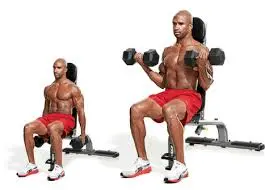
Step 1 Starting Position: Place your feet firmly on the floor and sit with your back against a backrest so that your head, shoulders, and butt touch the bench. With your palms facing forward and your thumbs wrapped around the handles, hold two dumbbells in a closed, supinated grip. Then, let your arms hang at your sides, near your body, palms facing forward. Your shoulders, or scapulae, should be retracted and depressed.
Step 2: Upward Phase: Without arching your back or bending your elbows forward, exhale and slowly bend each elbow in unison to bring the dumbbells to your chest. Keep your wrists in a neutral position (don’t flex or extend them) and keep your head, shoulder, and butt in contact with the bench. Avoid shrugging your shoulders during the lift, keeping your scapulae (shoulders) retracted and depressed, and keep your feet firmly planted on the floor.
Step 3: Downward Phase: Take a breath and slowly return the dumbbells to where you were before.
Step 4 Modification of this exercise: Adjust your starting position to highlight greater biceps activity. Before your forearms reach horizontal, turn your palms to your sides and rotate them forward (or up) during the upward phase. When your forearms reach the horizontal during the downward phase, rotate them back inward. Allowing the elbows to advance as the dumbbell approaches your chest will raise the dumbbell, bringing the upper arm closer to horizontal with the floor. This gives the biceps and a few anterior shoulder muscles a little more attention.
We might not be able to hold the dumbbells against our sides in the lowered position unless we force a bend at our wrists because some of us have structural differences at the elbow. Choose a dumbbell position that maintains your wrists in a straight line with your forearm and is most comfortable for you.
Common Mistakes to Avoid.
Avoid these mistakes to get the most out of your bicep curls.
Moving Too Quickly
Focus on correct form instead of quick execution. Take as much time lowering the weight as you do raising it, and lift the weights smoothly. Making the most of your time in the gym by gradually lowering the weight (eccentric portion) may help you gain more muscle.
Incorrect Elbow Position
To achieve the full range of motion, keep your elbows close to your body’s side and only move your lower arm until the top end of the movement, at which point your elbows should rise. You are most likely lifting too much weight if you observe your elbows swinging behind your body or moving away from your torso.
Making Use of Momentum
When performing the dumbbell curl, avoid using your shoulders or torso to swing the weights upward. This may resemble a heaving, twisting, or swinging motion. Avoid letting your lower body help with the movement in any way, nor let your hips hinge. To achieve the full range of motion, try to keep your elbows at your sides until they rise at the top of the movement.
Swinging
Using momentum may make it possible to lift more weight, but it detracts from the biceps. Maintain a straight, braced, and motionless torso.
Dropping
At the top of the rep, never drop the weight too quickly. You won’t get the most out of the move if you can’t control the eccentric phase. Continue to keep the tension high.
Pulling
A lot of people will drag the barbell up their bodies by pushing their elbows back. Although there is some value in the movement, it is preferable to screw your elbows to your torso and think of them as hinges that follow a controlled arc.
Using too much weight
Although lifting a lot of weight is a surefire way to gain muscle, it must be manageable because it puts the muscle under more stress. If you lose control, you might start pushing the weight up with your bodyweight, which will promote rocking and put undue strain on your wrists, elbows, and back, potentially leading to injury. Until you are prepared to increase the weight, put your ego aside and lift as much as you can.
Focus on keeping your core tight and your spine tall and straight. Keep your shoulders relaxed and keep an eye out that they don’t advance to start the movement. If this happens, decrease the number of repetitions or use lighter weights.
Other Bicep Curl Variations
To keep your training interesting and to give your muscles a different stimulus, try these variations.
Barbell Curl
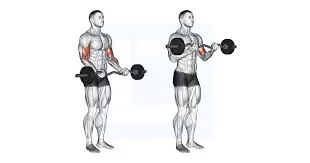
The barbell curl is one of the most well-liked bicep curl variations, though there are others. Get the best barbells for your home gym because they can be used for a variety of exercises.
As with a biceps curl, begin in the same position. Take an underhand grip on a barbell. As an alternative, use an EZ curl bar or a smaller barbell that has already been loaded.
- Hold the barbell so that it touches your legs as it hangs.
- Maintaining your arms close to your body, slowly raise the barbell by bending your elbows.
- Depending on the range of motion you want, raise the barbell to shoulder, eye, or forehead height. Increased range of motion can aid in muscle growth by attracting more muscle fibers.
- Control the weight as you slowly lower the barbell until your arms are completely extended.
- For curl exercises, a barbell, cable machine, or resistance bands can be used similarly. These variations offer a variety of ways to work your biceps.
Inclined curls

- With two dumbbells at your sides in an underhand grip, take a seat on a bench that is angled 45 degrees.
- Squeeze your biceps after curling the weights to shoulder height, then carefully go back to the starting position.
Curls of the Waiter

- With both hands parallel to your thighs and palms facing up, grasp the top of a dumbbell.
- Squeeze your biceps, curl the weight as high as you can, and then carefully return to the starting position.
Curls on plates
- Hold a weight plate in your hands at the 10 and 2 o’clock positions, respectively, while standing erect. Hold the weight by your waist in the starting position.
- Squeeze your biceps as you slowly curl the plate up toward your face, then return to the starting position.
Drag Curl EZ Bar
- A shoulder-width underhand grip should be used to hold the EZ bar in front of your thighs.
- To keep the bar as close to your torso as possible, curl it and push your elbows back as your hands rise.
- At the top, squeeze your biceps, and then slowly lower them.
Kettlebell Curls with Rope
- Thread a heavy battle rope through a kettlebell’s handle. Stretch both arms out and hold the battle rope in both hands.
- Stretch the rope apart and bring your hands up to your shoulders as you curl the weight up. Then go back to the starting position under control.
Curls with cables

- With the cable pulley set low, grasp the rope attachment while standing facing the cable machine.
- Squeeze your biceps, curl the rope up, and slowly reverse while keeping your elbows close to your waist.
Other Differences
Here are a few more variations you could try:
- Biceps curls in reverse
- Cable curl for the biceps
- TRX curl for the biceps
- Hammer curls
Light weights, like two pounds, may be used if you are deconditioned or recovering from an injury. Another option is to perform the exercise with a partner, who will help you raise and lower the weight. If you have trouble standing, you can perform this exercise on a weight bench or while seated in an armless chair.
Benefits of Bicep Curls
- You can develop upper arm strength and learn how to properly use your arm muscles by bracing with your core muscles by regularly performing the bicep curl. Curls strengthen the brachialis and brachioradialis muscles in the lower arm, as well as the bicep muscles in the front of the upper arm. Every time you pick something up, which happens frequently in daily life, you are using these muscles.
- A Guide to Bicep Curl Timing
- Bicep curls are excellent isolation exercises, but to get the most out of them, you must combine them with compound exercises. According to the Journal of Applied Physiology, when combined with multi-joint resistance exercises (such as pull-ups, squats, and deadlifts), single-joint exercises like bicep curls boost strength and size by an additional 10%.
- To target the biceps specifically, it is best to perform dumbbell curls at the end of a workout after working them through several compound “pulling” exercises (like close-grip chin-ups). To work your entire arm musculature, you could also superset them with triceps dips.
- Generally speaking, begin with a full-body workout, then progress to an exercise that works the bicep in combination with other muscles (lat pulldowns are fine), and finally arrive at your preferred bicep curl.
Safety and Precautions of Bicep Curl
- For the majority of people, this exercise is generally advised. However, do not proceed if you are experiencing pain during the motion or have an arm injury.
- After a few lifts, you should anticipate feeling exhausted and even like your forearm and bicep muscles are burning. This is what you want to happen to get your muscles to grow and strengthen. Once you are unable to perform the curls with proper form, don’t push yourself to do more repetitions. Before beginning the next set, rest.
- Avoid starting with a weight that is too heavy, and stop if you experience any pain. It’s common to build large biceps, but don’t jump to heavier weights before you’re ready. Your entire exercise regimen may be derailed if you sustain an elbow or wrist injury.
Five Best Practices for Increasing Bicep Curl Size
Inhale
As you curl all the way to the top, be sure to exhale. As you lower over a count of three, squeeze your biceps and take a breath. By doing this, you can better regulate your speed, make sure your biceps are working hard, and stay focused.
The twist
The ability of the biceps to rotate, or supinate, the forearm is one of their main roles. Accept the twist to activate your muscles to their fullest. As you curl up, start with the dumbbells at your sides and turn your wrist toward the ceiling.
Accuracy
It’s a good idea to isolate your biceps and use lighter weights to get more exercise without hurting your body. Swinging is prevented by a bench. Get a light bar on the other side of it while kneeling in front of it. Isolate your biceps by slowly curling them toward your forehead while resting your upper arms on the bench. To the end, squeeze, lower, and repeat.
Squeeze
Because it works the muscle you want to build, the bicep squeeze is crucial. Additionally, there’s a temptation to take a brief break from the curl at the top of the movement. Avoid doing it. According to PT Jason Patmore, “if you ‘rest’ at the top of the rep, the load is resting on your joints, which switches off the bicep.”
Additionally, make sure to fully extend your arm at the end of the repetition. A properly executed curl should be done slowly and with complete control, exerting the same amount of effort on the descent as on the ascent.
Keep your shoulders back.
Many people rock their elbows and use their shoulders. One of the primary roles of the bicep is to flex the elbow, so keep your arms perpendicular to the floor and force all movement to happen there.
How to Draw Attention to and Make Your Outer Biceps Appear Thicker
The hammer curls are designed to target your biceps. Your palms should be facing your torso as you hold the dumbbells. “This works the muscles in your forearms that are used to flex it at the elbow as well as the outer biceps,” Sedgley says.
How to Make Your Biceps Bigger
Just lie down and use the cable machine to curl your biceps. “This will challenge your biceps to keep your shoulders up, a function of the biceps that is often overlooked, while also allowing them to get a full stretch while still under load,” says Tracey.
How to Exercise Your Arms
Use curls to strengthen your pronator muscles. Do a standard curl. Rotate the weights until your palms are facing forward at the peak of the exercise. Stop just short of fully extending your arms as you slowly lower the dumbbells toward your thighs. Hold on. After that, return your palms to their initial position. And do it again.
Top Bicep Exercises
These are the top exercises from the MH archive that will help you develop larger arms and work your biceps.
- In 12 minutes, build enormous arms using just one dumbbell.
- Use The 5/20 Method to Gain Arm Length
- 15-Minute Arm Exercise with Dumbbells
- The Specialization Plan for “Big Guns”
- Do You Want Bigger Biceps? Every day, do this.
- 10 x 10 Exercise Inspired by Volume Training
FAQs
Is 20 kg bicep curl good?
Whether a 20 kg bicep curl is “good” or not will depend on your personal objectives, level of fitness, and curl type (barbell or dumbbell). While it is frequently an advanced weight for women, it can be regarded as an intermediate or even advanced weight for many men. If you can do it correctly and with control, it’s a powerful lift, especially if you want to gain strength and muscle.
What are bicep curls good for?
Bicep curls strengthen the arms and upper body, increase shoulder and elbow stability, and improve the ability to lift objects daily. By strengthening the biceps and supporting muscles, they also improve posture overall. The exercise is simple to learn and has numerous variations to avoid plateaus.
Which bicep curl is most effective?
Exercises that focus on tension and remove momentum, like the preacher curl and EZ bar curl, are great for building muscle mass, but the best bicep curl will depend on the particular muscle group you wish to work. The EZ bar curl is great for the biceps because it works the surrounding muscles and biceps with a comfortable angled grip. Because it isolates the biceps’ short head and discourages cheating, the preacher curl is also very effective at increasing distal (elbow) muscle growth.
Is curling 40kg good?
For instance, you should use a weight between 32 and 40 kg for barbell curls if your body weight is 80 kg. Using a heavier weight isn’t always preferable, even if your goal is to gain muscle.
Will hammer curls grow biceps?
In addition to increasing total arm strength, brachialis training thickens the upper arm and supports the superficial bicep muscle. Hammer curls are, therefore, your best option if you want to achieve that desired bulge and chiseled appearance.
How long to see bicep curl results?
You can develop a fuller bicep more quickly by switching up these routines once a week as opposed to doing just one or two exercises. After eight to twelve weeks, you should start to see noticeable results if you take your time.
How many sets per day?
Depending on your training objective, you should aim for 1-3 sets per day for general fitness, 3-6 sets for muscle strength or size, and 3-4 sets for endurance. In the end, the ideal volume is very personal and should be modified according to your progress and recuperation capacity. The majority of research indicates that 10–20 sets per muscle group per week is a good goal for muscle growth.
How many bicep curls a day?
Bicep curls should not be performed daily because muscle recovery is essential for muscle growth. For muscle growth, it is generally advised to perform 3–4 sets of 8–12 repetitions on 2–3 non-consecutive days per week. You can perform 1-3 sets of 12-16 repetitions with a lighter weight, two to three times per week, to build endurance.
Reference
- Neudecker, K. (2025, October 8). New research shows the curl is king for bigger biceps – and why compound lifts alone won’t cut it. Men’s Health. https://www.menshealth.com/uk/building-muscle/train-smarter/a68895432/compound-lifts-vs-curls-bigger-biceps/
- Rogers, P. (2024, May 13). How to do biceps curls: proper form, variations, and common mistakes. Verywell Fit. https://www.verywellfit.com/how-to-do-the-biceps-arm-curl-3498604
- Seated Biceps Curl | Exercise Library | ACE. (n.d.). https://www.acefitness.org/resources/everyone/exercise-library/44/seated-biceps-curl/?srsltid=AfmBOoqpQfkrnvgeaF7oXx2MSAQ91hriyoCpjtcGzxpzIrXHoJ3ZV35G


