Pilates Roll-Up
What is Pilates Roll-Up?
Pilates Roll-Up is a classic Pilates exercise that helps strengthen the core muscles, improve spinal flexibility, and enhance overall posture. It involves slowly rolling the spine up and down with control, promoting better body awareness, balance, and coordination.
One Pilates roll-up is reported to be equivalent to six standard sit-ups and to be far more effective at flattening the stomach than crunches.
Traditionally, the roll-over comes after the roll-up, which comes after the hundred.
Although rolling up is one of the first mat exercises you will learn, it is difficult, and you may need to adjust it or strengthen your core before you can perform it with perfect form.
Muscle Work During Pilates Roll-Up:
- Rectus Abdominis Muscle
- Transverse Abdominis Muscle
- Obliques Muscle
- Hip Flexor Muscles
- Deep Neck Flexors
- Lower Back Muscles
- Inner Thigh Muscles
How to Perform?
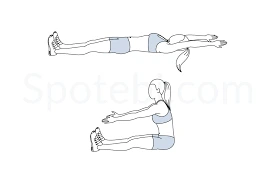
- Place your arms above your head, palms facing each other, biceps by your ears, and lie face up on a mat with your legs straight.
- Take a deep breath to be ready, then release it and raise your arms to the ceiling. As soon as they pass your eyes, carefully lift your head and neck off the ground and tuck your chin into your chest, allowing room for a fist. Reach your hands forward toward your feet while using your deep core to scoop and circle forward, removing your spine from the floor vertebra by vertebra.
- Reach your hands forward toward your toes and, if you can, past them once you’re seated. Keep your shoulders relaxed and down, tuck your tailbone, bring your belly button to your spine, and maintain a “C”-shaped back. Keep your eyes down at your knees and your chin slightly tucked.
- Inhale to lift your chest and straighten your spine, stacking your vertebrae, lengthening the crown of your head toward the ceiling, and maintaining your core engaged.
- Breathe out, tuck your pelvis, circle your back, and carefully roll your back down to the floor, one vertebra at a time. Stretch your arms upwards to return to the starting position after keeping them extended forward toward your toes until your mid-back touches the floor.
- Take a moment to lie on the floor with your spine in a neutral position. Ensure that your arms are touching the ground. One representative, that is.
Benefits:
- Strengthen the core, especially the difficult-to-target rectus abdominis and deep transversus abdominis.
- Exercise the entire range of motion of the core to develop muscle and eccentric control.
- Boost your posture.
- Increase mobility in the shoulders and hips.
- Boost hamstring and spine flexibility.
- It’s best to engage hip flexors before a run, bike ride, or other aerobic activity.
- Increase awareness of your spine, especially in the lumbar (lower back) and thoracic (mid-spine) regions, which are frequently tight.
- Give them the chance to practise relating breath to movement, which improves core efficiency and neuromuscular coordination.
Variations:
Bent Knee Roll Up:

Bending your knees is one of the best things you can do if you’re experiencing problems rolling up. This will enable you to strengthen and coordinate the transversus abdominis and other abdominal muscles by reducing the overactivity of the hip flexors.
- Use the basic form above to perform the roll-up, but slightly bend your knees. The exercise will get more difficult if you keep your heels away from your butt.
- As you rise, bend your knees more.
- If needed, use your hands to support the remainder of the roll up/down and lift yourself by grasping behind your knees.
Banded Roll Up:

- After encircling the balls of your feet with the exercise band, lie down.
- Keep your hands on the band while keeping your arms at your sides.
- To provide you with some support while you roll up and down, adjust the band’s tension.
Magic Circle Roll Up:
- Hold the magic circle above your chest to begin.
- As you roll up and down, squeeze the magic circle. You can focus on the segmental movement of the spine by using it.
Safety & Precautions:
If you experience any pain while performing this exercise, stop. Use the advice to adjust the exercise or talk to your Pilates instructor if you are unable to maintain proper form. It’s preferable to start this exercise with bent knees or a strengthening if you have low back pain. If you have a history of injuries or back problems, consult your physician first.
Pilates is great for postpartum recovery, but you must first acquire your doctor’s approval. If a woman has abdominal separation, she shouldn’t undertake these exercises until the separation is fixed. Anyone who has ever been pregnant may experience this.
Common Mistakes:
Using Momentum or Dropping When Halfway Down:
In addition to having to drop down because they lose power when rolling down, beginners may find themselves rolling up, utilising momentum rather than muscular strength. Both a flexible spine and a strong core are necessary for the Pilates roll-up. Practicing comparable exercises that introduce the roll-up in stages can help develop the strength and flexibility needed for it.
Roll down the wall first. This exercise is a simple approach to improve the spine’s articulation, which is necessary for rolling up.
Do a chest lift after that. You can build the strength to curl up your upper body by doing chest lifts.
Work on supported rollback after that. This is a fantastic exercise for learning to move the spine in a deep curve, strengthening what feels like “lower abs,” and achieving that roll under motion in the pelvis.
Lifting Legs and Feet From the Mat:
When the upper body lift causes the feet and legs to desire to fly off the mat, it can be frustrating. This is because several of the muscles that support forward bending of the upper body also flex the hips (hip-flexors).
The transversus abdominis is responsible for the important components of roll-up, which include abs in, ribs down, and a large curvature of the spine. The transverse muscle flexes the trunk forward and compresses the abdomen. It also helps close the ribs near the midline.
The roll-up will activate additional abdominal muscles. However, concentrating on the transversus abdominus action will help divert attention from the hip flexors and reduce “flying feet.”
Sustaining an Excessively Tucked Position:
The unduly tucked position is one of the most visually appealing pelvic misalignments. However, it will be much more difficult to roll up if you don’t tuck your pelvis. Your feet will likely desire to fly off the mat rather than your upper body, as all of your energy will be focused on your lower body.
FAQs
Are roll-up exercises effective?
In addition to building strong abdominal muscles, the Roll Up exercise is a great technique to increase your body’s flexibility by lengthening your hip flexors and extending your spine. This is crucial since a rigid body can create pain and reduce the effectiveness of your movements.
What are the risks of roll up strategy?
The difficulty of combining several businesses is one of the biggest dangers associated with roll-up tactics. Employee discontent and operational inefficiencies may result from differences in leadership, operating systems, and business culture.
What is the purpose of the roll-up Pilates?
The Roll Up is more than simply an “ab exercise”; it incorporates core strength, particularly in the hip flexors and abdominals, spinal articulation (flexing/rolling through the spine), and synchronised breathing.
Can Pilates change your body shape?
Pilates does have an impact on body form, but not because it “lengthens muscles” or burns a lot of calories. Alignment, posture, deep muscle activation, and regular practice all contribute to the evolution.
When should I avoid doing roll-up exercises?
When pregnant, avoid the Pilates roll-up. It should be avoided if you have a herniated disc because it involves a lot of spinal flexion. While moving up and down through the vertebrae, the spine opens and enhances its range of mobility.
References:
- Ryt, M. O. M. (2022, March 23). How to roll up in Pilates: proper form, variations, and common mistakes. Verywell Fit. https://www.verywellfit.com/how-to-do-pilates-roll-up-2704679#toc-common-mistakes
- Walsh, K. (1970, January 1). The Pilates Roll-Up is so much more than an AB exercise. Here’s how to master it. https://www.onepeloton.com/blog/pilates-roll-up