

10 Physiotherapy Exercises for Ankle Sprain Rehabilitation
Introduction:
You run the danger of spraining your ankle if you roll, twist, or turn it abnormally. This could result in the strong bands of tissue supporting the stability of your ankle bones being pulled or stretched. We refer to these strong bands of tissue as ligaments.
Ligaments stop dangerous movement and stabilise joints. Ankle sprains occur when the ligaments are damaged or overextended. Sprained ankles usually affect the three ligaments on the outside of the ankle.
What is an ankle sprain?
Strong, fibrous fibres called ligaments join one bone to another throughout the body. The many ligaments of the ankle help to keep the bones in their proper locations and stabilise the joint. For many kinds of activity, including standing, walking, and running, joint stability is crucial.
About 90% of ankle sprains result in an inversion injury (the foot twists inward) to the anterior talofibular (ATFL) and calcaneofibular (CFL) ligaments. The lateral ligaments, which are located outside the ankle, are the ATFL and CFL.
An eversion injury (the foot turns out) to the deltoid ligament on the inner of the ankle is the cause of the less frequent medial ankle sprain.
Causes:
Ankle or foot twisting injuries are common among patients. Sprains can happen suddenly and rapidly during a variety of activities, including:
- Exercise, work, or walking on an uneven surface
- Tripping or falling
- Playing dangerous sports like trail running, basketball, tennis, football, and soccer that involve cutting or jumping
Risk Factors:
- Inadequate equilibrium
- Overly flexible or lax ligaments
- Ankle alignment issues
- Putting on shoes with slick bottoms
- A prior ankle sprain that raises the possibility of another one
Symptoms:
- Pain both at rest and when moving or bearing weight
- Swelling
- Tenderness to touch and bruising
- Ankle instability, or the sensation that your ankle is failing
Exercise:
Ankle Circle:

- To keep your heel off the ground, sit on the floor and support your leg with a foam roller, rolled-up towel, or pool noodle.
- Move your ankle slowly in a clockwise circle. After ten repetitions of this, move the ankle in the opposite direction for the same number of repetitions.
Towel curls:
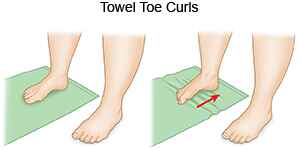
- Put a little towel on the ground in front of you.
- Using your toes, gently grasp the towel and scrunch it up. Repeat this twice.
- Let go of the towel and use the outside of your toes to push it back out while maintaining the same stance.
- Do this eight or ten times.
Towel Stretch:

- With your leg extended in front of you, take a seat on the floor.
- Cover the ball of your foot with a towel. To bring your toes closer to you, gently pull back on the cloth.
- Hold the stretch for 15 to 30 seconds.
Standing Calf Stretch:
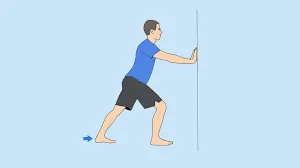
- Place your hands on a countertop or wall for support while standing facing it.
- Put your good foot forward and your affected ankle back approximately a step.
- Bend the front knee gradually while keeping your back heel flat on the ground until the calf on your affected side begins to stretch moderately.
Heel Raise:
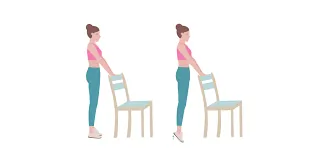
- Place your hands in front of you, supporting yourself with them against a wall, a countertop, or the back of a chair.
- Rise slowly on your toes while keeping your feet shoulder-width apart. For five seconds, maintain this posture.
- Return to the ground and elevate your toes while rocking back on your heels a little.
- Work your way up to 20 or more repetitions, starting with 10.
Elastic Band Push:

- Take a seat on the ground. Put the elastic band over the ball of your foot after extending your afflicted leg. Grasp both ends.
- The other side of the leg bends up to 90 degrees.
- As if you were pointing your toe, slowly push your ankle forward. Then return it gradually.
Elastic Band Pull:

- Fasten your resistance band to a hefty item, like the leg of a desk or table.
- Hook your toes and upper foot inside the band while seated on the ground.
- Return your foot to a vertical position by slowly drawing it back toward you. Do this ten times.
Basic Balance Exercise:

A sprain damages your nerve fibres. Your brain must restore its sense of where your ankle is and how to move it exactly as you develop strength. Proprioception is the term for this sensation.
For additional support when beginning this exercise, utilise a countertop or the back of a chair.
- Gently raise the other foot off the ground behind you while standing on the afflicted foot.
- First, hold this for a few seconds. Then, if you can, increase the duration to 30 seconds and 1 minute.
Single Leg Calf Raise:
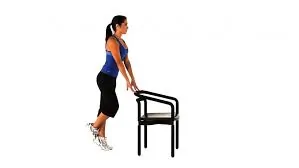
- Place your hands on the back of a chair, wall, or countertop and raise your good leg behind you until your weight is on the leg with the injured ankle.
- Push yourself up till your calf begins to function by raising your heel. After two seconds of holding this position, lower yourself.
Prevention:
- To increase stability and ankle strength, perform balance exercises.
- Warm up before working out or doing sports.
- When running, walking, or working on uneven surfaces, exercise caution.
- If your ankle is weak or has been injured in the past, use an ankle support brace or tape.
- Put on shoes that are appropriate for your activity and fit properly.
- To lessen ankle strain, wear high heels less frequently.
- Play sports or engage in activities that your body is ready for.
- Regular exercise will help you maintain the strength and flexibility of your muscles.
FAQs
What physio exercises for a sprained ankle?
The towel curls. Sit with your foot on a towel on the floor and use your toes to scrunch the towel in your direction. Next, push the towel away from you with your toes as well. Put a weighted object, like a soup can, on the other end of the towel to make this workout more difficult.
Is physiotherapy good for a sprained ankle?
The majority of ankle sprains are light, and full healing takes three weeks. Significant recovery can be anticipated within ten days. In more serious situations, it may take many months to fully recover; in these situations, early physical treatment is frequently beneficial.
Can I walk on my sprained ankle after 4 days?
If pain is less than moderate, grade 1 sprains frequently permit guarded walking in a supportive brace by days three to five. Before being able to walk comfortably, grade 2 sprains usually require 7 to 14 days of protective weight-bearing. It may take three to six weeks after a grade 3 sprain for complete weight-bearing to be appropriate.
Is it good to walk on a sprained ankle?
As soon as pain permits, early activity is frequently urged. To avoid stiffness and aid in rehabilitation, mild range-of-motion exercises may be started during the first day or two following an accident. Walking may require temporary immobilisation with a brace or boot for more serious sprains.
What is the most serious ankle sprain?
Grade 3: The afflicted ligament or ligaments are completely torn, and there is significant bruising and swelling. Walking is probably impossible due to the ankle’s instability and severe pain.
References:
- Sprained ankle – OrthoInfo – AAOS/orthoinfo.aaos.org/en/diseases–conditions/sprained-ankle/
- Sprained ankle – MayoClinic – www.mayoclinic.org/diseases-conditions/sprained-ankle/symptoms-causes/syc-20353225
- 9 exercises for your sprained ankle and when to see a doctor – 2025 – Hecht/www.healthline.com/health/sprained-ankle-exercises