Five-Pointed Star Pose (Utthita Tadasana)
What is the Five-Pointed Star Pose?
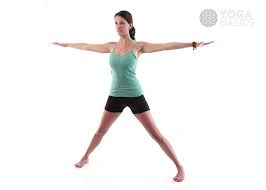
Five-Pointed Star Pose (Utthita Tadasana) is a standing yoga posture that promotes full-body stretching, balance, and energy activation. In this pose, the arms and legs are spread wide, creating a star-like shape that helps improve posture, enhance circulation, and increase body awareness while building strength and stability.
Additionally, it serves as a beginning or transition stance for a variety of yoga poses, including the Triangle stance, the Goddess Pose, and Warrior II Pose.
Utthita Tadasana also helps to extend the spine and is an excellent chest opener. The wide posture, which involves spreading your hands and legs to the sides, makes you feel strong and promotes joy and happiness in life.
Training your leg muscles, lengthening your spine, and extending your hips also gives you flexibility and strength.
Muscle Work During Five-Pointed Star Pose:
- Arms Muscles
- Shoulders Muscles
- Chest Muscles
- Hip Muscles
How to Perform?
- Stand in the Mountain Pose (Tadasana) to begin.
- With your toes pointing front, spread your legs three to four feet apart. Spread your weight across the four corners of your feet while keeping your feet firmly planted.
- With your palms facing up, down, or forward, raise your arms to the side at shoulder height. As if you wanted to touch the walls, extend your fingers.
- Keep your chest open, shoulders down, and shoulder blades gently pressed back. To prevent your back from arching, tuck your tailbone.
- Inhale deeply while extending the crown of the head towards the heavens. Maintain a straight head with your eyes facing forward and your chin parallel to the floor.
- Take a deep belly breath and visualise your head, arms, and legs expanding during the subsequent inhale. Take up as much room as you can.
- Maintain a steady breath while holding this stance for 30 seconds. With consistent practice, you can progressively extend the duration.
- Bring your arms down slowly and return to Tadasana to exit the pose.
Benefits:
- By realigning your spine, this pose is among the best ways to improve your posture.
- Using every muscle and joint in the body, it provides a good stretch.
- Encourages you to open your heart and chest to receive happiness, love, and joy.
- Strengthens the sacrum, abdomen, shoulders, back, ankles, legs, and the balls and heels of your feet.
- You may improve blood and oxygen circulation throughout your body by extending your body in all directions.
- Stress is released as you stimulate your crown.
- You must pay attention to your breathing when maintaining the stance for extended periods of time.
Beginner’s Advice:
- Your knees will be strained if you lock them. For comfort and flexibility in the position, maintain a micro-bend.
- Your shoulders will naturally stay away from your ears if you maintain a relaxed posture.
- Your hips, shoulders, and ears should all line up. It will assist you in improving your posture.
- Pick a focal point right in front of you to help you stay focused. Maintain a steady breathing pattern.
- Expand your collarbones for a more profound heart-opening experience.
- To achieve a straight spine, maintain a neutral pelvis.
Follow-Up Poses:
- Warrior II (Virabhadrasana II)
- Reverse Warrior Pose (Viparita Virabhadrasana)
- Triangle Pose (Trikonasana)
- Goddess Pose (Utkata Konasana)
- Standing Wide Angles Forward Bend (Prasarita Padottanasana)
- Standing Yoga Mudra (Dandayamana Mudrasana)
Modifications and Variations:
- The distance between your legs can be changed. The inner thighs will be nicely stretched by taking a broader posture. To improve your balance, you can begin with a smaller breadth.
- Use the wall’s support if you can’t stay balanced for any reason. Your heels, shoulders, buttocks, and head should all be in contact with the wall.
- Keep your hands on your hips if you have any medical conditions, such as stiff shoulders. Turn your palms towards the heavens to widen your chest.
- You can test your ability to balance on the balls of your feet. The ability to balance on one leg is another advanced stage. Raise your opposing leg a few inches off the ground while tilting to one side.
Precautions & Contraindications:
- This pose should be avoided by anyone with severe arthritis and migraines.
- It is best to avoid this posture until you have healed if you have had hip, ankle, or shoulder injuries or surgeries. Stiffness and soreness may result from holding this pose for an extended period of time.
- Those who have high blood pressure symptoms should use caution when performing this position as a vinyasa.
Conclusion:
One of the fundamental stances of yoga is the Five-pointed Star Pose. When switching between stances, you also strike this pose. It provides your body with a wonderful stretch, increases your flexibility, and gives you good energy as you extend yourself in all five directions.
Increasing the flow of prana energy throughout the body is another benefit. This will support your mind-body balance and help you with other yoga poses.
You can strike this stance whenever you need joy, happiness, and optimism in your life!
FAQs
What are the benefits of Utthita tadasana?
Lengthens, stretches, and improves range of motion and flexibility: The shoulders, arms, sacrum, heels, ankles, and balls of the feet are all strengthened by Five Pointed Star Pose (Utthita Tadasana). This pose is excellent for increasing joint flexibility and strengthening the joints.
Why is utthita padmasana called tadasana?
To comprehend the meaning of each in Sanskrit, the name “Utthita Tadasana” (Five Pointed Star Pose) may be divided into three pieces. “Utthita” translates to “stretched,” “Tada” signifies “mountain,” while “asana” denotes “pose or posture.”
Can the five-pointed star pose help with balance?
Making this standing star form strengthens your legs, butt, and core in addition to improving your balance. Place your hands on your hips and stand with your feet parallel and hip-width apart. Raise, lower, and roll your shoulders. As you raise your chest, contract your lower belly.
How long should you hold the five-pointed star pose?
Feel your body extending in all directions—up, down, left, right, forward, and backward—with each exhale. Gently look up at the horizon. After holding the posture for up to a minute, step your feet back together at the top of your mat in Mountain posture and release your arms to your sides.
Is the five-pointed star pose a standing or seated pose?
You can perform the Star Pose while standing or while seated in a chair. Star stance can be performed on its own or as a transitional stance for a variety of poses, such as Straddle Twists, Squatting Star, lunging warm-ups, and Warrior Poses, among others.
References:
- Five-Pointed Star Pose (Utthita Tadasana) – Meaning, Steps and Benefits – Fitsri Yoga. https://www.fitsri.com/poses/five-pointed-star-pose
- Five-Pointed Star Pose Yoga Pose (Utthita Tadasana). Tummee. https://www.tummee.com/yoga-poses/Utthita Tadasana.


