Hip Range Of Motion Exercises
Introduction
Hip Range of Motion (ROM) exercises are gentle movements designed to maintain and improve the flexibility, mobility, and joint health of the hip. These exercises help reduce stiffness, improve posture and gait, and support daily activities like walking, sitting, and bending. Regular hip ROM exercises are especially beneficial for people with hip stiffness, sedentary lifestyles, or those recovering from injury or surgery.
Due to excessive sitting and insufficient exercise, many people have weak or rigid hips.
It can be challenging to choose the best hip exercises for you because there are so many available.
Weightlifters, hikers, runners, senior citizens, and those with arthritis can all benefit from these 14 top hip exercises.
Find out which hip exercises are best for you and how to perform them by reading on.
These hip exercises are beneficial for hip pain and other hip-related issues.
To prevent injuries, make sure you have enough room around you and remember to stay hydrated while working out.
Almost everything you do, including walking, sitting at your desk, running up a hill, and performing yoga poses, is powered by your hips. Maintaining the strength and mobility of the surrounding muscles is important for comfortable movement because the hip joint is a ball-and-socket joint with a wide range of motion.
Your capacity for both internal and external rotation, as well as full hip extension, may decrease if your hip flexors, glutes, hamstrings, or deep hip rotators become tight. Physical therapy, that restricted range can affect performance, slow down your stride, or raise your risk of injury. Including a few focused mobility exercises in your routine can greatly increase flexibility and functional strength, regardless of whether you’re a runner, an aerobics beginner, or someone who just wants to move more easily.
These professional-recommended hip mobility exercises enhance full-body stability as well as hip extension and rotation. Incorporate some into your hard warm-up or strength training schedule.
What muscles should you be targeting?
You should focus on the following to strengthen and stretch your hips:
The primary hip extensor muscle is the gluteus maximus, while the primary hip side muscle is the gluteus medius.
In simple terms, you will be stretching and strengthening the sides and back of your hips.
The tensor fasciae latae, which are located directly in front of the hip joint, should not be overworked. Overuse of this muscle can result in unexpected back, hip, or knee pain.
The same muscle groups can be targeted by both men and women. Though this can vary, men typically have tighter hips than women. Anyone with inflexible, tight hips should start slowly and build up gradually.
Muscles That Move Your Hips
The number of muscles required to move your hips may surprise you. Flex (bend), extend (stand), abduct (move outward), and adduct (move inward) are the four categories into which they fall.
Weak hips are typically caused by a sedentary lifestyle that includes excessive sitting and little exercise. Your hip muscles may be weak or immobile if you experience pain, tightness, cramping, or other unpleasant symptoms.
All of the muscles involved in hip bending are referred to as hip flexors. Hip flexor muscles are used whenever you move your knee forward or upward, such as when walking or climbing stairs. Among them are:
- Your quadriceps’ rectus femoris
- The psoas major, which joins your hips and spine
- Iliacus, which connects to your thigh bone and hips
- Your groin muscle is called the pectineus.
- Sartorius, which joins each leg’s hip and knee joints
Hip Extensors
The function of these muscles is the opposite of that of the hip flexors. Hip extensors extend the hips, while hip flexors bend them. Among these muscles are:
- The biceps femoris is also referred to as the hamstrings
- The biggest butt muscle is the gluteus maximus.
Hip Abductors
Your leg can be moved outward, or away from your body, by using your hip abductors. Among them are:
- Your gluteal sides are made up of the gluteus medius.
- Beneath the gluteus maximus and medius is a tiny muscle called the gluteus minimus.
- Tensor fasciae latae (TFL) stabilizes your hip and knee by attaching to your iliotibial band.
Hip Adductors
The opposite action of the hip abductors is carried out by the hip adductors. When you squeeze your legs together, for example, they pull your legs inward or toward your body. The five tiny muscles that run along the inside of your thighs are called adductors. Among them are:
- Gracilis
- Obturator externus
- Adductor brevis
- Adductor longus
- Adductor magnus
Hip Range Of Motion Exercises
Warmup exercises
Before starting a workout, always warm up the big muscles that surround your hips. Before you begin harder exercises, this increases your circulation and makes these muscles more flexible and active.
You can start with the following warm-up exercises:
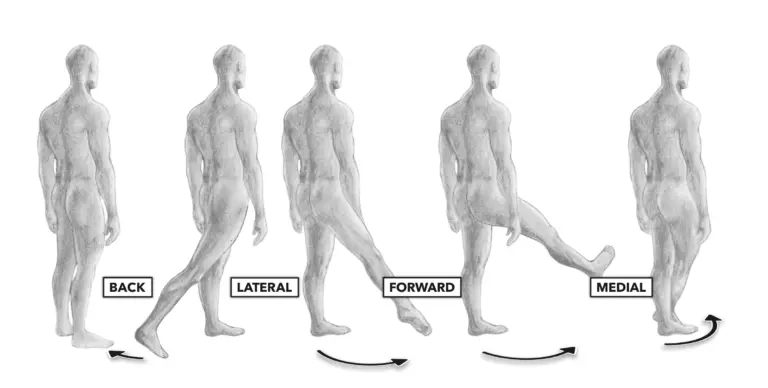
1. Frankenstein walk
This exercise strengthens your hamstrings, quadriceps, and hips. Additionally, it improves the range of motion. As you advance, keep your posture straight, avoid bending at the waist, and pick up the pace.

Guidelines:
- With your palms down, extend your arms in front of you.
- Swing your right leg up and extend it straight out as you advance, forming a 90-degree angle with your body.
- Swing your left leg up in the same manner after lowering your right leg to the ground.
- If you have limited space, change directions and keep going for one minute.
- For each leg, you can perform two or three sets of ten to twelve repetitions.
When you’re comfortable, extend your arm behind you and reach out to touch the foot on the other side.
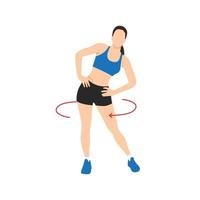
2. Hip circles
This exercise improves stability and flexibility. Use a stable object to provide additional support.
Guidelines:
- Lift your left leg and stand on your right leg.
- Make circles with your left leg.
- Make 20 circles in each direction.
- Next, switch to your right leg.
- You can perform 10 to 15 repetitions per leg in two or three sets.
- Increase the size of the circles and perform two to three sets to make this exercise more challenging.
Exercises with bands
For these exercises, a resistance band is required. To raise the resistance, use a thicker band.
3. Sidestep exercise
Keep your toes and hips facing straight ahead. Lowering the band until it is above your ankles and lowering your squat position will increase the intensity.

Guidelines:
- Wrap a resistance band around your lower thighs and stand in a half-squat position.
- Take slow, tiny steps to the side while using your hip muscles.
- Take eight to fifteen steps in a single direction.
- Perform on the other side after that.
4. Clamshell exercise
This exercise strengthens your thighs, glutes, and hips. It helps avoid overuse and injury by stabilizing your pelvic muscles and easing lower back tightness. Check out a few variations after you’ve mastered the fundamental pose.
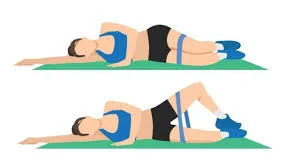
Clamshells Guidelines:
- Place a resistance band around your lower thighs and lie on your side with your knees bent.
- After rotating your upper leg as high as you can, take a brief break.
- Reduce to the initial position.
- Perform one to three sets of eight to fifteen repetitions.
Exercises with weights
5. Lateral step-up
This exercise strengthens and stabilizes your core while working your hamstrings, quadriceps, and glutes. Increase the weight to increase the intensity.

Guidelines:
- Hold a weighted plate or dumbbell in front of your chest with both hands.
- Place a box or bench to your right.
- Put your right foot on the bench and bend your knee.
- Tap your left foot on the bench while maintaining a straight posture.
- Return your left foot to the ground slowly.
- You can perform two to three sets of eight to fifteen repetitions on each side.
6. Single-leg Romanian deadlifts
This exercise will increase your core strength, hip mobility, and balance. It also works your hamstrings and glutes.

Guidelines:
- With your knee slightly bent, stand on your right foot. In your left hand, grasp a dumbbell.
- As you bend forward to align your torso with the floor, keep your spine neutral. Raise your left leg.
- Return to your standing position. Bring your left leg down.
- Do two to three sets of eight to fifteen repetitions on each side.
Exercises for seniors
By enhancing balance, coordination, and movement patterns, these exercises can help reduce the risk of falls and injuries.
7. Hip marching
Your thighs and hips will become more flexible and stronger as a result of this exercise.
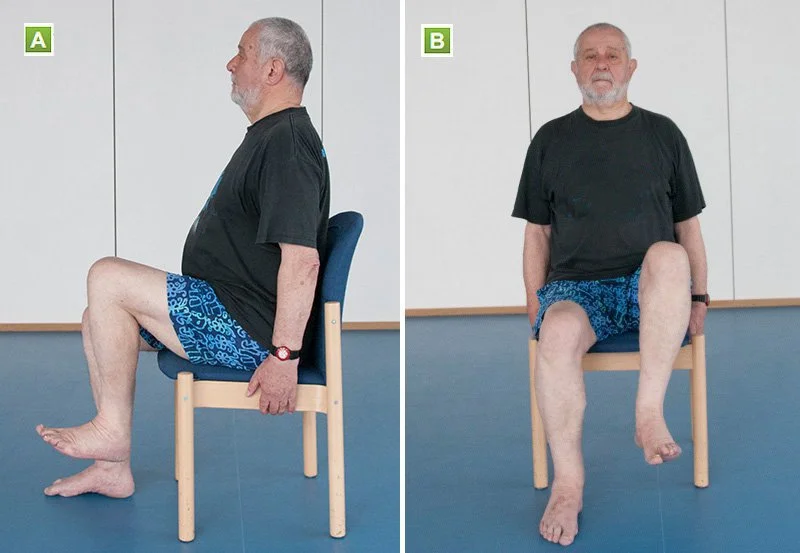
Guidelines:
- Sit near the front edge of the chair.
- Keeping your knee bent, raise your left leg as high as you can.
- Lower your foot carefully and slowly.
- Next, work on the right side.
- There is one repetition of this.
- Perform two to three sets of five to twelve repetitions.
8. Floor hip flexors
Your thighs, glutes, and hip flexors are all stretched by this exercise.
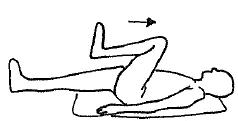
Guidelines:
- Lying on your back, pull your right leg into your chest.
- Feel your hip stretch as you press the back of your left knee into the ground.
- For up to 30 seconds, maintain this posture.
- Repeat two to three times on each side.
Exercises for those with arthritis
Stretching every day, even for a brief period of time, is recommended if you have arthritis. When you have arthritis, it is better to stretch daily rather than just a few times a week.
9. Butterfly pose
This exercise increases blood circulation while stretching your hips.
To support the pelvic tilt, place your sitting bones on the edge of a folded blanket or cushion. Put cushions or blocks under your thighs for support if you feel constricted.

Guidelines:
- Bend your knees and place the soles of your feet together while seated.
- Put your fingers together beneath your feet.
- As you let go of tension, feel an opening in your hips.
- After 30 seconds, fold your arms forward and extend them in front of you.
- Maintain this posture for a maximum of one minute.
- Bringing your heels closer to your body will help you achieve a deeper stretch.
10. Knee-to-chest pose
This pose stretches your hips and stabilizes your pelvis.
For additional support, place your head on a flat cushion or folded blanket. Put your hands around the backs of your thighs if you are unable to reach your arms around your shins.
One leg at a time, with the other leg bent at the knee or extended straight out, will make the exercise easier.

Guidelines:
- Bend your knees toward your chest while lying on your back.
- To grasp your hands, forearms, or elbows, put your arms around your legs.
- To lengthen the back of your neck, gently tuck your chin into your chest.
- For up to 30 seconds, maintain this posture.
- You can perform this stretch two or three times.
Exercises for runners
Runners may suffer from hip pain and poor flexibility as a result of high-impact movements and overuse. By strengthening and stretching tense muscles, these exercises can correct imbalances.
11. Donkey kicks
To tone and strengthen your hips and glutes, perform this exercise.
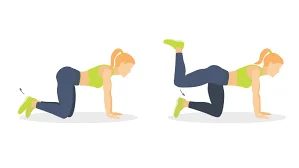
Guidelines:
- Lift your right knee from a tabletop position and kick upward while keeping it bent.
- Bring your foot’s bottom up toward the ceiling.
- Go back to where you were.
- Do 12–20 repetitions on each side in two to three sets.
12. Side leg raises
Your thighs and glutes will get stronger from this exercise. Put a weight on your thigh to make it harder.

Guidelines:
- With your legs stacked, lie on your right side.
- As much as you can, lift your left leg.
- After pausing here, go back to where you were before.
- Perform two to three sets of twelve to fifteen repetitions on each side.
Exercises for relieving hip pain
13. Single-leg bridge
This exercise stretches your hips and encourages proper posture while working your hamstrings, glutes, and core.

Guidelines:
- Bend your knees and bring your feet closer to your hips while lying on your back.
- Make your right leg straight by extending it.
- Raise your hips as high as you are able to.
- For thirty seconds, maintain this posture.
- Do each side two or three times.
14. Figure Four
Your hips and glutes are stretched in this pose.

Guidelines:
- Bend your knees and bring your feet close to your hip while lying on your back or seated on a chair.
- Place your right ankle at the base of your left thigh.
- Draw your leg in toward your chest while connecting your fingers around your shin or thigh.
- Hold for a maximum of one minute.
- On the other side, repeat.
- Straightening your lower leg will make it harder.
Worst exercises for hip pain
If you have hip pain, you should stay away from certain exercises. For as long as you can, rest and avoid stressful daily activities.
High-impact exercises like sprinting, jumping, or lifting weights should generally be done very carefully. When walking on uneven surfaces, like on a hike, be especially mindful of how you move and make an effort to establish stability.
Exercises that stress your hips include step-ups, lunges, and squats. Use caution when performing these exercises, and refrain from doing them when experiencing any kind of flare-up.
Follow your body’s instincts. Avoid any movements that hurt you and only go as far as is comfortable.
How to Improve Tight or Weak Hips
Making a few easy lifestyle adjustments to enhance hip health. Walking and taking more frequent breaks from the computer are definitely beneficial, but not everyone can do that daily.
Stretching your hip flexors a few times a day would be beneficial if you don’t have time to get up from your desk. Quick bodyweight exercises, such as hip bridges, may assist with addressing muscle imbalances caused by prolonged sitting.
It doesn’t take long: Try doing ten glute bridges after a 20-second hip flexor stretch on each leg the next time you experience tight hips. This can improve your mood and will only take two minutes or so.
FAQs
What are the six ROMs for the hip?
Abduction: 0 to 45 degrees.
45 to 0 degrees is the adduction.
30 to 0 degrees is the extension.
Flexion range: 0 to 135 degrees.
0 to 45 degrees of external rotation.
Internal rotation ranges from 0 to 45 degrees.
Which motions are done with the hips during range-of-motion exercises?
The femur’s head articulates with, or moves against, the pelvic bone’s acetabulum in this joint. Flexion, extension, abduction, adduction, external rotation, internal rotation, and circumduction are all possible because it is a multiaxial joint.
What is the most effective hip exercise?
Extensions for Quadruple Hips (QHE). One of the best ways to activate the Gluteus Maximus muscle is through this exercise.
The classic squat. One of the best exercises for your lower body is the squat.
Side-lying abductions.
Clamshells.
Sumo squats, straight leg raises, and standing banded adduction exercises.
How to get a full range of motion in the hips?
You could do three to five sets of front foot elevated split squats for hip flexion, then three to five sets of standing hip flexion isometrics. You could do three to five sets of the 90/90 hip stretch for hip external and internal rotation, then three to five sets of active external and internal rotation in the same position.
What causes limited hip range of motion?
ROM exercises come in four different varieties.
Active range of motion: the patient moves his joint on his own without assistance.
Active assistive range of motion: a professional helps the patient move their joint.
Passive ROM: The patient needs medical assistance because he is unable to move his joint.
What are the two types of range of motion exercises?
An imbalance in the muscles surrounding the hip joint can result in tense muscles and reduced range of motion, which can lead to tight hips. Additionally, some lifestyle choices, like prolonged sitting, can exacerbate hip tightness.
Stretching and Range of Motion Exercises
Active Range of Motion (AROM): A joint’s movement that is solely supplied by the person doing the exercise.
Movement applied to a joint exclusively by another person or people, or by a passive motion machine, is known as passive range of motion, or PROM.
How to increase blood flow to the hip joints?
Exercise & Mild Movement
Seated Marching: While seated, raise your knees one at a time to engage your thigh and hip flexors, which will pump blood.
Knee-to-Chest (Seated): To improve flow, gently pull one knee toward your chest, then switch, using your hip flexors.
Ankle Pumps: To move blood from your legs back up, just flex and point your feet.
Gentle Squats: Hip and thigh muscles are efficiently worked by small squats, even those that are only a few inches down.
Hip Abduction (Lying): To strengthen your outer hip muscles, raise your upper leg straight up while lying on your side with your kneecap facing forward.
Stretches
Butterfly Stretch: To release hip tension, sit with the soles of your feet together, gently press your knees down with your elbows, and then fold forward.
How can I increase my range of motion?
Stretch both statically and dynamically. When it comes to increasing range of motion, two types of stretches can give you an advantage: static stretching, which involves holding a stretch, and dynamic stretching, which involves moving within your range of motion.
References
- Ces, A. C. C. C. (2024, June 10). 12 Hip exercises and stretches to boost strength and mobility. Verywell Fit. https://www.verywellfit.com/the-best-12-stretches-and-exercises-for-your-hips-5179317
- Comella, T. (2024, June 30). How to improve your hip range of motion. E3 Rehab. https://e3rehab.com/how-to-improve-your-hip-range-of-motion/
- Cronkleton, E. (2025, July 3). 14 Exercises for strengthening and increasing mobility in the hips. Healthline. https://www.healthline.com/health/hip-exercises
- Exercises for the hips. (n.d.). Arthritis UK. https://www.arthritis-uk.org/information-and-support/living-with-arthritis/health-and-wellbeing/exercising-with-arthritis/exercises-for-healthy-joints/exercises-for-the-hips/
- Mph, S. C. M. (2025, December 2). Normal hip range of motion. Verywell Health. https://www.verywellhealth.com/hip-rom-5111354
- Rizzuto, J. (2025, December 29). A personal trainer recommends these three standing exercises for strengthening the hips. Fit&Well. https://www.fitandwell.com/exercise/home-workouts/a-personal-trainer-recommends-these-three-standing-exercises-for-strengthening-the-hips