
Vestibular Rehabilitation Exercise
Introduction:
Vestibular Rehabilitation Exercises are specialized exercises designed to improve balance, reduce dizziness, and enhance coordination in individuals with vestibular disorders. These exercises help the brain adapt to inner ear problems by improving eye movements, head control, and body stability.
Recognise that each deliberate, controlled episode of dizziness gets you closer to your final one as you continue to provoke your dizziness numerous times a day. After you’ve made some progress and achieved some control over your practice sessions, look for sports or other challenging movement activities and practice them for extended periods of time until you no longer have any symptoms.
In order to assist people in regaining confidence in their everyday activities and avoid falls, vestibular therapy is frequently advised for diseases like vertigo, balance issues, dizziness, and inner ear dysfunction.
What is Vestibular Rehabilitation Exercise?
Exercises used in vestibular rehabilitation therapy, also known as vestibular rehabilitation, can help you manage imbalance and dizziness.
- Dizziness
- The illness of Ménière
- BPPV, or benign paroxysmal positional vertigo
- Labyrinthitis
- Neuritis vestibular
- Headache from a migraine
- Stroke
- Brain damage caused by trauma
- Risk of falling
Vestibular therapy begins with tests to identify your specific symptoms. For example, a vestibular test battery may be performed by an audiologist. A physical therapist will evaluate your gait, arm and leg strength and flexibility, and balance.
What happens during Vestibular Rehabilitation?
You may experience dizziness and balance problems in numerous ways. Vestibular rehabilitation therapy will be customised by your healthcare professional to meet your individual needs. Particular exercises could consist of:
Eye movement control: Exercises include gaze stabilisation. Gaze stabilisation is slowly moving your head up and down or side to side while maintaining attention on a goal or object.
Balance retraining: It aids with balance management. Your healthcare professional can ask you to begin by standing with your feet together, one foot in front of the other, and then standing on one foot while maintaining your balance.
Walking exercises: Your provider might urge you to walk around obstacles, at various speeds, and with head movements.
Exercises that use your body weight to increase muscle strength include stretching and strengthening.
Benefits:
- Diminish your dizzy symptoms
- Boost your equilibrium
- Assist you in stabilising your vision
- Lower your chance of falling
- Boost your physical stamina
Exercises:
Cawthorne-Cooksey Exercises:
The Cawthorne-Cooksey exercises aim to improve general coordination, relax the neck and shoulder muscles, train the eyes to move independently of the head, practise good balance in everyday situations, practise head movements that cause dizziness (to aid in the development of vestibular compensation), and promote spontaneous, natural movement.
To lower the chance of harm, make sure you are in a secure setting before beginning any of the activities. If you believe you are at risk of falling without safety precautions in place, do not perform any exercises. It’s also crucial to remember that when performing these activities, you can feel a little lightheaded. This is entirely typical.
It is recommended that you do no more than ten of the following exercises. Initially, they should be finished slowly. You can begin performing the exercises faster as they get easier over time.
In Bed or Sitting:
A. Eye Movement:
- Both up and down
- From side to side
- Focusing on how the finger moves from three feet to one foot away from the face.
B. Head motions:
- Bending both forward and backward
- Shifting back and forth
Sitting:
- Head and eye motions, as above
- Circle your shoulders and shrug
- Reach ahead and retrieve items from the floor
- Pick up items from the ground by bending side to side.
Standing:
- Head, shoulder, and eye movements while standing, like above
- It is not recommended for older people with postural hypertension to move from a sitting to a standing position with their eyes open and then closed.
- Toss a ball from hand to hand above eye level.
- Throw a ball under your knee from hand to hand.
- When you move from a sitting to a standing position, turn around.
Moving About:
- Walking up and down a slope
- Climb and descend stairs
- Throw and retrieve a ball
- Any sport where players must kneel, stretch, and aim (like bowling)
Gaze stabilization exercises:
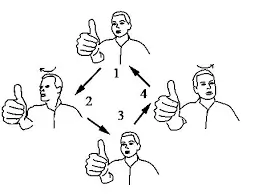
- Look directly ahead and concentrate on a letter that is held at eye level in front of you, such as an “E.”
- Keep your eyes on the target letter as you move your head back and forth. Increase the speed at which your head moves. Maintaining the letter’s emphasis is essential. Slow down if you feel too lightheaded.
- Start performing the exercise for as long as it causes mild to moderate symptoms (you could use the number rating scale). This could last for just ten seconds. You can gradually increase the duration to one minute (the brain requires this time to adjust). Gradually increase the frequency to three to five times each day.
Canalith repositioning procedures (CRPs):
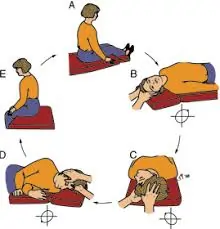
Canalith repositioning procedures (CRPs) are intended to cure benign paroxysmal positional vertigo (BPPV). It is believed that BPPV may result from crystals, also called otoconia, being displaced from their typical location inside the inner ear and relocating to the semicircular canals, a part of the ear that senses rotation.
Dizziness is caused by the crystals moving about in this area of the ear. A series of precise head and upper body motions is used in canalith repositioning operations, which may be able to return the crystals to their proper location in the ear.
- Whichever ear is giving you vertigo, turn your head 45 degrees in that direction.
- Help you rapidly lie down in the same posture, with your head slightly off the edge of the test table (this aspect of the operation may exacerbate your vertigo symptoms).
- Slowly turn your head to the other side.
- Make sure the rest of your body is in line with your head by rotating it.
- I would like you to stay on your side for a short while.
- assist you in sitting up straight.
Brandt-Daroff exercises:
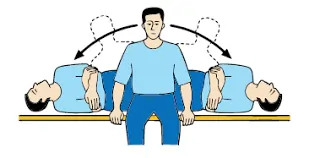
BPPV can be treated at home with Brandt-Daroff exercises without a professional’s supervision. The precise mechanism of these activities is unknown. The crystals may be moved back to their proper location inside the inner ear (as with CRPs) by the frequent head motions.
On the other hand, it’s possible that frequent exposure to movements that cause feelings of dizziness teaches your brain to pay less attention to the signals coming from your ears (vestibular compensation).
- Turn your head 45 degrees to one side while sitting on the bed’s edge.
- Quickly lie down on the other side of the bed so that the back of your head, behind your ear, touches the bed (to the left if you rotated your head to the right, and vice versa).
- Maintain this posture for approximately 30 seconds or until the symptoms of vertigo subside.
- Go back to your seated position.
- On the opposite side, repeat steps 1-4.
FAQs
How to cure vestibular issues?
Depending on the underlying cause, treatment may involve medication, therapy, and lifestyle modifications. If your symptoms don’t improve with various therapies, you might need surgery. If you have vertigo, dizziness, or changes in your hearing, consult your healthcare professional.
What vitamin deficiency causes vestibular problems?
Vitamin B6 insufficiency is one of the reasons for vestibular illness in individuals. In order to improve the functioning of the vestibular operating system and eliminate sensations of nausea and vertigo, it is necessary to consume foods and supplements that contain more vitamin B6.
What foods should I avoid with a vestibular disorder?
Vertigo is the hallmark of vestibular migraine attacks, which can be quite painful, but symptoms may be lessened by avoiding trigger foods. Aged cheeses, processed meats, chocolate, coffee, MSG, and alcoholic drinks, including beer and red wine, are the most frequent dietary causes.
Is walking good for vestibular rehabilitation?
You’re not alone; a lot of people who have vertigo and dizziness avoid physical exercise out of concern that it will make their symptoms worse. There’s a narrow line to walk when it comes to how much activity you can handle without experiencing severe symptom exacerbation, while yet beneficially engaging your vestibular and muscle systems.
References:
- Vestibular rehabilitation therapy – 2026 – Professional/my.clevelandclinic.org/health/treatments/15298-vestibular-rehabilitation
- Vestibular (Balance) Exercises – University of Mississippi Medical Center/Healthcare/ENT/Patient-Handouts/Adult/Otology/Vestibular_Exercises.html
- Canalith repositioning procedure – 2026 – Professional/my.clevelandclinic.org/health/treatments/17930-canalith-repositioning-procedure-crp