
Parivrtta Trikonasana (Revolved Triangle Pose)
What is Parivrtta Trikonasana?
Parivrtta Trikonasana (Revolved Triangle Pose) is a standing twisting yoga pose that enhances balance, flexibility, and core strength. It stretches the hamstrings, spine, and shoulders while improving digestion and stability.
In order to stretch the opposing sides of the triangle position body, Parivrtta Trikonasana is a counter pose to Utthita Trikonasana.
This is a great Hatha Yoga twisting position that not only twists your body but also quiets your mental chatter.
You may find it difficult to rotate your torso through your hips when performing parivrtta trikonasana for the first time, but your calf, abdominal, and hamstring muscles will undoubtedly get stronger. Therefore, it is typically performed following mastery of the mountain posture and foundation triangle pose.
Meaning of Parivrtta Trikonasana:
Trikonasana, or triangle position, is termed parivrtta, which means revolved. Parivrtta Trikonasana requires a twisting action in the torso, which offers the spine a deeper stretch than the straightforward triangle position.
There is a noticeable distinction between the revolved triangle posture and the triangle pose. The pelvis is hides behind the leg in the revolved triangle because the body is rotated around the front, extended leg. In the triangle pose, the pelvis stays in the front while the torso merely bends sideways without rotating.
The energy block that is locked in the form of tightened muscles is broken by the twisting in this pose. This promotes flexibility throughout the body, which enhances the flow of energy.
Muscle Work During Parivrtta Konasana:
- Arm and Shoulder Muscles
- Neck Muscles
- Chest Muscles
- Middle and Lower Back
- Core Muscles
- Hip Muscles
- Psoas Muscle
- Gluteus Muscle
- Hamstring Muscles
- Quadriceps Muscle
How to Perform?
- Place yourself in tadasana in front of your mat. Place your legs three to four feet apart, which is a little wider than shoulder-width apart. Verify that your feet are in a straight line.
- As you inhale, raise your arms to shoulder height and extend them parallel to the floor on either side of your shoulder.
- At this moment, angle your right foot towards your left foot by about 45 degrees. Turn your left foot in the direction of your outstretched left hand. Also, tilt your body towards the left foot and try to square your hips.
- Exhale and bend forward towards the extended left leg while extending your left hand upward towards the sky and your right hand downward towards the left leg (keeping the palm on the floor immediately in front of the left foot). Your torso will twist as a result of this action. In this twist, feel the pull of your right hamstring.
- Your body should be balanced along the hypothetical line connecting your foot and heel. Look at the lifted left arm (at the left fingers) by turning your neck. By pressing through the elevated arm, you may adjust the upper body position.
- This is the revolved triangle pose’s last position. For 20 to 30 seconds, maintain this posture. Breathe deeply in and out while experiencing your body’s full range of motion.
Beginner’s advice:
- Keep an eye on your shoulder alignment as you bend and extend your arms downward to perfect the revolved triangle position.
- It is advised that you prepare your body for this asana by performing Utthita Ashwa Sanchalansana (lunge position) and Virabhadrasana (warrior pose), which will prepare your lower and upper bodies for the strong bending and stretching required for the complete body.
- Avoid moving your head past the leg you are touching with your hands when bending, since this can cause you to lose your equilibrium.
Modifications:
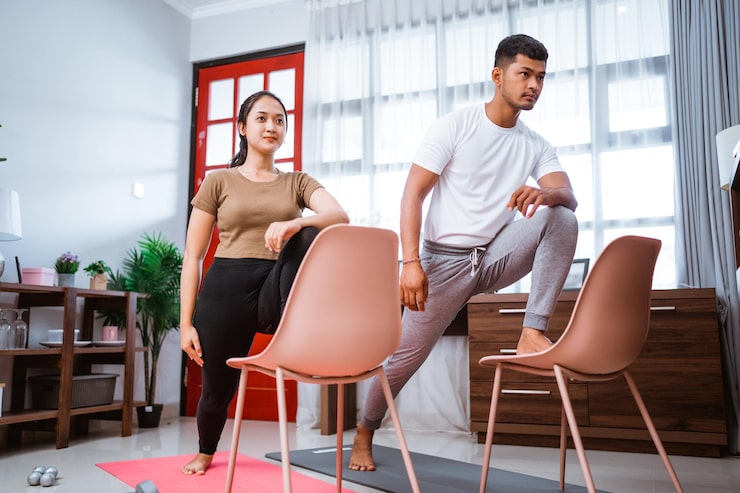
- Stretch your calves completely by using a flip chair as a support. You may use the chair’s legs, which will be in front of your legs, as a support while you spin in the other direction.
- Place a block of the appropriate height next to your front leg and rest your hands over it if you are unable to touch the ground with one hand in the opposite direction.
- You can use the chair’s seat as a prop to bend forward if you don’t need to bend all the way.
- You can perform Parivrtta Trikonasana with wall assistance since beginners need more practice with balance in this pose.
Benefits:
- Parivrtta Trikonasana develops core muscles and strengthens the abdominal muscles because of the twist in the abdominal region.
- By extending your legs, hips, hamstrings, and spine, this pose helps to strengthen them.
- Because it stretches the hip joints, pelvis, and lower back, it is beneficial for women’s reproductive systems in general.
- This pose will help if your back discomfort is brought on by a sedentary lifestyle.
- By encouraging the stomach’s digestive fluids, the rotated triangle posture aids in better digestion. Constipation may be relieved with daily practice.
- People who are obese will lose weight by performing this full-body stretching pose daily.
- By twisting, the revolving triangle position opens up the chest and strengthens the lungs. This is an asana that will help those with asthma.
- This pose is very beneficial for mending energy blockages and letting go of emotions. This stance, which involves rotating the torso, allows energy to freely circulate throughout the body.
Preparatory Poses:
- Tadasana (Mountain pose)
- Utthita Trikonasana (Extended triangle pose)
- Reclining Bound Angle Pose (Supta Baddha Konasana)
- Standing Forward Bend (Uttanasana)
- Prasarita Padottanasana (Wide-Legged Standing Forward Bend)
Precautions and Contraindications:
- The rotated triangle posture should not be performed by practitioners who have back or spinal injuries.
- It should not be used if you have a headache, vertigo, or migraine since it might make things worse.
- Women who are pregnant should avoid this since deep twisting and forward bending may be harmful.
- Additionally, avoid from performing Parivrrta Trikonasana if you have diarrhoea, sleeplessness, or high blood pressure.
FAQs
What are the benefits of a revolved triangle pose?
In addition to providing a sense of stability and concentration, this position is well-known for its capacity to expand and thoroughly stretch the muscles of the legs, hips, and spine. The Revolved Triangle Pose’s twisting action is very helpful for energising the abdominal organs, facilitating digestion, and improving detoxification.
What should you avoid in the revolved triangle pose?
Injury and Surgery: To avoid additional harm, students who have a sprain or injury in the ankles or shoulders should avoid this position.
Absence of Body-Breath Connections: When entering and exiting the position, students should be conscious of and knowledgeable about breath synchronisation.
What are some modifications for a revolved triangle?
Changing the Pose by Making Adjustments
To make the posture easier to achieve, narrow your stance. The stance is also made simpler by positioning the feet as though they are on railway tracks rather than in a single line.
To lay the lower hand on the block, place it on the inner or outside of your front foot.
What is Revolved Trikonasana in Sanskrit?
With a twist and a side bend, Parivrtta Trikonasana (Revolved Triangle practice) is a potent standing yoga practice for intermediate practitioners. Trikona means triangle, asana means posture, and parivrtta means rotate in Sanskrit. Alternatively known as Twisted Triangle Pose or even Revolved Triangle Pose.
How is Parivrtta Trikonasana different from Trikonasana?
Among its many other advantages, Parivrtta Trikonasana is a powerful counter-pose to Utthita Trikonasana (Extended Triangle Pose) and helps to increase stability and balance. In the Revolved Triangle, it’s crucial to concentrate on the middle and upper back muscles rather than overtwisting the neck.
What are some common mistakes in the revolved triangle pose?
Elevated hips: During the twist, keep both hips horizontal to the floor and avoid from letting them rise. Error: Incorrect alignment: When twisting, many people lose the correct body line. Make sure your chest stays open and both feet are firmly planted.
How to do the revolved triangle pose?
Triangle Pose in rotation at a wall
Put your left foot in front of you and your right foot behind you. Stretch your arms shoulder-high out to the sides. Reach the crown of your head toward the ceiling to stretch your spine and rotate to the left, enabling your right hand to contact the wall and your left hand to reach behind you.
References:
- Parivrtta Trikonasana (Revolved Triangle): Steps, Benefits, Precautions – Fitsri Yoga. https://www.fitsri.com/poses/parivrtta-trikonasana
- Revolved Triangle Pose Yoga Pose (Parivrtta Trikonasana). Tummee. https://www.tummee.com/yoga-poses/ Parivrtta Trikonasana