

13 Best Home Exercises after Rotator cuff Surgery
Introduction:
Home exercises after rotator cuff surgery focus on gentle, controlled movements that protect healing tissues while gradually restoring shoulder mobility and strength. These exercises are typically introduced in phases, beginning with passive range of motion and slowly progressing to active motion and strengthening as guided by your physiotherapist.
The group of tendons and muscles that encircle the shoulder is called the rotator cuff. It keeps your humerus, or upper arm bone, in its socket within your scapula, or shoulder blade. Rotator cuff injuries are prevalent, particularly among athletes involved in contact sports.
An exercise conditioning program can help you resume your regular activities and lead a healthier, more active lifestyle following an injury or surgery. You can resume sports and other leisure activities by adhering to a structured conditioning program.
This program offers a variety of workouts for overall conditioning. The program should be carried out at home under the supervision of a therapist or under the supervision of your physician to guarantee that it is safe and beneficial for you. Discuss with your physician or physical therapist the exercises that will help you achieve your recovery objectives.
13 Best Home Exercises after Rotator Cuff Surgery
Pendulum
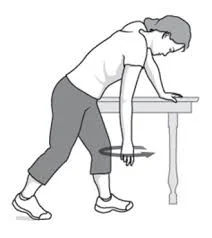
- Start in a standing position.
- Put one hand on a table or counter for support as you lean forward. Allow your other arm to dangle at your side.
- Swing your arm forward and backward gently. Repeat the exercise with your arm going side to side, then in a circular motion.
- Continue with the other arm.
- Perform 10-15 reps.
Crossover Arm Stretch

- Start in a standing position.
- Relax your shoulders and gradually pull one arm over your chest as far as possible while holding your upper arm.
- After 30 seconds of holding the stretch, take a 30-second break.
- Continue with the opposite arm.
Passive Internal Rotation

- Start in a standing or sitting position.
- Hold a stick behind your back with one hand and softly hold the opposite end with the other.
- Pull the stick horizontally as indicated to passively stretch your shoulder until you feel a pull without experiencing any pain.
- After 30 seconds of holding, let go for another 30 seconds.
- Repeat with the opposite side.
Passive External Rotation
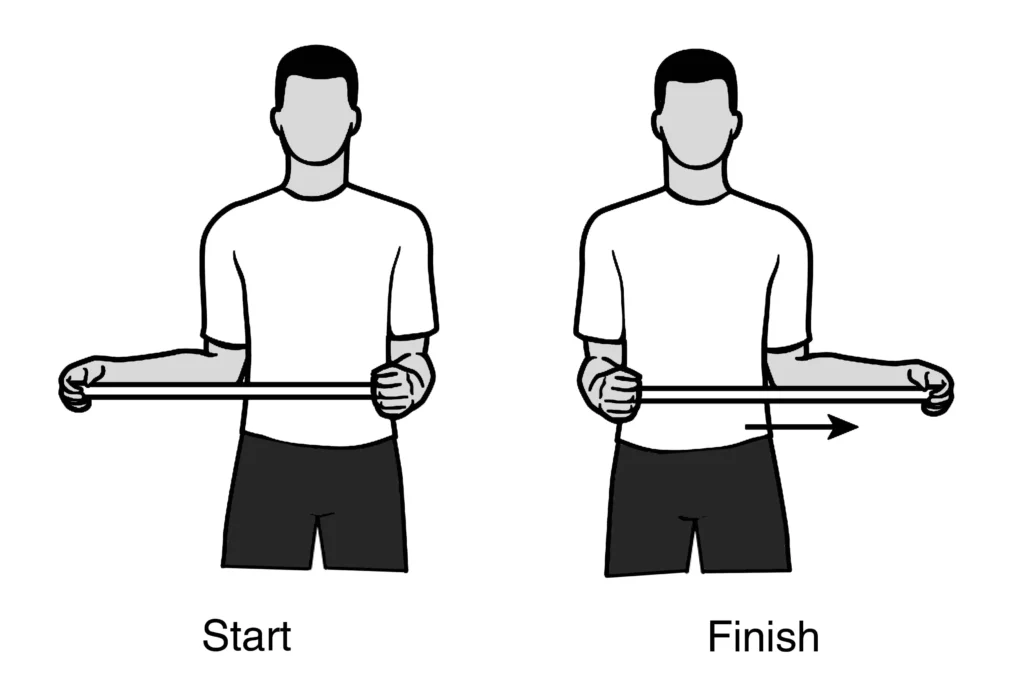
- Hold the stick in one hand and grasp the other end with the other.
- As demonstrated, push the stick horizontally until you feel a pull without experiencing any pain, keeping the elbow of the shoulder you are stretching against the side of your body.
- After 30 seconds of holding, let go for another 30 seconds.
- Repeat with the opposite side.
Standing Row

- Tie the ends of the elastic band together to form a loop that is three feet long. Fasten the loop to a stable object, such as a doorknob.
- As seen in the start position, grip the band while keeping your elbow bent and at your side.
- Pull your elbow straight back slowly while keeping your arm close to your side.
- Go back to the starting position slowly and repeat.
Doorway stretch

- Standing in an open doorway with your arms out to the side will help you warm up your muscles.
- Lean forward through the doorway until you feel a slight stretch while holding onto its sides with each hand at or below shoulder height.
- Lean and shift your weight onto your toes while maintaining a straight back. The front of your shoulder should feel stretched. Avoid overstretching.
- Repeat three times a day, holding each time for fifteen to thirty seconds.
Side-lying external rotation
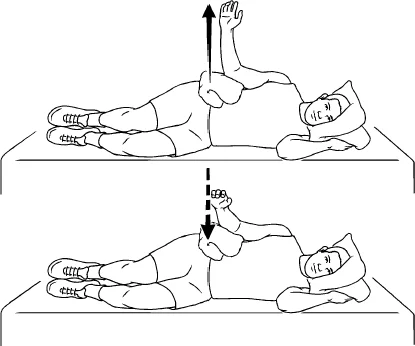
- Lie down on the side opposite the damaged arm.
- Your damaged arm’s elbow should be bent to a 90-degree angle and resting on your side. You should place your forearm over your abdomen.
- Raise a light dumbbell gently towards the ceiling while holding it in the hand of the affected side and maintaining your elbow against your side. If you experience any strain, stop rotating your arm.
- Return to the starting position with your arm down after holding the dumbbell up for a few seconds.
- Do three sets of ten once a day. When a set of ten gets simple, increase the number of repetitions to fifteen.
Reverse fly
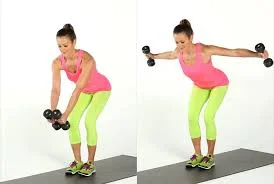
- Start in a standing position.
- Place your feet shoulder-width apart and slightly bend your knees.
- Bend forward a little at the waist while maintaining a straight back.
- Extend your arms and lift them away from your body while holding a little weight in each hand. Avoid locking your elbow. As you do this, clench your shoulder blades together. Avoid lifting your arms higher than your shoulders.
- Go back to the beginning and repeat three sets of ten.
Wall slides
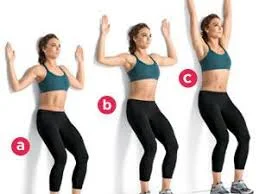
- Place your forearms shoulder-high on a wall and point your fingers upward.
- Gently press your forearms onto the wall after sliding them up towards the ceiling.
- Keep pushing lightly into the wall while holding at the top, and then go back to the beginning.
Scapular squeeze
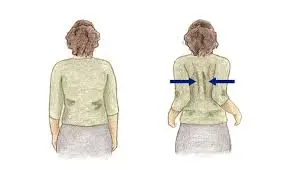
- Stand with your elbows bent at 90 degrees and resting at your sides.
- Squeeze your shoulder blades together by pulling your shoulders and elbows back.
- Return your shoulders to their initial posture.
Wall push-ups

- Place your hands at chest height on a wall, then take a few steps away from the wall while keeping your arms straight.
- Slowly slide your chest towards the wall by bending through your arms; stop when your head and chest are near the wall.
- Straighten your arms by pushing through your hands to get back to the beginning posture.
Scapula Setting

- Lie on your stomach, arms by your sides.
- If necessary, place a cushion beneath your forehead for comfort.
- Draw your shoulder blades together gently and as far down your back as you can.
- Leave this position approximately halfway, then hold it for ten seconds.
- Let go and do it ten times.
Bent-Over Horizontal Abduction
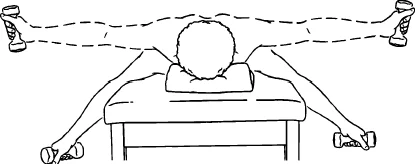
- Lie on your stomach on a table or bed, with your damaged arm dangling off the side.
- Raise your arm slowly to eye level while maintaining a straight posture.
- Repeat after slowly lowering it back to the beginning position.
Summary
The rotator cuff, which consists of four muscles, is essential for maintaining the stability and range of motion of the shoulder.
You can improve your range of motion and strength following a rotator cuff injury, such as a tear or strain, by performing particular exercises and stretches. Additionally, these workouts can aid in recovery and lower the likelihood of future difficulties.
Nevertheless, consult your doctor if, more than a few days after your injury, you continue to have pain, swelling, trouble elevating your arm, or trouble sleeping on your arm. These are signs of a more serious injury.
FAQs
Which activity is ideal for people who have had rotator cuff surgery?
Stretching exercises for rotator cuff issues include shoulder extensor stretches and pendulum swings. For rotator cuff issues or following surgery, exercises to preserve joint motion and gently move and stretch the shoulder are typically initiated immediately. Perform the exercises several times a day.
How can rotator cuff surgery recover more quickly?
Here are some strategies that can help you recover from shoulder surgery more quickly.
Ensure that you have adequate assistance at home.
Take caution when you’re sleeping.
Make time to sleep a lot.
Observe the suggested physical therapy regimen.
Keep an eye out for any indications of problems.
Make it a point to observe how you move.
After rotator cuff surgery, when should I begin exercising?
About five to six weeks following surgery, you will start doing active range of motion (AROM) activities. This occurs when you raise your arm’s weight against gravity without adding any more weight. Most patients start strengthening activities with weights or resistance bands around 7 to 8 weeks.
Can exercising help repair rotator cuffs?
The goal of treatment is to strengthen your shoulder joint once your range of motion has improved. Although strengthening the surrounding muscles relieves some of the strain on the affected area, a rotator cuff tear won’t heal on its own.
For rotator cuff pain, what is the ideal sleeping position?
Sleeping on your back is the ideal sleeping posture if you have rotator cuff pain. To prevent your arm from falling, place a blanket or cushion beneath it. By doing this, you can prevent shoulder discomfort. Maintain your arm’s alignment with your body.
After rotator cuff surgery, what are the worst things to do?
Avoid routine tasks that could require you to lift or depend on your arm. Outside of your training regimen, performing pointless motions might exacerbate the healed tendon and produce scar tissue.
Referances
- Rotator cuff and shoulder conditioning program – OrthoInfo – AAOS. (n.d.). https://orthoinfo.aaos.org/en/recovery/rotator-cuff-and-shoulder-conditioning-program/
- Barta, K. (2024, February 13). Rotator Cuff exercises to help heal or strengthen. Healthline. https://www.healthline.com/health/rotator-cuff-injury-stretches#additional-exercises
- Wall slides. (n.d.). [Video]. Hingehealth. https://www.hingehealth.com/resources/articles/rotator-cuff-exercises/